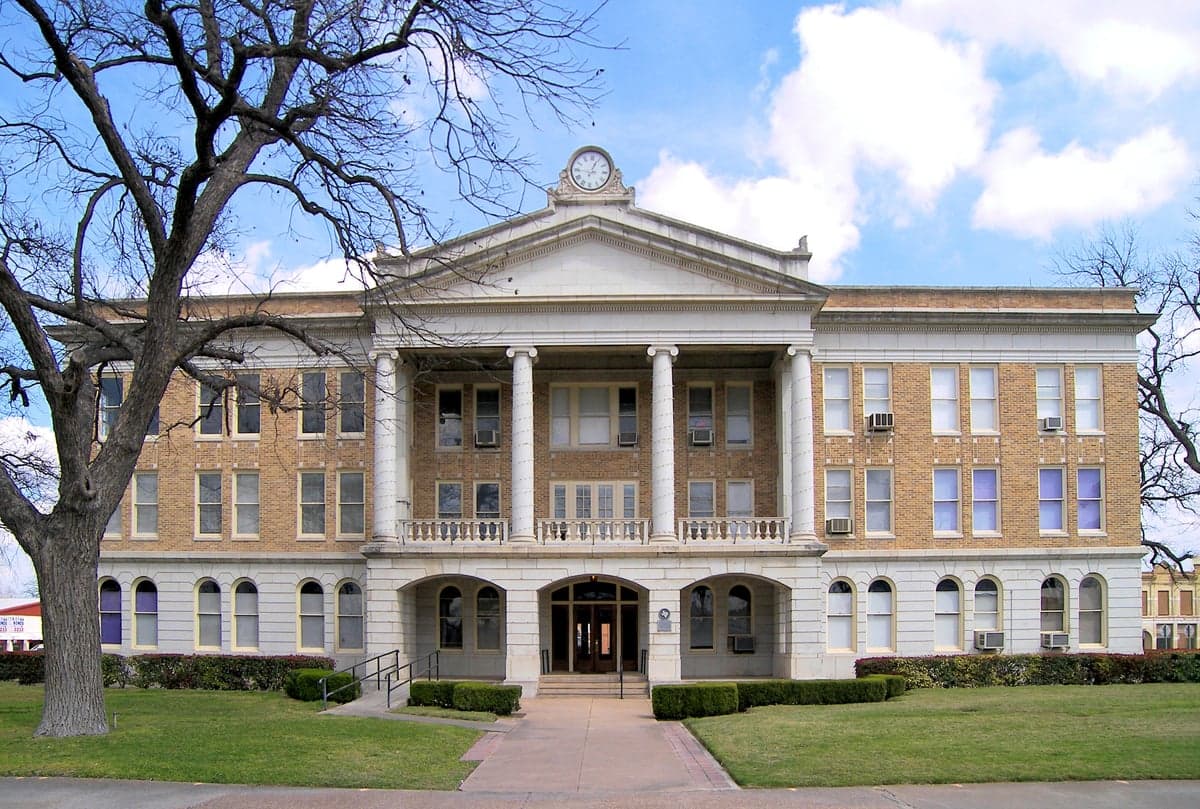
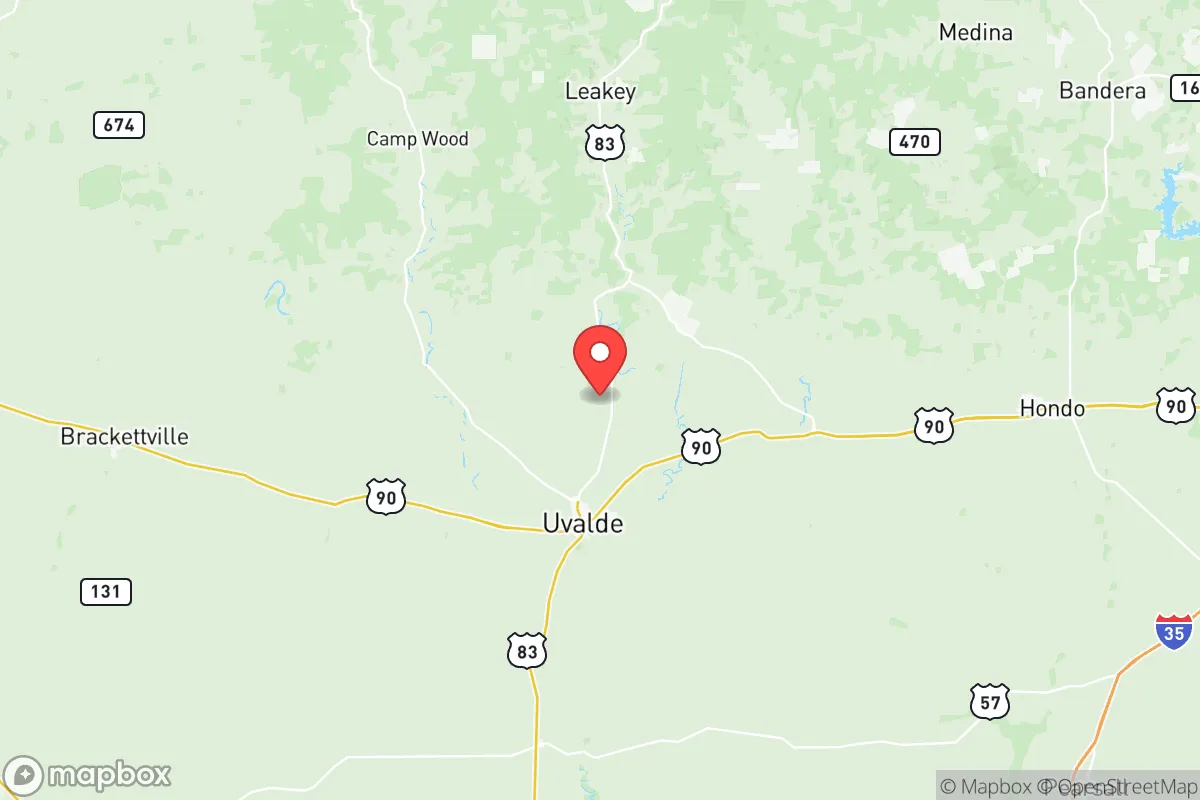
Photo: Wikipedia
Political ClimatePolitical Climate in Uvalde County
Showing county-level results — no local-only data available.
Lean and PVI are calculated from this county’s 2020 and 2024 presidential results, Cook-style.
Political rankings in Texas
- Most Conservative Cities in Texas
- Most Liberal Cities in Texas
- Best Liberal-Leaning Towns in the South
- Safest Liberal-Leaning Towns in the South
- Safest Conservative-Leaning Towns in the South
- Affordable Small Towns for Conservatives
- Most Affordable Liberal-Leaning Small Towns in the U.S.
- Safest Conservative-Leaning Cities in the U.S.
- Most Conservative Counties in Texas
- Most Liberal Counties in Texas
Local Political AnalysisPolitical Analysis of Uvalde County
Uvalde County is a solidly Republican area, with a Cook PVI of R+7, meaning it votes about seven points more Republican than the nation as a whole. That puts it in line with the broader Texas political landscape, though the county’s trajectory is more complicated than a simple red-vs-blue label. The county seat, Uvalde, is the only real population center, and it’s where you’ll find the most political diversity—while the surrounding unincorporated areas and smaller communities like Knippa, Sabinal, and Utopia lean heavily to the right.
How it compares
Texas as a whole is also a Republican-leaning state, though its Cook PVI isn’t officially calculated the same way. In practice, Uvalde County is a bit more conservative than the state average, especially outside the city limits. The rural precincts around Utopia and the ranch country west of town reliably turn out 70-80% Republican in most elections. In contrast, the city of Uvalde itself has a meaningful Democratic minority, driven largely by the Hispanic-majority precincts on the south and east sides of town. Those precincts can swing, though—they’re not reliably blue, and in down-ballot races they often split tickets. The swing precincts are the working-class neighborhoods near the old Uvalde Meat Processing plant and the areas around Southwest Texas Junior College, where turnout is lower but can tip a close countywide race.
What this means for residents
For conservative residents, the R+7 lean means the county is reliably friendly territory. Republican primaries are where most local races are decided—county commissioner seats, sheriff, and the school board are all effectively settled in the spring, not November. If you’re a liberal resident, the reality is that you’re in the minority, but not an isolated one. The city of Uvalde itself has a Democratic base that can win city council seats and occasionally influence county-level races when turnout spikes, like it did in the 2022 special election cycle after the Robb Elementary tragedy. That event reshaped local politics in a way that’s still playing out—it brought national attention, new funding, and a more vocal progressive presence, but it also hardened some conservative positions on school safety and gun policy. In practical terms, both sides have to work with the same small pool of local officials, and personal relationships still matter more than party labels in day-to-day governance.
The cultural and policy distinctions here are rooted in the county’s dual identity: it’s a ranching and hunting community with deep Texas traditions, but it’s also a majority-Hispanic county with strong family and faith ties that don’t always map neatly onto national partisan lines. Gun rights are nearly universally supported, even among many Democratic voters, while issues like water rights, property taxes, and rural healthcare access cut across party lines. The recent influx of state and federal money for school security and mental health services has created a new dynamic, with local leaders from both parties pushing for more control over how those funds are spent. Looking ahead, the county’s political future likely hinges on demographic shifts—the city is growing slowly, and if that growth brings younger, more diverse residents, the R+7 lean could soften to something closer to R+4 or R+5 over the next decade. But for now, Uvalde County remains a place where the Republican primary is the main event, and the general election is often a formality—except in the city precincts, where the real political fights happen.

State Political ClimatePolitical Climate in Texas
State Political AnalysisPolitical Environment in the State
Texas is a solidly Republican state, but the nature of that majority is shifting beneath the surface. The GOP has won every statewide race since 1994, and Donald Trump carried the state by 5.6 points in 2024, a noticeable drop from his 8.6-point margin in 2016. The dominant coalition is a mix of rural conservatives, suburban families, and a growing base of Hispanic voters in the Rio Grande Valley, but the explosive growth of the Austin, Dallas, and Houston metros is slowly tightening the map.
Urban vs. rural divide
The political geography of Texas is a tale of two landscapes. The vast rural expanse—from the Panhandle down through West Texas and into the Hill Country—is deeply conservative. Lubbock, Abilene, and Midland are Republican strongholds where a Democrat rarely cracks 30% of the vote. But the state’s population centers tell a different story. Austin is the undisputed liberal anchor, with Travis County voting for Joe Biden by a 50-point margin in 2020. Harris County, home to Houston, has flipped decisively blue in recent cycles, while Dallas County and Bexar County (San Antonio) are now reliably Democratic. The real battleground is the suburbs. Collin County, north of Dallas, was once a GOP fortress, but its margin has shrunk from 30 points to under 15 in a decade. Fort Bend County, southwest of Houston, is now a true swing county, reflecting the political power of its diverse, educated, and fast-growing population.
Policy environment
Texas runs on a low-tax, low-regulation model that is a major draw for conservative relocators. There is no state income tax, and the property tax burden is high to compensate—averaging around 1.8% of home value annually. The regulatory posture is business-friendly, with no state-level minimum wage above the federal $7.25 and a right-to-work law that limits union power. Education policy is a flashpoint: the state funds public schools through a complex Robin Hood system that redistributes property tax revenue, but it also leads the nation in school choice, with a new universal Education Savings Account program passed in 2025. Healthcare is a mixed bag—Texas has the highest uninsured rate in the country, having refused Medicaid expansion, but it also boasts world-class medical centers in Houston and Dallas. Election laws are strict: voter ID is required, and the 2021 Senate Bill 1 limited mail-in voting and early voting hours, drawing sharp criticism from Democrats and praise from Republicans for election integrity.
Recent policy direction
The last five years have seen Texas push hard on cultural and social issues. The 2021 heartbeat bill (SB 8) banned abortion after roughly six weeks, and the 2023 trigger law made it a near-total ban. On guns, Texas is a constitutional carry state since 2021, allowing permitless carry of handguns for adults. Parental rights in education took center stage with the 2023 "Parental Bill of Rights," which requires schools to notify parents about curriculum and medical services. The state has also restricted how race and gender can be taught in public schools. On privacy, Texas passed a 2024 law requiring age verification for adult websites, and it has aggressively subpoenaed tech platforms over alleged censorship. Property rights are strong—there is no state income tax on capital gains, and the 2025 session passed a bill limiting municipal annexation powers. Ballot access is restrictive by national standards, but the state has expanded early voting hours in rural counties to compensate for fewer polling places.
Civil unrest & political movements
Texas has been a stage for high-profile political flashpoints. The 2021 abortion law sparked nationwide protests, with large demonstrations in Austin and Houston. The state’s border security initiative, Operation Lone Star, has deployed thousands of National Guard troops to the Rio Grande Valley, creating a visible federal-state standoff over immigration enforcement. Governor Greg Abbott has bused over 100,000 migrants to sanctuary cities like New York and Chicago, a move that galvanized both supporters and detractors. On the right, the Texas Nationalist Movement, a fringe secessionist group, has gained some traction but remains politically marginal. On the left, the Texas Democratic Party has seen a surge of grassroots organizing in the suburbs, fueled by groups like Indivisible and Battleground Texas. Election integrity remains a live issue: the 2020 audit of Harris County’s results, ordered by the state, found no widespread fraud but deepened partisan distrust. A new resident will notice the political energy—yard signs, bumper stickers, and passionate local debates are common, especially in the purple suburbs.
Projection
Over the next decade, Texas is likely to become more competitive, but not necessarily blue. The in-migration of roughly 1,000 new residents per day is split—many are conservatives fleeing California’s taxes, but a significant number are young, college-educated professionals who lean Democratic. The Hispanic vote is the wildcard: while the Valley remains Democratic, the margin is shrinking, with some counties like Zapata flipping to Trump in 2024. The suburbs will determine the state’s future. If Collin and Fort Bend counties continue their leftward drift, Texas could become a true battleground state by 2032. However, the state legislature’s redistricting power and the concentration of rural seats mean the GOP will likely hold the levers of power for at least another decade, even if the presidential margin tightens to 3-4 points. A new resident moving in now should expect a state that is politically energized, with a growing divide between the urban cores and the rural expanses, but one where conservative policy will remain the default for the foreseeable future.
For a new resident, the bottom line is this: Texas offers a genuinely conservative policy environment—low taxes, strong gun rights, and a business-friendly climate—but it is not a political monoculture. If you live in Austin or central Houston, you will be surrounded by progressive politics; if you settle in Lubbock or the Hill Country, you will be in deep red territory. The suburbs are where the action is, and they are changing fast. Whether you are conservative or liberal, you will find a community that shares your views, but you will also be living in a state where the political debate is loud, constant, and consequential. Come for the opportunity, but be ready for the politics.
* Values derived from national, state, county, city and local statistics and may differ in a specific area. Last updated: 2026-10-31T04:48:06.000Z
Narrative content on this page is AI-generated and may contain mistakes. Verify any details that matter before acting on them.
ReloMaps may earn a commission from affiliate links at no extra cost to you.

