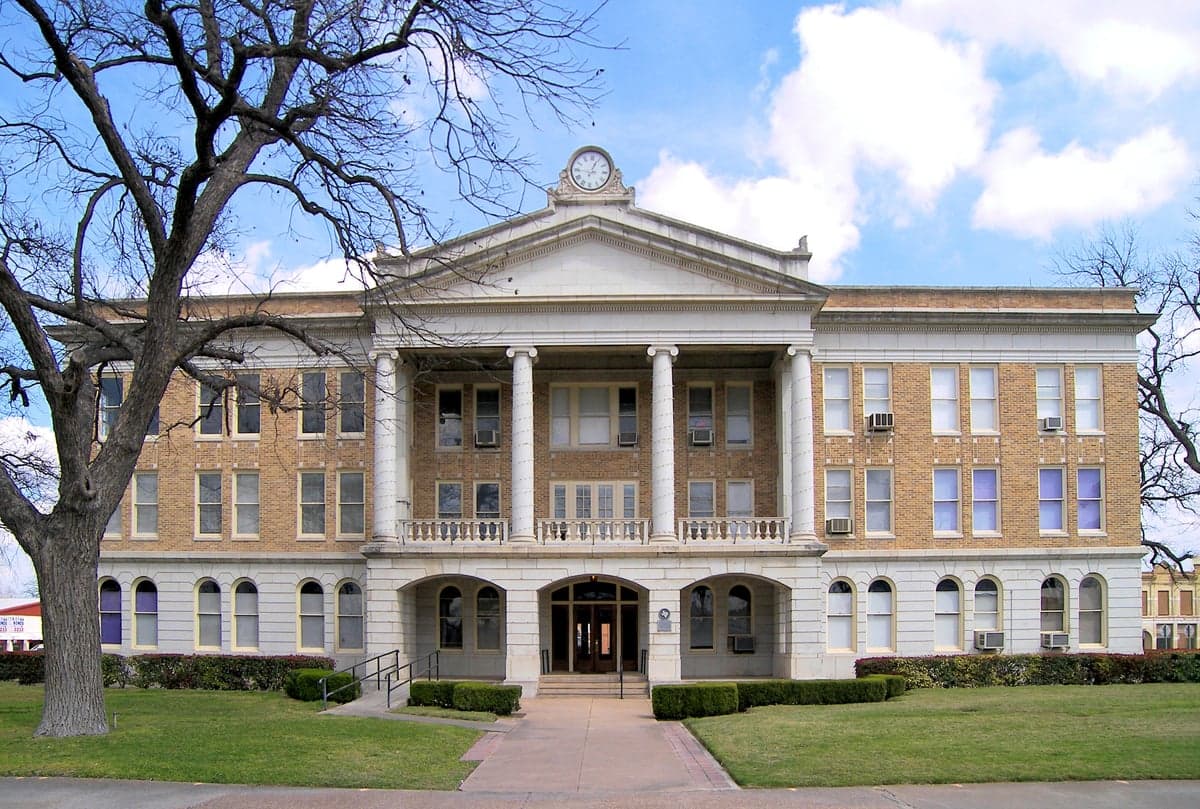
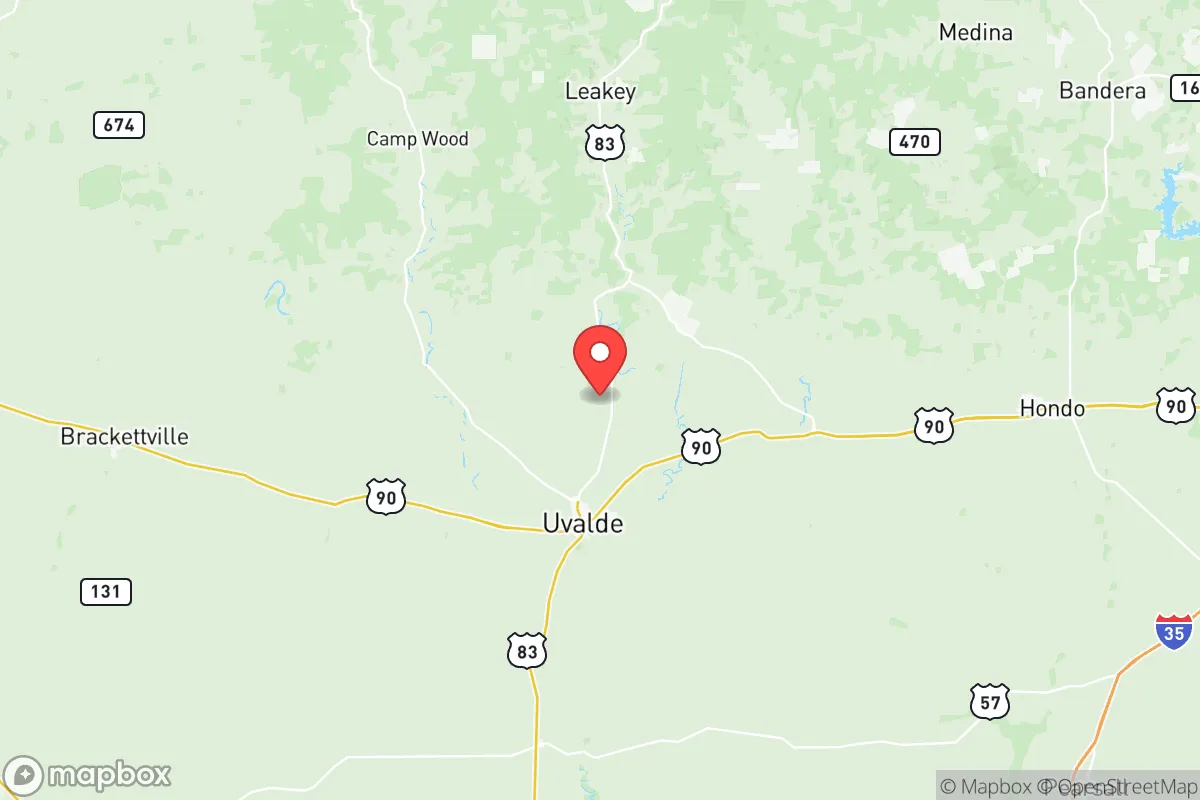
Photo: Wikipedia
Demographics of Uvalde County
Affluence Level in Uvalde County
A below-average socioeconomic profile. Incomes, home values, and educational attainment trail the U.S., with higher poverty and unemployment.
People of Uvalde County
The people of Uvalde County, Texas, today are overwhelmingly Hispanic — 70.7% of the county's 24,810 residents — with deep roots in the South Texas borderlands that stretch back centuries. The county's identity is shaped by a ranching and agricultural heritage, a strong Catholic tradition, and a rural character that remains distinct from the fast-growing Interstate 35 corridor to the east. Non-Hispanic whites make up 25.8% of the population, while Black (0.6%), East/Southeast Asian (0.9%), and Indian-subcontinent (0.3%) communities remain small but present, and just 6.1% of residents are foreign-born.
Settlement & growth (pre-1960)
Long before Anglo settlers arrived, the Uvalde County area was home to several Native nations, including the Lipan Apache, Comanche, and Coahuiltecan peoples, who used the region's spring-fed rivers and rolling hills for hunting and seasonal camps. Spanish expeditions passed through as early as the 17th century, but no permanent Spanish or Mexican settlements took root in what is now Uvalde County — the area remained a frontier buffer zone between Spanish Texas and the Comanche heartland well into the 19th century.
The first permanent Anglo-American settlers arrived in the 1850s, drawn by the promise of cheap land and abundant water from the Leona and Nueces rivers. The county was formally organized in 1856, and the town of Uvalde — named for a Spanish governor — became the county seat and primary population center. These early settlers were predominantly of Scots-Irish and English descent, many migrating west from the older Anglo settlements of East Texas and the Gulf Coast. They established cattle ranching as the county's economic backbone, a legacy that persists today.
In the decades following the Civil War, the population grew steadily as ranchers consolidated land holdings and the railroad arrived in the 1880s, connecting Uvalde to San Antonio and the national market. The railroad brought a wave of new residents, including German and Czech families who settled in and around the town of Uvalde, as well as in smaller communities like Knippa and Sabinal to the south. These European immigrants brought farming expertise and helped diversify the local economy beyond cattle into cotton, grain, and later, winter vegetables.
Mexican-American families have been a continuous presence in Uvalde County since its founding, but their numbers grew substantially in the early 20th century. The Mexican Revolution (1910–1920) pushed refugees north across the Rio Grande, and the expansion of irrigated farming and railroad work created steady demand for labor. By the 1930s, Mexican-American residents formed a substantial minority in the county, concentrated in the working-class neighborhoods of Uvalde and in agricultural labor camps scattered across the county's farming districts. This community maintained strong ties to the border region, with many families maintaining dual residences in Texas and northern Mexico.
The Dust Bowl and Great Depression of the 1930s brought a smaller but notable wave of Anglo migrants from Oklahoma and West Texas, though Uvalde County's agricultural economy was itself struggling. The county's population peaked in the 1940s at roughly 16,000 before entering a period of slow decline as mechanization reduced farm labor demand and younger residents left for San Antonio and other urban centers.
Modern era (post-1965)
The 1965 Hart-Cellar Act, which ended national-origin quotas and opened the door to large-scale immigration from Latin America and Asia, had a profound effect on Uvalde County — though not in the way it did on urban Texas. Rather than attracting new international immigrants directly, the county's Hispanic share grew steadily through natural increase and continued migration from the Rio Grande Valley and northern Mexico. The foreign-born share today, at 6.1%, is actually lower than the Texas state average, indicating that most of the county's Hispanic growth comes from U.S.-born families with deep regional roots.
By the 1980s, Uvalde County had become majority Hispanic, a shift that reflected both the growth of the Mexican-American community and the out-migration of Anglo residents to larger cities. The county seat of Uvalde grew as a regional service center for the surrounding ranch country, with schools, a hospital, and a community college anchoring the local economy. The smaller communities of Batesville and Utopia in the county's western hill country remained predominantly Anglo, while the southern farming communities of Knippa and Sabinal became overwhelmingly Hispanic.
The post-1965 era also brought a modest but notable wave of domestic migration from the Rust Belt and California, as retirees and remote workers sought the county's low cost of living and mild winters. This influx has been small in absolute numbers but has contributed to the county's small East/Southeast Asian and Indian-subcontinent communities, which together account for roughly 1.2% of the population. These newer residents are concentrated almost entirely in the city of Uvalde, where the hospital, school district, and county government employ a professional class that includes doctors, engineers, and educators recruited from outside the region.
Suburbanization has been limited in Uvalde County compared to the explosive growth seen in the Texas Triangle cities. The county's population has remained remarkably stable over the past half-century, hovering between 25,000 and 28,000 since the 1970s. The city of Uvalde itself has absorbed most of the growth, while the surrounding unincorporated areas have seen modest development along the U.S. 90 and U.S. 83 corridors.
The future
Uvalde County is likely to become slightly more diverse over the next two decades, though the pace of change will be gradual. The Hispanic share of the population is projected to continue its slow climb, potentially reaching 75–78% by 2040, driven by higher birth rates among Hispanic families and continued in-migration from the border region. The county's Anglo population, concentrated in the older age cohorts, is expected to decline modestly as retirees pass away or move to larger cities with better healthcare access.
The East/Southeast Asian and Indian-subcontinent communities, while small, are likely to grow as the Uvalde school district and the regional hospital continue to recruit professionals from outside the area. The county's relatively affordable housing — median home prices remain well below the Texas average — may attract more remote workers and retirees from coastal states, though the lack of major employment centers will limit large-scale domestic migration. The expansion of the U.S. 90 corridor and the potential for industrial development around Uvalde's airport and rail connections could bring new jobs and residents, but no major projects are currently on the books.
Culturally, the county is becoming more firmly bilingual and bicultural, with Spanish-language media, Mexican-American festivals, and Catholic traditions playing an increasingly central role in public life. The 2022 school shooting at Robb Elementary in Uvalde has also reshaped the community's identity, drawing national attention and bringing a wave of grief, activism, and outside visitors that has accelerated the county's engagement with broader national conversations.
For someone moving to Uvalde County today, the bottom line is this: you are entering a stable, deeply rooted community that is becoming more Hispanic, more bilingual, and more connected to the wider world, but at a gradual pace. The county offers a low-cost, family-oriented, rural lifestyle with genuine small-town character, but it is not a place of rapid growth or dramatic demographic transformation. New residents will find a community that values its ranching heritage, its faith traditions, and its independence — and one where the Spanish language and Mexican-American culture are integral to daily life, not peripheral to it.

* Values derived from national, state, county, city and local statistics and may differ in a specific area. Last updated: 2026-10-31T04:48:06.000Z
Narrative content on this page is AI-generated and may contain mistakes. Verify any details that matter before acting on them.
ReloMaps may earn a commission from affiliate links at no extra cost to you.

