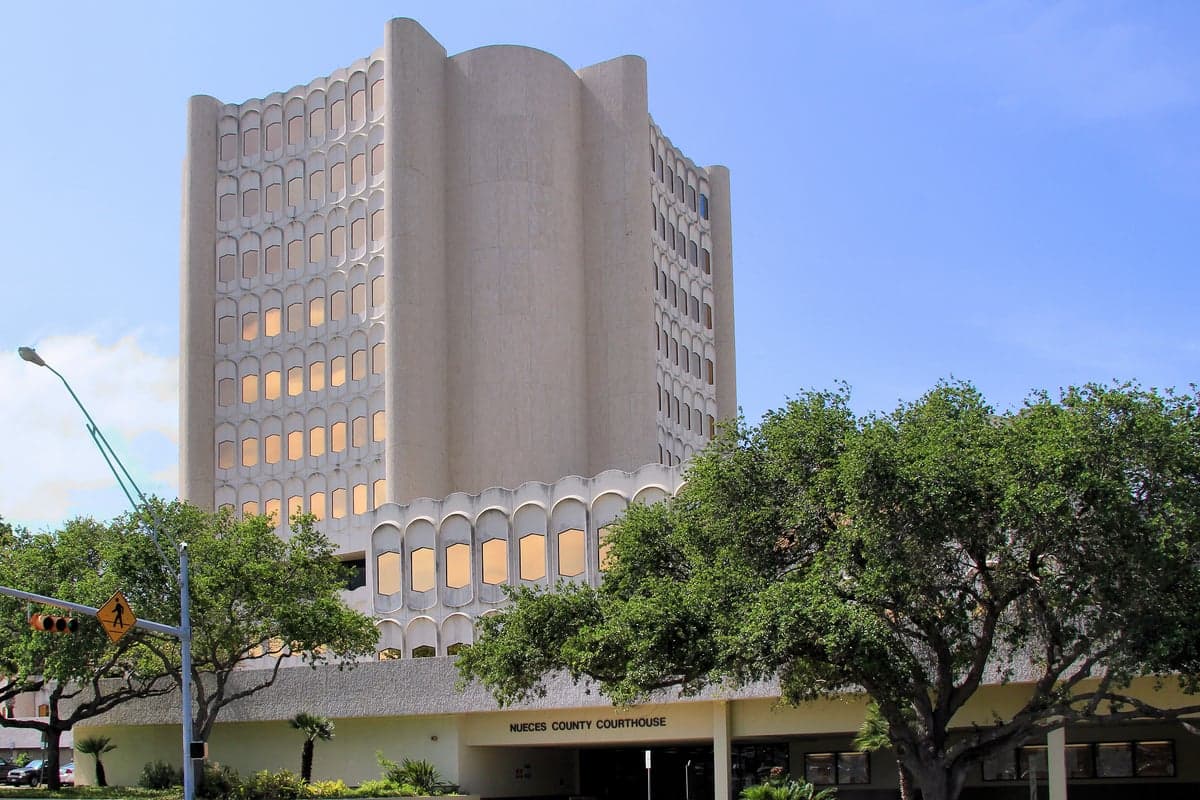
Photo: Wikipedia
Political ClimatePolitical Climate in Nueces County
Showing district-level results — no local-only data available.
Local Political AnalysisPolitical Analysis of Nueces County
Nueces County has been a reliable Republican stronghold for decades, but its political profile is more nuanced than the county-level numbers suggest. The Cook Partisan Voting Index (PVI) of R+14 means the county votes about 14 points more Republican than the national average, but that's a full 10 points redder than the state of Texas as a whole, which sits at R+4. However, the county's political geography is far from uniform — the city of Corpus Christi, which holds the bulk of the population, is the real battleground, while the rural and suburban precincts tilt heavily red.
How it compares
Texas as a state has been trending slightly more competitive in recent cycles, with the R+4 PVI reflecting a narrowing gap in statewide races. Nueces County, by contrast, has held its R+14 lean steady, largely because its rural and exurban areas — places like Robstown, Bishop, and Driscoll — vote overwhelmingly Republican. The real action is inside Corpus Christi itself. The city's northside and central neighborhoods, particularly around the Bluff and the Marina District, lean Democratic, often voting 60-40 or better for Democratic candidates. Meanwhile, the city's southside and the affluent Calallen area are reliably red. The swing precincts are in the middle-class suburban rings of Portland and Ingleside, where ticket-splitting is common — these areas can flip between parties depending on the candidate and the national mood.
What this means for residents
For conservative residents, Nueces County offers a comfortable political environment where Republican candidates typically win countywide races by comfortable margins. Local offices — from the county commissioners court to the district attorney — are dominated by Republicans, and the county's legislative delegation in Austin is solidly red. For liberal residents, the picture is more mixed. While they can reliably carry the city's core precincts, they face an uphill battle in countywide elections. However, the city of Corpus Christi itself has a more competitive political landscape — the mayor and city council are nonpartisan, but the city's electorate is roughly evenly split, meaning progressive candidates can win local office if they build coalitions across the city's diverse neighborhoods. The county's political reality means that conservative policy priorities — like lower taxes and limited regulation — generally prevail at the county level, while city-level debates often center on infrastructure, public safety, and economic development, with both sides having a real voice.
Culturally, Nueces County feels more like South Texas than the rest of the state. The strong Hispanic heritage — the county is over 60% Hispanic — shapes local politics in ways that don't always align with national partisan labels. Many Hispanic voters here are socially conservative and fiscally moderate, which explains why the county can vote for Republicans while also supporting Democratic candidates for local office who emphasize community and family values. The county's political trajectory is likely to remain steady: the rural areas will stay red, the city core will stay blue, and the suburbs will continue to be the deciding factor. For anyone moving here, the key takeaway is that political life is less polarized than the national headlines suggest — neighbors of different political stripes tend to get along, and local issues like the port, the bay, and the school districts matter more than party labels in day-to-day life.

State Political ClimatePolitical Climate in Texas
State Political AnalysisPolitical Environment in the State
Texas has been a solidly Republican state for decades, with a Cook Partisan Voting Index of R+4, but the last 10-20 years have seen a slow, steady shift toward competitiveness. The dominant coalition remains conservative, anchored by rural and suburban voters, but explosive growth in the Dallas-Fort Worth metroplex, Houston, and Austin is bringing in a wave of new residents—many from blue states—who are gradually turning the state purple. The 2024 presidential election saw Donald Trump win Texas by roughly 9 points, down from 11 points in 2020 and 16 points in 2016, signaling a real trajectory that relocators should understand before moving.
Urban vs. rural divide
The political map of Texas is a tale of two landscapes. The state's major metros—Houston, Dallas, San Antonio, and especially Austin—are Democratic strongholds. Harris County (Houston) alone delivered over 1 million votes for Joe Biden in 2020, and Travis County (Austin) voted for Biden by a 50-point margin. Meanwhile, the vast rural and exurban areas—places like the Panhandle around Lubbock, East Texas timber country, and the Hill Country west of Austin—vote Republican by 30 to 50 points. The real battleground is the suburbs: Collin County (north of Dallas) and Fort Bend County (southwest of Houston) have flipped from reliably red to competitive or even blue in recent cycles, driven by educated, affluent newcomers. El Paso remains a Democratic stronghold, while Corpus Christi and the Rio Grande Valley have shifted rightward, with the Valley moving from reliably Democratic to a swing region in just the last two cycles.
Policy environment
Texas has no state income tax, a fact that dominates relocation conversations. The trade-off is higher property taxes and sales taxes, which can be a shock for newcomers from states with low property levies. The regulatory posture is famously business-friendly: no state-level occupational licensing for many trades, minimal zoning in most cities, and a right-to-work law that limits union power. Education policy is a flashpoint: the state funds schools largely through local property taxes, leading to wide disparities between wealthy suburbs and rural districts. School choice voucher bills have been debated intensely but have not passed as of 2026, though the political momentum is growing. Healthcare policy is limited: Texas did not expand Medicaid under the Affordable Care Act, leaving roughly 1.5 million uninsured residents. Election laws have tightened since 2020, with Senate Bill 1 (2021) adding ID requirements for mail-in ballots, limiting drive-through and 24-hour voting, and expanding poll watcher access. For a conservative relocator, the low-tax, low-regulation environment is a major draw; for a liberal one, the lack of a safety net and restrictive voting laws may be a concern.
Recent policy direction
The last five years have seen Texas move decisively in a conservative direction on several fronts. On gun and self-defense law, the state enacted permitless carry (House Bill 1927) in 2021, allowing most adults to carry a handgun without a license. On parental and education rights, the so-called "Don't Say Gay" bill (HB 3979, later refined by SB 3) restricts classroom discussion of sexual orientation and gender identity in elementary grades, and a 2023 law (SB 15) bans diversity, equity, and inclusion offices at public universities. Speech and privacy issues have been shaped by a 2022 law (HB 20) that restricts social media platforms from moderating content based on viewpoint, though it has been tied up in court. On medical and bodily autonomy, Texas has one of the most restrictive abortion bans in the nation (SB 8, the "Heartbeat Act," and a near-total ban triggered in 2022), with no exceptions for rape or incest. Property rights remain strong, with no state-level rent control and relatively few land-use restrictions outside of incorporated cities. Taxation remains low at the state level, but property tax relief has been a recurring legislative priority, with a $18 billion package passed in 2023 to raise homestead exemptions and compress school tax rates. Voting and ballot access have tightened, as noted, but early voting remains generous by national standards.
Civil unrest & political movements
Texas has seen its share of political flashpoints in recent years. The 2020 protests in Austin over police brutality were among the largest and most sustained in the country, leading to a state law (HB 1900) that defunded Austin's city budget and restricted police funding cuts statewide. Immigration politics are a constant presence: the state has bused thousands of migrants to Democratic-led cities like New York and Chicago, and Governor Greg Abbott's Operation Lone Star has deployed state troopers and National Guard to the border, including a controversial floating barrier in the Rio Grande near Eagle Pass. Secession rhetoric flares up periodically—the Texas Nationalist Movement has some grassroots support—but remains a fringe position with no serious political path. Election integrity controversies have been a persistent theme since 2020, with Republican leaders pushing for audits and tighter rules, while Democrats argue these measures suppress turnout. A new resident will notice the political polarization in yard signs, bumper stickers, and local news coverage, but daily life is generally peaceful and civil, especially outside of the most heated election cycles.
Projection
Over the next 5-10 years, Texas is likely to continue its slow shift toward competitiveness, driven by in-migration from California, New York, and Illinois. The suburbs of Dallas, Houston, and San Antonio will be the key battlegrounds, with fast-growing exurbs like Kyle (south of Austin) and Frisco (north of Dallas) potentially flipping the state's political balance. The Hispanic vote, long assumed to be reliably Democratic, is fracturing, with working-class voters in the Rio Grande Valley and around Corpus Christi moving rightward on economic and cultural issues. The state's Republican majority in the legislature is likely to hold for the next decade, but the margin will shrink, leading to more moderate policy outcomes on issues like school funding and property taxes. A relocator moving in now should expect a state that remains conservative in its overall orientation but is becoming more internally contested, with the political center of gravity slowly shifting toward the fast-growing, diverse suburbs.
For a new resident, the bottom line is this: Texas offers a low-tax, low-regulation environment that appeals strongly to conservatives, with a political culture that values individual liberty and limited government. Liberal residents will find safe havens in Austin, Houston, and Dallas, but will face a state government that is actively hostile to many of their policy priorities, particularly on abortion, gun control, and voting access. The state is not going to flip blue anytime soon, but it is becoming more competitive, and the political battles of the next decade will be fought in the suburbs and exurbs where most new arrivals are settling. If you value low taxes, strong property rights, and a business-friendly climate, Texas will feel like home. If you prioritize a robust social safety net, progressive social policies, or tight gun regulation, you will find yourself in a constant defensive posture.
* Values derived from national, state, county, city and local statistics and may differ in a specific area. Last updated: 2026-06-17T15:31:05.000Z
Narrative content on this page is AI-generated and may contain mistakes. Verify any details that matter before acting on them.
ReloMaps may earn a commission from affiliate links at no extra cost to you.

