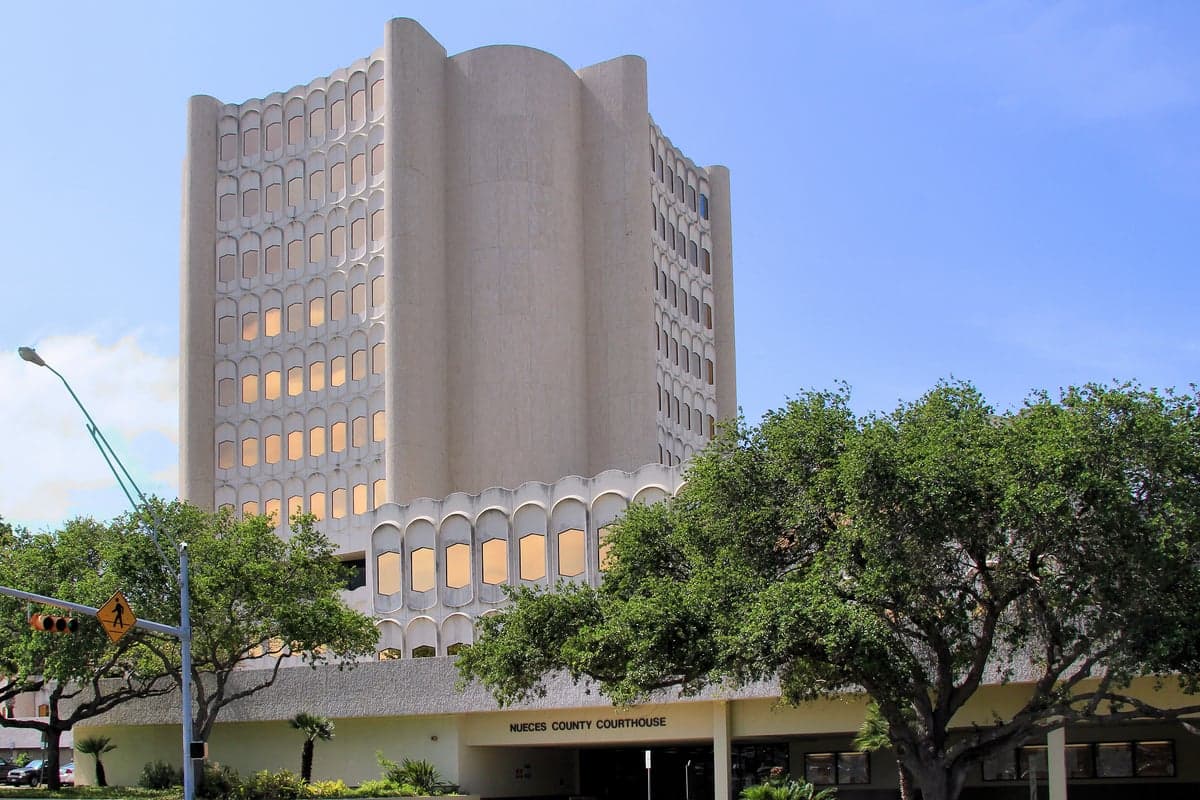
Photo: Wikipedia
Demographics of Nueces County
Affluence Level in Nueces County
A below-average socioeconomic profile. Incomes, home values, and educational attainment trail the U.S., with higher poverty and unemployment.
People of Nueces County
Nueces County, anchored by Corpus Christi, is home to 352,829 residents who form a predominantly Hispanic (62.1%) and culturally Texan-Mexican community, with a white non-Hispanic population of 29.9% and small but established Black (3.7%) and East/Southeast Asian (1.7%) communities. The county's identity is shaped by its deep ranching and Gulf Coast heritage, a relatively low foreign-born share of 4.9%, and a college attainment rate of 23.7% that reflects its blue-collar and military-influenced economy. Nueces County remains a place where Spanish-language fluency and Catholic traditions mix with a strong patriotic and military culture, particularly around Naval Air Station Corpus Christi. For a conservative-leaning family or individual, the county offers a rooted, family-oriented environment with a slower pace than Texas's booming interior metros.
Settlement & growth (pre-1960)
Before European contact, the region was home to the Karankawa people, a nomadic coastal tribe who lived along the bays and barrier islands. Spanish explorers arrived in the 16th century, but permanent colonization did not begin until the late 18th century, when Spanish land grants established ranches along the Nueces River. The area remained sparsely populated through the Mexican period, with a few scattered ranchos near present-day Robstown and Bishop.
After Texas independence and annexation, Anglo-American settlers moved into the Nueces Strip, a contested borderland between the Nueces River and the Rio Grande. The 1840s and 1850s saw the arrival of ranchers and farmers, many from the U.S. South, who established cattle operations on the vast King Ranch and other spreads that extended into Nueces County. The county was formally organized in 1846, and Corpus Christi grew as a port and trading hub. The railroad's arrival in the 1870s connected the county to national markets, spurring growth in Agua Dulce and Banquete as agricultural shipping points.
Mexican-American families, many of whom had lived in the region for generations, formed the backbone of the labor force on ranches and in the cotton fields. The early 20th century brought a wave of Mexican immigration driven by the Mexican Revolution (1910–1920), which swelled the Hispanic population in Robstown and the Molina neighborhood of Corpus Christi. The discovery of oil in the 1920s and 1930s transformed the county's economy, drawing workers from across Texas and the South. During World War II, the establishment of Naval Air Station Corpus Christi brought thousands of military personnel and their families, many of whom stayed after the war. The 1950s saw suburban expansion in Portland and Calallen, as white families moved to newer housing developments away from the urban core.
Modern era (post-1965)
The 1965 Hart-Cellar Act did not dramatically reshape Nueces County's immigration patterns, as the region's foreign-born population remains low at 4.9%. Unlike Houston or Dallas, Nueces County did not receive large waves of post-1965 immigrants from Asia or Africa. Instead, the county's demographic evolution has been driven by domestic migration and natural increase among the Hispanic population. The Hispanic share rose steadily from roughly 40% in 1970 to over 62% today, fueled by higher birth rates and continued migration from the Rio Grande Valley and northern Mexico.
The white non-Hispanic population has declined in absolute numbers since the 1980s, as younger families moved to larger metros for jobs and as older residents retired elsewhere. The Black population, historically small, has remained stable at around 3.7%, concentrated in Corpus Christi's central and southside neighborhoods. The East/Southeast Asian community, at 1.7%, is modest and largely tied to the medical and engineering sectors at Corpus Christi's hospitals and the Texas A&M University-Corpus Christi campus. The Indian-subcontinent population is even smaller at 0.6%, with families typically employed in healthcare or information technology.
Suburbanization has reshaped the county since the 1990s, with growth shifting to the northwest corridor toward Robstown and the southern edge near Bishop. New master-planned communities and school-driven subdivisions have attracted families seeking newer housing and lower taxes. The county's population grew by about 8% between 2010 and 2020, slower than the Texas average, reflecting a stable but not booming economy anchored by the Port of Corpus Christi, refining, and military installations.
The future
Nueces County is projected to become more Hispanic and older over the next two decades, with the white non-Hispanic share continuing to decline gradually. The foreign-born share is likely to remain low, as the county does not have the job diversity or immigrant networks of larger Texas cities. The East/Southeast Asian and Indian communities may grow modestly as the healthcare and engineering sectors expand, but they will remain small minorities. New residential development is concentrating in the Corpus Christi northwest side and in Robstown, where land is cheaper and new schools are being built. The county's cultural identity will likely remain deeply rooted in Tejano and ranching traditions, with a growing emphasis on the military community as Naval Air Station Corpus Christi continues to be a major employer. For a conservative-leaning family, the county offers a stable, family-oriented environment with a strong sense of place, though economic opportunities are more limited than in the Dallas-Fort Worth or Houston metros.
For someone moving in now, Nueces County represents a community that values tradition, family, and self-reliance, with a demographic trajectory that is slowly diversifying but remains overwhelmingly Hispanic and culturally Texan. The county is not experiencing rapid transformation, but rather a gradual evolution that preserves its historic character while accommodating modest growth. New residents will find a place where neighbors know each other, local politics lean conservative, and the Gulf Coast lifestyle is a daily reality.

* Values derived from national, state, county, city and local statistics and may differ in a specific area. Last updated: 2026-06-17T15:31:05.000Z
Narrative content on this page is AI-generated and may contain mistakes. Verify any details that matter before acting on them.
ReloMaps may earn a commission from affiliate links at no extra cost to you.

