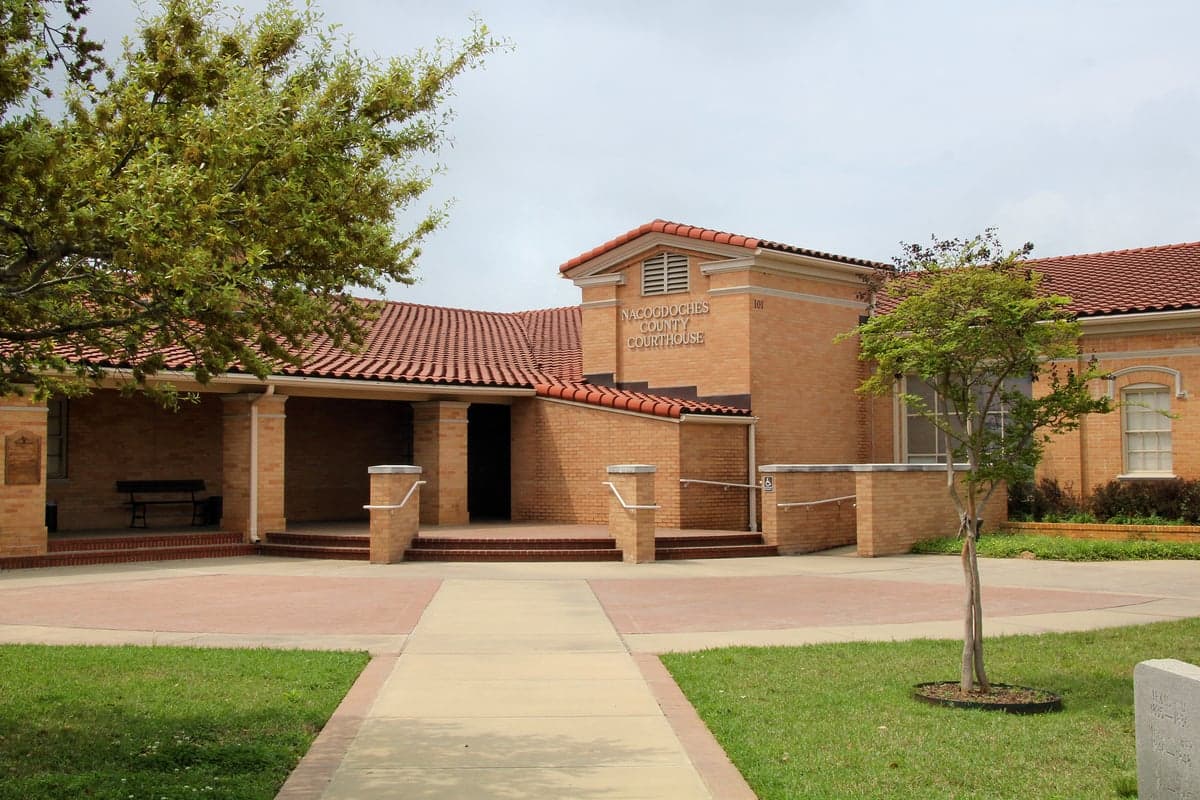
Photo: Wikipedia
Political ClimatePolitical Climate in Nacogdoches County
Showing district-level results — no local-only data available.
Local Political AnalysisPolitical Analysis of Nacogdoches County
Nacogdoches County, anchored by the oldest town in Texas, leans solidly Republican with a Cook PVI of R+14, making it significantly more conservative than the state of Texas as a whole, which sits at R+4. This isn't a new development, but the margin has widened over the last decade as rural precincts have shifted rightward faster than the state's urban centers. The county's political identity is a blend of deep East Texas tradition, a sizable university population, and a growing number of retirees, creating a more nuanced landscape than the raw PVI suggests.
How it compares
The R+14 rating puts Nacogdoches County roughly ten points to the right of Texas overall, a gap that has grown since 2020. In the 2024 presidential election, the county delivered about 68% of its vote to the Republican candidate, compared to roughly 56% statewide. This divergence is driven by the county's rural character: outside the city limits of Nacogdoches, precincts in places like Garrison, Chireno, and Woden routinely vote 80% or more Republican. The city of Nacogdoches itself is the only real counterweight. Precincts around Stephen F. Austin State University, particularly near the campus and in the historic downtown area, often split more evenly or even lean Democratic, with some precincts hitting 55-60% for Democratic candidates. The unincorporated community of Martinsville and the area around Lake Nacogdoches tend to be swingier, often reflecting the countywide average more closely. So while the county is reliably red, it's not a monolith—it's a red county with a blue-leaning college town at its heart.
What this means for residents
For conservative residents, the political climate is comfortable and affirming. Local offices—county commissioner, sheriff, school board—are overwhelmingly held by Republicans, and policy debates tend to center on tax rates, rural infrastructure, and property rights. The county's Republican primary is often the de facto general election for local races. For liberal residents, the reality is more about finding community within the city. The SFA campus and the arts district in downtown Nacogdoches provide a social and political counterbalance, but progressive candidates rarely win countywide. The practical effect is that both sides tend to coexist with a live-and-let-live attitude, though national politics can stir tensions, especially around issues like public school funding and land use. The county's trajectory suggests it will remain R+14 or even drift slightly redder as the rural population ages and the university's influence remains contained to the city limits.
One cultural distinction worth noting is the county's strong sense of local identity, which sometimes transcends party lines. The annual Texas Blueberry Festival and the Nacogdoches Azalea Trail are community touchstones that draw participation from across the political spectrum. There's also a pragmatic streak here: even in deep-red precincts, voters have supported local bond measures for schools and roads, and the county has a history of backing moderate incumbents in state-level races. The biggest policy friction point in recent years has been over growth management—how to balance new housing developments and commercial expansion with the county's historic character and piney woods landscape. That debate doesn't break cleanly along party lines, and it's where you'll see the most interesting cross-party alliances form. For anyone moving here, the key takeaway is that Nacogdoches County is politically predictable in its overall lean, but the local dynamics are shaped more by the town-gown divide and the tension between preservation and growth than by national partisan scripts.

State Political ClimatePolitical Climate in Texas
State Political AnalysisPolitical Environment in the State
Texas has been a Republican stronghold for decades, with a Cook Partisan Voting Index of R+4, but the state is in the middle of a slow, grinding realignment. The dominant coalition remains conservative, anchored by suburban and rural voters, but the margin of victory has shrunk from double digits in 2012 to a 5.6-point win for Donald Trump in 2024. Over the last 10-20 years, the story has been one of rapid urbanization and demographic change — the state is now roughly 40% Hispanic, and the fast-growing metros of Austin, Dallas-Fort Worth, Houston, and San Antonio are pulling the state toward a more competitive, purple future.
Urban vs. rural divide
The political map of Texas is a study in stark contrasts. The major metros — Austin (Travis County), Dallas (Dallas County), Houston (Harris County), and San Antonio (Bexar County) — are solidly Democratic, with Harris County alone delivering over 1 million votes for Joe Biden in 2020. Meanwhile, the vast rural and exurban areas, especially in West Texas, the Panhandle, and East Texas, are deeply Republican. The real battleground is the suburbs: Collin County (north of Dallas) and Fort Bend County (southwest of Houston) have been trending left, but they still lean Republican in most statewide races. The Rio Grande Valley, once a Democratic stronghold, has shifted right — Hidalgo County went from +40 D in 2012 to +15 D in 2024, driven by working-class Hispanic voters moving toward the GOP on economic and cultural issues. The divide isn't just about geography; it's about lifestyle and density, with urban cores voting blue and everything else trending red.
Policy environment
Texas operates with a distinctly conservative policy framework. There is no state income tax, relying instead on high property taxes (averaging 1.6-2.0% of home value) and a 6.25% state sales tax (local add-ons can push it to 8.25%). The regulatory posture is business-friendly — no state-level minimum wage above the federal $7.25, and a right-to-work law that limits union power. Education policy is decentralized, with school choice (vouchers) a perennial legislative battle; the state funds schools through a Robin Hood system that redistributes property tax revenue from wealthy districts to poor ones. Healthcare is a flashpoint: Texas has the highest uninsured rate in the nation (around 17%), having refused Medicaid expansion under the ACA. Election laws have tightened — the 2021 SB 1 restricted mail-in voting, added ID requirements, and banned 24-hour and drive-through voting. Abortion is effectively banned after a 2021 trigger law (SB 8) and a near-total ban (HB 1280) that took effect after Dobbs, with no exceptions for rape or incest. Gun laws are permissive: permitless carry (HB 1927, 2021) allows most adults to carry a handgun without a license, and there are no red-flag laws.
Recent policy direction
The last five years have seen Texas lurch further right on cultural and liberty issues, even as the state's demographics shift. On gun and self-defense law, the 2021 permitless carry law (HB 1927) was a landmark, removing the training and licensing requirement for carrying a handgun. Parental and education rights were a major focus: the 2023 HB 900 (the "READER Act") required age-based ratings for library books and restricted "sexually explicit" material in schools, while the 2021 "critical race theory" law (HB 3979) limited how race and current events can be taught. Speech and privacy saw a push to regulate social media platforms (HB 20, 2021), which banned viewpoint-based censorship by large platforms — a law currently tied up in court. Medical and bodily autonomy is sharply restricted: abortion is banned, and the state has also restricted gender-affirming care for minors (SB 14, 2023). Property rights remain strong, with no state-level rent control and a homestead exemption that protects primary residences from forced sale. Taxation saw a modest property tax cut in 2023 (SB 2), which increased the homestead exemption and compressed school tax rates. Voting and ballot access tightened with SB 1 (2021), which added a strict ID requirement for mail ballots and limited drop-off locations. The overall direction is toward more individual liberty on guns and speech, but less on medical choice and voting access.
Civil unrest & political movements
Texas has seen its share of political flashpoints. The 2020 Black Lives Matter protests in Austin, Dallas, and Houston were large and occasionally violent, leading to a heavy police response and a subsequent "defund the police" movement that fizzled after a 2021 budget cycle. On the right, the Texas Nationalist Movement (Texit) has been a persistent but fringe force, pushing for a referendum on secession — it has no serious legislative traction. Immigration politics are a constant: Governor Greg Abbott's Operation Lone Star (2021) deployed state troopers and National Guard to the border, bused migrants to Democratic-led cities, and led to a legal standoff with the Biden administration over border enforcement. Sanctuary city policies are banned by state law (SB 4, 2017), which allows law enforcement to inquire about immigration status. Election integrity remains a hot-button issue: the 2020 election saw Trump's team challenge results in Harris County, and the 2021 SB 1 was a direct response to that controversy. A new resident would notice the heavy presence of border security checkpoints in South Texas and the constant political ads on TV about immigration and crime.
Projection
Over the next 5-10 years, Texas is likely to become more competitive but not flip blue overnight. The key driver is in-migration: roughly 1,000 people move to Texas every day, many from blue states like California and New York. These newcomers tend to be younger, more diverse, and more moderate — they're not all Democrats, but they're less reliably Republican than the native-born population. The suburbs of Dallas, Houston, and Austin will continue to trend purple, while the Rio Grande Valley may become a true swing region. However, the rural vote is not shrinking fast enough to flip the state: the 2024 margin was 5.6 points, and demographic projections suggest a 3-4 point margin by 2032. The state legislature will remain Republican-controlled through at least 2030 due to gerrymandering. A relocator moving in now should expect a state that is politically divided but functionally conservative — the policy environment will remain business-friendly and culturally right-leaning, but the political conversation will get louder and more contentious as the state edges toward competitiveness.
For a new resident, the bottom line is that Texas offers a low-tax, low-regulation environment with a strong economy, but the political climate is increasingly polarized. Conservatives will find a state that largely aligns with their values on guns, taxes, and education, but they'll need to navigate growing urban opposition. Liberals will find a state where their votes matter more every cycle, but where state policy will remain hostile to their priorities on abortion, voting, and healthcare for the foreseeable future. The practical takeaway: if you want a place where your vote is likely to be in the majority and your lifestyle choices are protected by law, Texas is a good fit for conservatives. If you're liberal, you'll be fighting an uphill battle at the state level, but you'll have plenty of company in the cities.
* Values derived from national, state, county, city and local statistics and may differ in a specific area. Last updated: 2026-06-20T11:54:18.000Z
Narrative content on this page is AI-generated and may contain mistakes. Verify any details that matter before acting on them.
ReloMaps may earn a commission from affiliate links at no extra cost to you.

