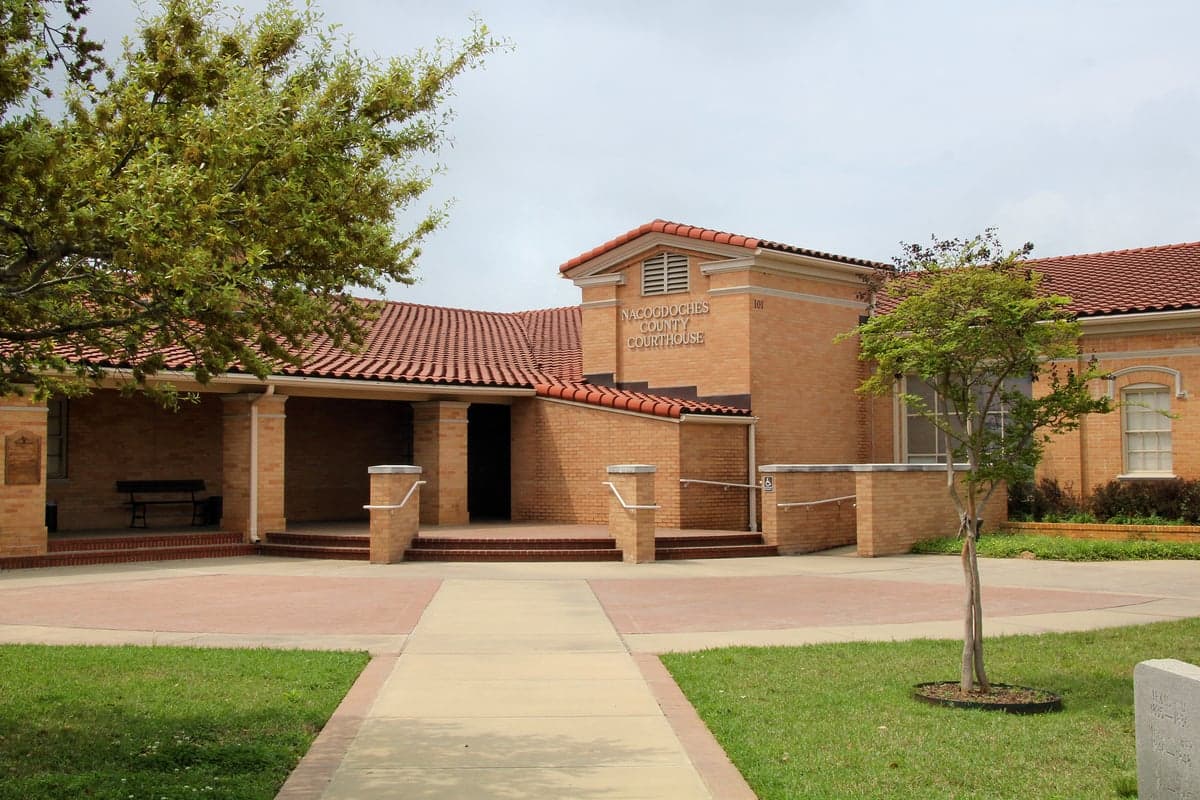
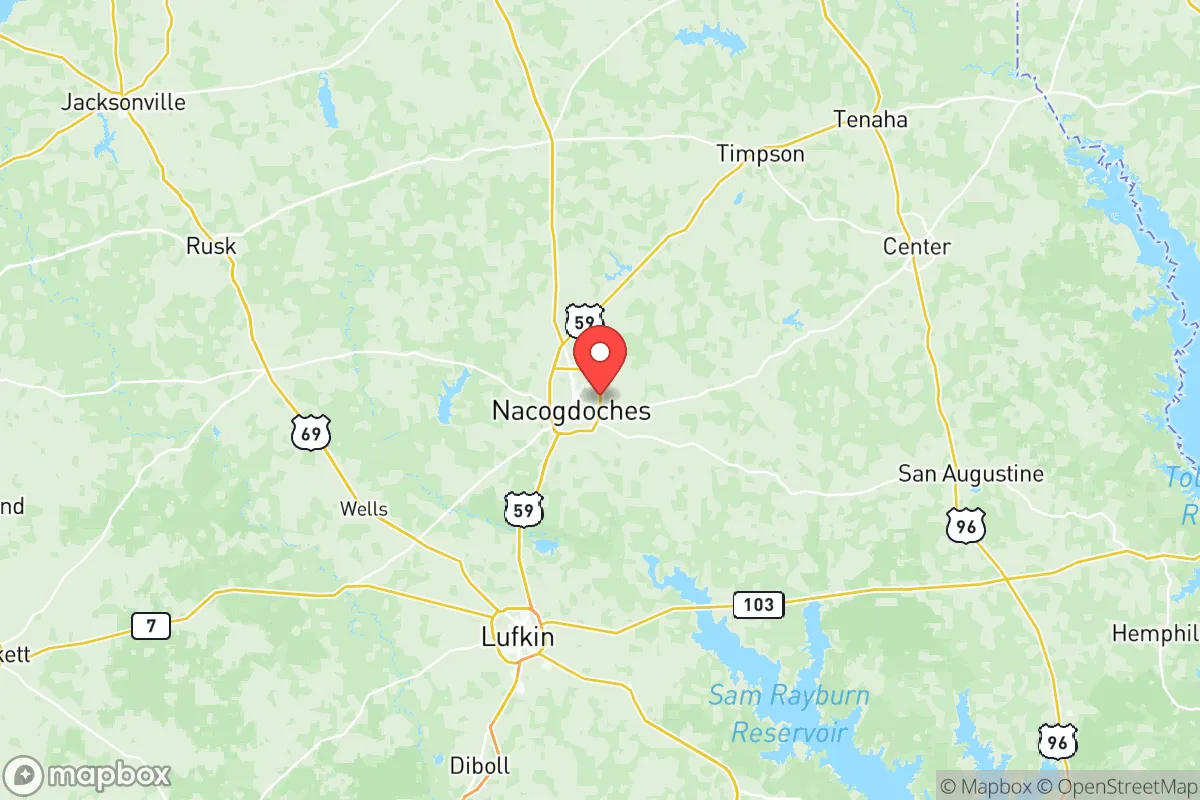
Photo: Wikipedia
Demographics of Nacogdoches County
Affluence Level in Nacogdoches County
A low-income area with significant economic hardship. Household wealth and educational attainment are well below national averages.
People of Nacogdoches County
Today, the people of Nacogdoches County form a small but distinctive East Texas community rooted in centuries of layered settlement. With 64,897 residents, the county is predominantly white (57.8%) but has a notable Black population (17.0%) and a fast-growing Hispanic community (21.3%). Foreign-born residents account for just 5.3% of the population, and only 26.5% hold a college degree, reflecting the area’s rural character and blue-collar economy centered on timber, agriculture, and Stephen F. Austin State University. The county’s identity carries a strong sense of place — Nacogdoches bills itself as “the oldest town in Texas” — and that deep history shapes who lives here today.
Settlement & growth (pre-1960)
Long before Europeans arrived, the Caddo Confederacy — particularly the Hasinai branch — occupied the piney woods and bottomlands of what is now Nacogdoches County. Their settlements, including the village of Nabedache near modern-day Appleby, cultivated corn, beans, and squash. Spanish explorers encountered the Caddo in the 16th century, and by 1716 the Spanish crown established Mission Nuestra Señora de Guadalupe de los Nacogdoches near the present-day city center to assert claim over the region. The mission failed, but a small civilian settlement persisted around the old site.
After Mexico gained independence in 1821, the area attracted Anglo-American settlers under Stephen F. Austin’s colony and later the Fredonian Rebellion. By the 1830s, families from the southern United States — primarily of English, Scots-Irish, and African descent (the latter enslaved) — poured into the county. Nacogdoches town became a commercial hub, while plantations spread along the Angelina River around present-day Garrison and Chireno. The 1860 census counted more than 3,000 enslaved people in the county, roughly 40% of the total population.
The Civil War and emancipation reshaped the county’s racial landscape. Formerly enslaved people established independent communities such as Woden and Melrose, where Black families farmed small plots and worked in the burgeoning timber industry. The arrival of the railroad in the 1880s boosted the lumber economy and drew new migrants — white sharecroppers from the Deep South and a modest number of European immigrants, including Irish railroad laborers and German tradesmen who settled in Cushing and Sacul. By 1900, the county’s population had swelled to roughly 28,000, with roughly one in three residents Black.
The early 20th century saw the rise of the Texas timber boom, with mills in Nacogdoches, Garrison, and Martinsville drawing both white and Black workers. The Great Depression and the Dust Bowl brought a trickle of Okies and Arkies, but Nacogdoches County remained relatively insular. World War II and the subsequent GI Bill fueled expansion of Stephen F. Austin State University, which began attracting students from across the state, but the county’s ethnic and racial composition stayed largely unchanged through 1960: roughly 67% white and 32% Black, with a tiny Hispanic presence of less than 1%.
Modern era (post-1965)
The 1965 Hart-Cellar Immigration Act opened the door to new migration streams, but Nacogdoches County did not experience the mass immigration seen in Houston or Dallas. Instead, demographic change came primarily from two sources: the expansion of Stephen F. Austin State University and the broader Texas-to-Sun Belt migration within the United States. Starting in the 1970s, Hispanic families — many from South Texas and northern Mexico — moved into the county for agricultural work (poultry processing, row crops) and the service economy. By 2000, the Hispanic share had reached 12%, and it has since climbed to 21.3%, concentrated in the city of Nacogdoches and in unincorporated areas near Trawick and Etoile.
The Black population has remained stable at about 17%, though its distribution has shifted. Rural Black communities like Woden and Melrose have seen outmigration to larger cities, while Nacogdoches itself has maintained a strong Black presence tied to the university and local churches. The county’s Asian population — East and Southeast Asian — is only 0.6%, mostly international students and faculty at SFA. The Indian-subcontinent population is even smaller at 0.2%, confined almost entirely to the university community.
Domestic migration patterns have been modest but notable. Some retirees and teleworkers from the Dallas‑Fort Worth metroplex have relocated to Appleby and Cushing for lower housing costs and a quieter lifestyle. However, the county has not seen the explosive suburban growth that characterizes counties nearer to Houston or DFW. Its foreign-born share (5.3%) remains below the state average (17%) but has doubled since 2000, driven primarily by Mexican and Central American immigrants working in construction, landscaping, and poultry processing plants in Garrison and near the Nacogdoches county line.
The future
Projections suggest Nacogdoches County will continue to become more Hispanic, mirroring statewide trends. By 2040, the Hispanic share could approach 30%, while the white share will likely dip below 50%. The Black population is expected to remain relatively stable, with slight intergenerational loss. The Asian and Indian shares will probably rise slowly, pushed by the university and medical sector, but will likely remain under 3% combined. New residential growth is dispersing along the US‑59 corridor and around the Nacogdoches‑Alto area, with more scattered development in Martinsville and Chireno.
Culturally, the county is becoming more politically and socially diverse, though its East Texas conservatism remains strong. The university brings a liberal counterweight, but the rural and small-town majority continues to shape local policy, community life, and religious institutions. For someone moving in now, Nacogdoches County offers a slowly diversifying, family-oriented environment where the old timber-and-cotton identity is giving way to a more mixed economy of education, healthcare, and light manufacturing.
In short, the people of Nacogdoches County are holding onto their deep roots while gradually evolving. The county is becoming a bit more varied — more Hispanic, slightly more educated, and gently suburbanizing — but it remains a place where family history and place still matter profoundly. For relocating families looking for a lower-cost, slower-paced part of East Texas with a tangible American story, Nacogdoches County offers a rooted community in flux, not a boomtown.

* Values derived from national, state, county, city and local statistics and may differ in a specific area. Last updated: 2026-06-20T11:54:18.000Z
Narrative content on this page is AI-generated and may contain mistakes. Verify any details that matter before acting on them.
ReloMaps may earn a commission from affiliate links at no extra cost to you.

