Photo: Wikipedia
Political ClimatePolitical Climate in Llano County
Showing district-level results — no local-only data available.
Local Political AnalysisPolitical Analysis of Llano County
Llano County is one of the most reliably Republican counties in Texas, with a Cook Partisan Voting Index (PVI) of R+22 — meaning it votes about 22 points more Republican than the national average. That’s a far cry from the state of Texas as a whole, which sits at R+4, and it makes Llano County a deep-red stronghold even by Texas standards. The county has been trending redder over the past decade, driven largely by an influx of retirees and second-home owners from the Austin and Dallas suburbs who are drawn to the Hill Country’s slower pace but tend to lean conservative on fiscal and cultural issues.
How it compares
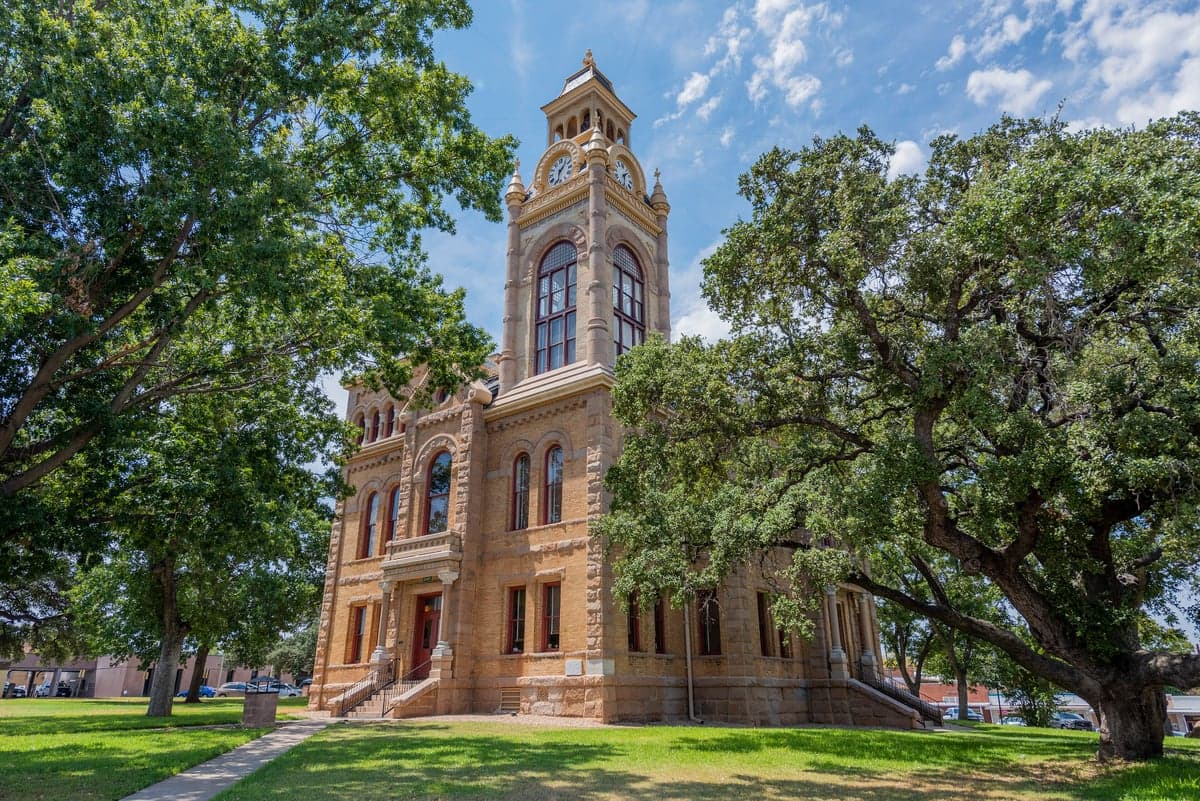
To put the R+22 PVI in perspective, Texas statewide races are typically decided by single-digit margins — Donald Trump won the state by about 5.5 points in 2024. In Llano County, Republicans routinely win by 30 to 40 points. The county’s largest town, Llano, is the political heart of the GOP, with precincts around the courthouse and the western side of town consistently delivering 75-80% Republican votes. Kingsland, the second-largest community, is slightly more moderate — its lakeside precincts along Lake LBJ sometimes see 60-65% Republican margins, with a small but noticeable Democratic presence among the seasonal residents and hospitality workers. Tow and Buchanan Dam are the most conservative pockets, often hitting 85% Republican, while Sunrise Beach Village and Horseshoe Bay (which straddles Llano and Burnet counties) show a bit more variation — Horseshoe Bay’s gated golf communities lean red but have a handful of swing precincts where Libertarian and independent candidates pull 5-8% of the vote. The only precincts that ever lean blue are a few rural precincts near the Burnet County line, where a mix of younger families and Austin commuters live; even there, Democrats rarely crack 40%.
What this means for residents
For conservative residents, Llano County’s political climate means their values are reflected in nearly every level of local government — from the county commissioners court to the school board to the sheriff’s office. Tax policy is consistently low, with no countywide property tax for roads or parks, and the Llano County Library system has been a flashpoint for conservative activism around book content. For liberal residents, the reality is more isolating. There’s no organized Democratic Party presence in the county; the nearest Democratic club meets in Burnet or Marble Falls. Socially, progressive viewpoints are rarely voiced in public meetings or local media, and many liberal-leaning residents report keeping their politics private to avoid friction with neighbors. That said, the county’s small size (about 21,000 residents) means most people interact across political lines at the grocery store, the Llano River fishing spots, or the county fair — it’s not a place where politics dominates daily life the way it does in Austin or Dallas.
Culturally, Llano County stands apart from the rest of Texas in a few notable ways. The county is one of the few in the state that still enforces a blue law on Sundays — most car dealerships and some retail stores are closed until noon. The local Republican Party holds a monthly “Coffee with Conservatives” at the Llano County Community Center that draws 50-60 people, while the only progressive gathering is a small book club at the Kingsland library. The county’s political trajectory seems locked in for the near future: as long as the Hill Country continues to attract conservative-leaning retirees and remote workers, Llano County will remain a R+20-plus bastion, with the only real drama being primary elections between different factions of the GOP.

State Political ClimatePolitical Climate in Texas
State Political AnalysisPolitical Environment in the State
Texas has been a solidly Republican state for decades, with a Cook Partisan Voting Index of R+4, but the political reality on the ground is far more nuanced than that single number suggests. The state’s dominant coalition has long been built on a mix of suburban conservatives, rural voters, and business interests, but explosive population growth—especially in the metroplexes of Dallas-Fort Worth, Houston, San Antonio, and Austin—has been steadily shifting the ground beneath that coalition. Over the last 10-20 years, the trajectory has been one of slow but real Democratic gains in the suburbs and major cities, while rural and exurban areas have hardened their Republican lean, creating a state that is both more competitive and more polarized than it was in the 2000s.
Urban vs. rural divide
The political map of Texas is a story of two worlds. The major urban counties—Harris (Houston), Dallas, Tarrant (Fort Worth), Bexar (San Antonio), and Travis (Austin)—are now reliably Democratic, with Travis County delivering margins of 70%+ for Democratic presidential candidates. The suburbs around these cities, places like Collin County (north of Dallas) and Williamson County (north of Austin), have been the real battlegrounds. Collin County, once a GOP stronghold, voted for Biden in 2020 by a narrow margin, and Williamson County has flipped blue in recent presidential cycles. Meanwhile, rural West Texas, the Panhandle, and East Texas remain deeply Republican. Lubbock, Amarillo, and Tyler are GOP anchors, while the Rio Grande Valley—historically Democratic—has shifted right, with Hidalgo County (McAllen) voting for Trump in 2024 after backing Biden in 2020. The divide isn’t just geographic; it’s cultural and economic, with urban centers driving tech, healthcare, and finance, while rural areas rely on oil, agriculture, and ranching.
Policy environment
Texas’s policy environment is defined by a low-tax, low-regulation posture that has been consistent for decades. There is no state income tax, and property taxes are high (among the top in the nation) to compensate, with a 2023 law capping appraisal increases for homeowners at 10% annually. The regulatory climate is business-friendly, with minimal zoning in many cities and a right-to-work law that limits union power. Education policy is a flashpoint: the state funds public schools through a complex Robin Hood system that redistributes property tax revenue from wealthy districts to poorer ones, and school choice (vouchers) has been a major legislative battle, with Governor Greg Abbott pushing for it but facing opposition from rural Republicans. Healthcare is a mixed bag—Texas has the highest uninsured rate in the country, having refused Medicaid expansion under the Affordable Care Act. Election laws have tightened since 2021’s Senate Bill 1, which added ID requirements for mail-in ballots, limited drive-through voting, and banned 24-hour polling places. For a relocator, the practical takeaway is that Texas offers low taxes and light regulation, but public services—especially healthcare access and public school funding—reflect that trade-off.
Recent policy direction
The last few years have seen Texas push aggressively on several fronts that matter to relocators weighing personal liberties. On gun rights, the state enacted permitless carry (HB 1927) in 2021, allowing most adults to carry a handgun without a license or training. On parental rights and education, the 2023 passage of HB 900 (the "READER Act") required book vendors to rate materials for "sexually explicit" content, and the state has banned diversity, equity, and inclusion (DEI) offices at public universities. On speech and privacy, a 2023 law (HB 20) prohibits social media platforms from moderating content based on viewpoint, though it’s been tied up in court. Medical and bodily autonomy is sharply restricted: Texas has a near-total abortion ban (SB 8, the "Heartbeat Act," and the trigger law from 2021) with no exceptions for rape or incest, and a 2023 law (SB 14) bans gender-affirming care for minors. Property rights are strong, with no state-level rent control and a robust homestead exemption that protects a primary residence from creditors. On voting, the 2021 SB 1 tightened ballot access, but turnout has still risen. The overall direction is toward expanding gun rights, restricting abortion and transgender care, limiting corporate speech moderation, and prioritizing parental control over schools—a package that appeals to many conservatives but feels restrictive to liberals.
Civil unrest & political movements
Texas has seen its share of political flashpoints. The 2020 protests following George Floyd’s murder in Minneapolis sparked large demonstrations in Austin, Houston, and Dallas, with some property damage and a heavy police response. The state’s immigration politics are a constant source of tension: Governor Abbott’s Operation Lone Star has deployed state troopers and National Guard to the border, bused migrants to Democratic-led cities like New York and Chicago, and led to legal battles over the state’s authority to enforce immigration law. The "sanctuary city" debate is active, with some cities like Austin and San Antonio adopting policies that limit local police cooperation with federal immigration enforcement, while the state has banned such policies (SB 4, 2017). Secession rhetoric—"Texit"—is a fringe movement but has a vocal online presence, though no serious political traction. Election integrity controversies have been loud, with Trump’s 2020 loss fueling claims of fraud in Harris County (Houston), leading to a state takeover of the county’s elections in 2023. A new resident would notice the political polarization in yard signs, bumper stickers, and local news, but daily life is generally peaceful—the flashpoints are more legal and legislative than violent.
Projection
Over the next 5-10 years, Texas is likely to become more competitive at the statewide level, but not necessarily blue. The in-migration of millions of people—many from California and other blue states—is often cited as a Democratic boon, but many of those newcomers are conservatives or moderates fleeing high taxes and regulation. The suburbs of Dallas, Houston, and Austin will continue to be the key battlegrounds, with areas like Fort Bend County (southwest of Houston) already trending Democratic. Rural areas will remain deeply Republican, and the Rio Grande Valley’s rightward shift could accelerate. The state’s policy direction will likely stay conservative on guns, abortion, and taxes, but the growing urban and suburban population may force compromises on school funding, healthcare, and infrastructure. A relocator moving in now should expect a state that remains Republican-led but with a narrower margin, where local politics vary wildly—from the deep-blue city of Austin to the deep-red Panhandle town of Amarillo.
For a new resident, the bottom line is that Texas offers a political environment that is broadly conservative but with significant local variation. If you value low taxes, gun rights, and parental control in education, you’ll find a state that actively legislates in those directions. If you prioritize abortion access, strong public healthcare, or progressive social policies, you’ll face a state government that is actively hostile to those goals—but you’ll find like-minded communities in the major cities and inner suburbs. The key is to choose your location carefully: Austin and Houston are blue islands, while Lubbock and Tyler are red strongholds, and the suburbs are the true swing zones. The political climate is intense but not unstable, and the state’s growth ensures that the debate will only get louder.
* Values derived from national, state, county, city and local statistics and may differ in a specific area. Last updated: 2026-07-17T02:25:36.000Z
Narrative content on this page is AI-generated and may contain mistakes. Verify any details that matter before acting on them.
ReloMaps may earn a commission from affiliate links at no extra cost to you.

