
Photo: Wikipedia
Strategic Assessment of Llano County
Workable tactical position. Some exposure to population density or targets, but generally defensible in a crisis.
What does the Strategic Assessment tell us?
Our Strategic Assessment grades tactical survivability of an area. Major population centers, military targets, fallout zones, natural disasters, and border exposure all drive risk — lower exposure means a more defensible position in a crisis.
This is heavily inspired by Joel Skousen's Strategic Relocation book. Highly recommended you checkout the book ($)What does this tell us?
Our Strategic Assessment grades tactical survivability of an area. Major population centers, military targets, fallout zones, natural disasters, and border exposure all drive risk — lower exposure means a more defensible position in a crisis.
This is heavily inspired by Joel Skousen's Strategic Relocation book. Highly recommended you checkout the book ($)Strategic Pillars

Key Distances
Strategic Assessment Analysis
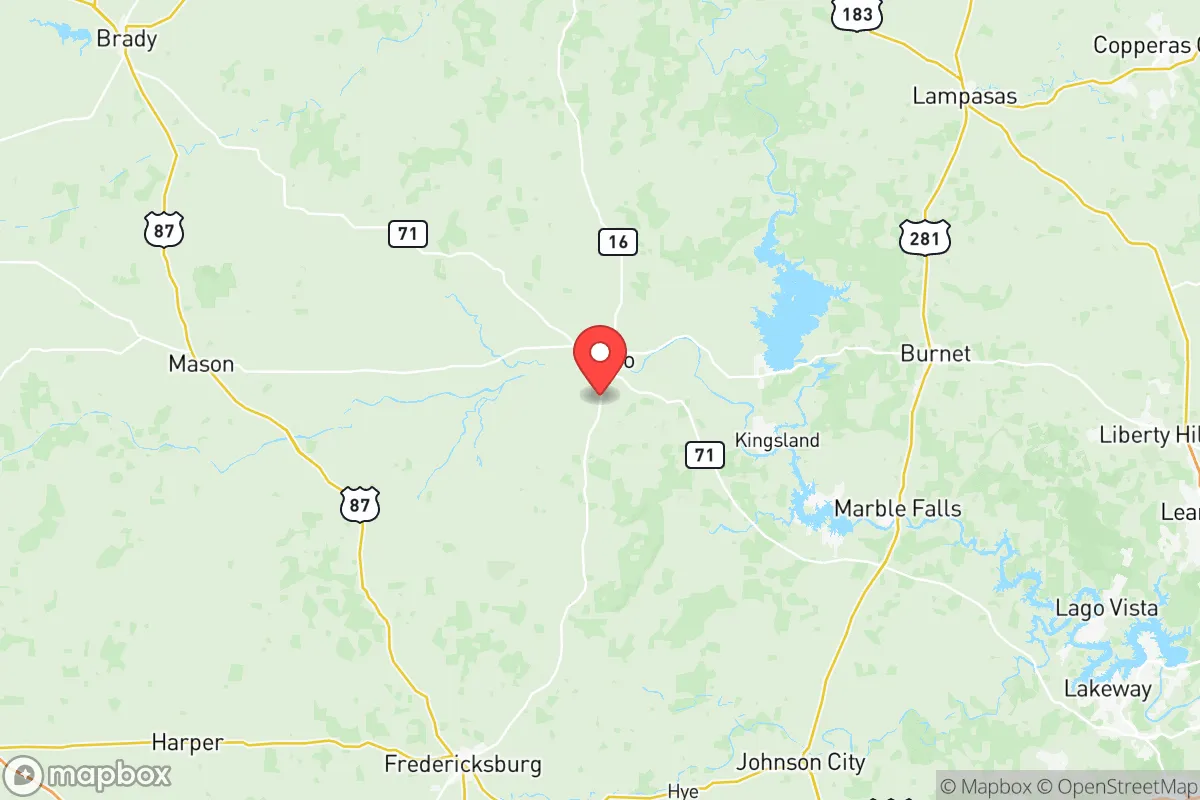
Llano County, Texas, offers a compelling strategic position for relocators prioritizing resilience and self-sufficiency, balancing rural remoteness with reasonable access to essential services. Located in the Texas Hill Country roughly 75 miles northwest of Austin and 90 miles north of San Antonio, the county avoids the immediate fallout zones of major metropolitan areas while remaining within a practical driving distance for medical care, supply runs, or professional obligations. The county seat of Llano and the smaller communities of Kingsland, Buchanan Dam, and Tow anchor a sparsely populated region of roughly 20,000 residents across 935 square miles, providing a low-density buffer that inherently reduces exposure to cascading urban disruptions.
Geographic position and natural advantages for long-term security
Llano County sits atop the Llano Uplift, a geological formation that provides some of the most stable bedrock in Texas, minimizing risks from subsidence or seismic activity. The terrain is rolling hills with granite outcroppings, juniper, and live oak, offering natural defensibility through limited road access and numerous choke points along the county's two-lane highways. The county is bisected by the Llano River and bordered by the Colorado River, which feeds the Highland Lakes chain—specifically Lake Buchanan and Inks Lake—providing a reliable surface water source that is rare in much of arid West Texas. The region's elevation (typically 800–1,200 feet) places it above the flood-prone coastal plains and away from the hurricane storm surge zones that threaten Houston and Galveston. The climate is semi-arid with hot summers and mild winters, reducing the risk of prolonged winter storms that can cripple power grids farther north, though the 2021 Winter Storm Uri did cause localized outages here.
Risk exposures and proximity to fallout-relevant landmarks
While Llano County avoids the worst of urban threats, it is not without exposure. The county lies roughly 60 miles southwest of Fort Cavazos (formerly Fort Hood), a major Army installation that could become a target or a staging area during a national security crisis. The South Texas Nuclear Generating Station near Bay City is over 200 miles away, placing Llano outside the most severe fallout zones for a reactor incident, though prevailing winds from the southeast could carry lighter particulate over the region. The county's own infrastructure is limited: the only hospital is the 25-bed Llano Memorial Hospital, and the nearest Level I trauma centers are in Austin and San Antonio, both over an hour's drive. Wildfire risk is moderate, particularly in drought years, as the juniper and grass understory can carry fast-moving flames. The county's power grid is part of the ERCOT system, meaning it is vulnerable to the same statewide failures that affected millions in 2021, though rural areas here generally saw faster restoration than dense suburbs.
Practical resilience for a relocator: food, water, energy, and defensibility
For a relocator serious about self-sufficiency, Llano County offers strong fundamentals. Water access is the standout advantage: the Llano River and Highland Lakes provide ample surface water, and groundwater from the Ellenburger-San Saba aquifer is generally reliable at depths of 200–400 feet, though well drilling costs can run $15,000–$25,000. The county has no municipal water utility outside the small towns, so most rural properties rely on private wells or rainwater catchment, which is legal and encouraged. Food resilience is moderate: the county has a handful of small farms and ranches, a weekly farmers market in Llano, and abundant game (white-tailed deer, wild hogs, turkey) for hunting, but large-scale agriculture is limited by thin soils and periodic drought. The Llano County Cooperative Extension offers resources for home gardening and livestock, and the local feed stores in Llano and Kingsland stock seeds, fencing, and animal supplies. Energy resilience is a mixed picture: solar potential is excellent (over 260 sunny days per year), and many rural homes already have propane tanks and generators, but natural gas is not piped to most areas, and firewood is available but requires labor to harvest. Defensibility is high due to low population density, limited road access (primarily Highway 71, 29, and 16), and the ability to monitor approaches from elevated terrain. The county's sheriff's office has about 20 deputies for the entire county, so law enforcement response times in remote areas can exceed 30 minutes, making personal security measures—dogs, fencing, and situational awareness—a practical necessity.
The overall strategic picture for Llano County is one of balanced trade-offs. It offers genuine advantages in water availability, low population density, and natural defensibility that are rare in Texas at this price point (median home values around $250,000–$350,000). The proximity to Fort Cavazos and the ERCOT grid vulnerability are real but manageable risks for a prepared household. For a relocator who values self-sufficiency over convenience, Llano County provides a solid foundation—provided they invest in their own well, solar, and food storage systems. It is not a bunker, but it is a defensible, resource-rich slice of the Hill Country that rewards preparation and common sense.

* Values derived from national, state, county, city and local statistics and may differ in a specific area. Last updated: 2026-07-17T02:25:36.000Z
Narrative content on this page is AI-generated and may contain mistakes. Verify any details that matter before acting on them.
ReloMaps may earn a commission from affiliate links at no extra cost to you.

