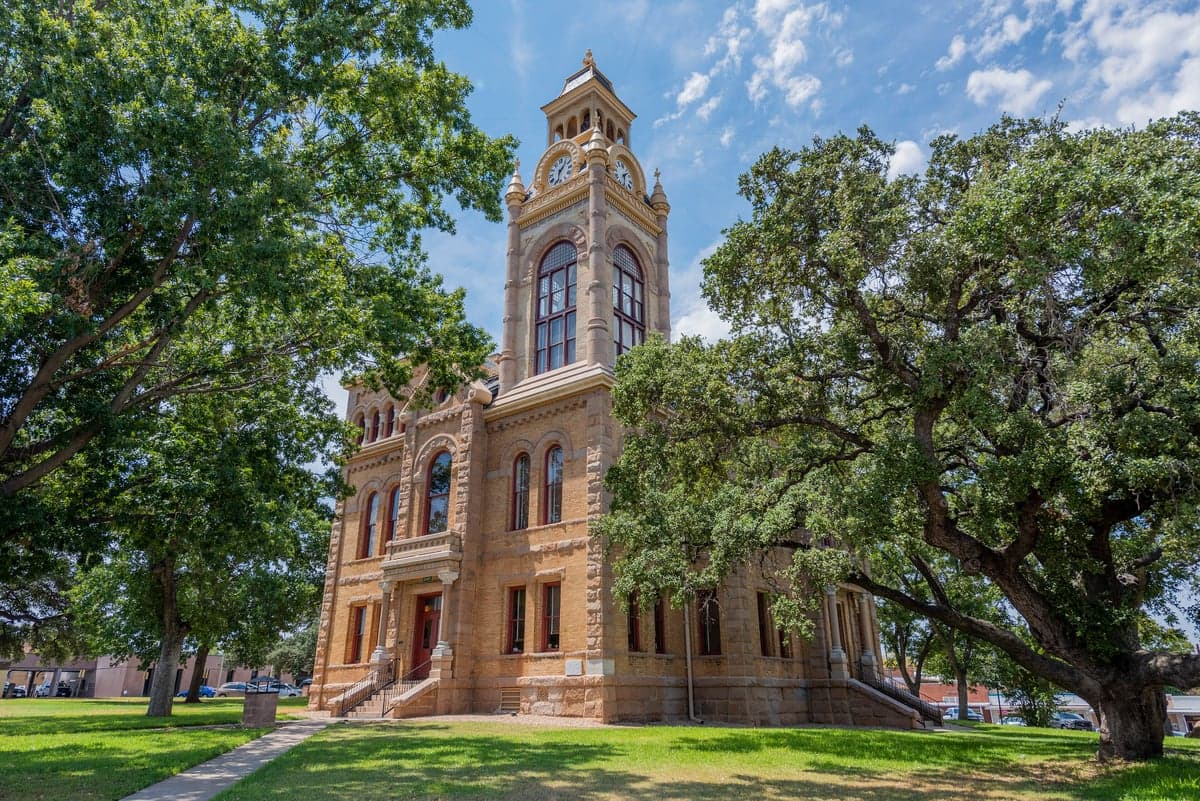
Photo: Wikipedia
Demographics of Llano County
Affluence Level in Llano County
A middle-class area roughly in line with national averages across income, home values, education, and employment.
People of Llano County
The people of Llano County, Texas, today number 22,011, forming a predominantly white (83.2%) and politically conservative rural community with a small but growing Hispanic minority (12.7%). The county’s population density remains low at roughly 18 people per square mile, and its identity is deeply rooted in German-Texan heritage, a legacy of 19th-century immigration, and a modern influx of retirees and remote workers drawn to the Highland Lakes region. Distinctive markers include a strong local ranching culture, a high rate of veteran residency, and a population that is older than the state average, with a median age of 49.5 years.
Settlement & growth (pre-1960)
Before European contact, the area now known as Llano County was inhabited by the Lipan Apache and Comanche nations, who used the Llano River valley for hunting and seasonal camps. Spanish expeditions passed through in the 18th century, but no permanent Spanish or Mexican settlements were established here; the region remained a frontier buffer zone. After Texas independence in 1836, Anglo-American settlers began trickling in, but the decisive population wave came after the Civil War, when German immigrants—many from the Adelsverein colonization societies—pushed north and west from established communities like Fredericksburg and New Braunfels. These German families founded the county’s enduring settlements: Llano (the county seat, established 1856), Kingsland (a key river crossing), and Tow (a farming hamlet). They brought with them a tradition of small-scale agriculture, stone masonry, and Lutheran church life that still defines the county’s cultural core.
By the 1880s, the arrival of the Austin and Northwestern Railroad spurred a second wave: Anglo farmers from the Deep South, many of Scots-Irish descent, who established cotton and cattle operations in the southern part of the county around Buchanan Dam and Castell. The railroad also brought a small number of African American families, mostly as laborers and sharecroppers, who settled in Llano town’s “Southside” neighborhood. Their numbers peaked at roughly 8% of the county population in 1900 but declined steadily through the 20th century due to outmigration. The Dust Bowl of the 1930s drove a modest influx of “Okie” families from Oklahoma and the Texas Panhandle, who took up dryland farming and ranching in the western reaches near Valley Spring. The construction of the Buchanan Dam (completed 1937) and later the Wirtz Dam (1951) created the Highland Lakes, transforming the county’s economy from purely agricultural to include tourism and second-home development. This period saw the first significant wave of Anglo retirees from Houston and Dallas, who built lake houses around Horseshoe Bay and Sunrise Beach Village.
Modern era (post-1965)
The 1965 Hart-Cellar Act had a minimal direct effect on Llano County, as the foreign-born population today is just 2.2%—far below the Texas average of 17%. The county did not experience the large-scale immigration from Latin America or Asia that reshaped urban Texas. Instead, the post-1965 demographic story is one of domestic migration: a steady, mostly white influx from the metropolitan areas of Texas and, increasingly, from other states. The creation of Horseshoe Bay as a master-planned resort community in the 1970s accelerated this trend, drawing affluent retirees and second-home owners from Houston, San Antonio, and the Midwest. The county’s Hispanic population grew from 4.5% in 1990 to 12.7% today, driven by families moving from the Rio Grande Valley and San Antonio for construction, hospitality, and service jobs tied to the lake economy. These Hispanic residents are concentrated in Llano town and the unincorporated areas around Kingsland, where they form a visible but not segregated community. The Black population remains very small at 1.0%, largely descendants of the original railroad-era families, with no significant new migration. East/Southeast Asian residents (0.4%) and Indian-subcontinent residents (0.1%) are present in tiny numbers, mostly professionals associated with the Highland Lakes tourism industry or remote workers.
Suburbanization has been limited by the county’s rural character and distance from major job centers. However, the 2010s saw a notable uptick in “amenity migration”—people moving from California, Colorado, and the Pacific Northwest, drawn by lower housing costs, the lakes, and the conservative political climate. This group tends to settle in the lakefront communities of Horseshoe Bay and Sunrise Beach Village, where new subdivisions have been built. The county’s college-educated share stands at 33.1%, slightly above the national rural average, reflecting the professional and retiree composition of these newer arrivals.
The future
Llano County is projected to become slightly more diverse over the next 10-20 years, but the change will be gradual. The Hispanic share is expected to rise to 15-18% by 2040, driven by natural increase and continued migration from South Texas. The white non-Hispanic share will likely decline to around 75-78%, but the county will remain overwhelmingly non-Hispanic white. The foreign-born share may tick up to 3-4%, still far below state averages. The most significant demographic trend is aging: the county’s median age is already 49.5, and the retiree-heavy lake communities will push it higher. Younger families are being priced out of lakefront property, concentrating in Llano town and the more affordable western areas like Castell and Valley Spring. The cultural identity is evolving from a purely German-Texan ranching heritage toward a broader “Hill Country lifestyle” brand that appeals to conservative-leaning newcomers. No new immigrant enclaves are forming; the small Hispanic and Asian populations are dispersing rather than concentrating. The county’s political character—solidly Republican, with 80%+ of votes going to GOP candidates in recent elections—is unlikely to shift meaningfully.
For someone moving in now, Llano County offers a stable, low-density, culturally conservative environment where the population is older, whiter, and more affluent than the Texas average. The community is welcoming to newcomers who respect its rural traditions, but it is not a place of rapid demographic change or ethnic diversity. The future points to continued slow growth, an aging population, and a gradual blending of old ranching families with new lake-oriented residents—a place where the past remains visible but the future is shaped by the Highland Lakes and the people who come to enjoy them.

* Values derived from national, state, county, city and local statistics and may differ in a specific area. Last updated: 2026-07-17T02:25:36.000Z
Narrative content on this page is AI-generated and may contain mistakes. Verify any details that matter before acting on them.
ReloMaps may earn a commission from affiliate links at no extra cost to you.

