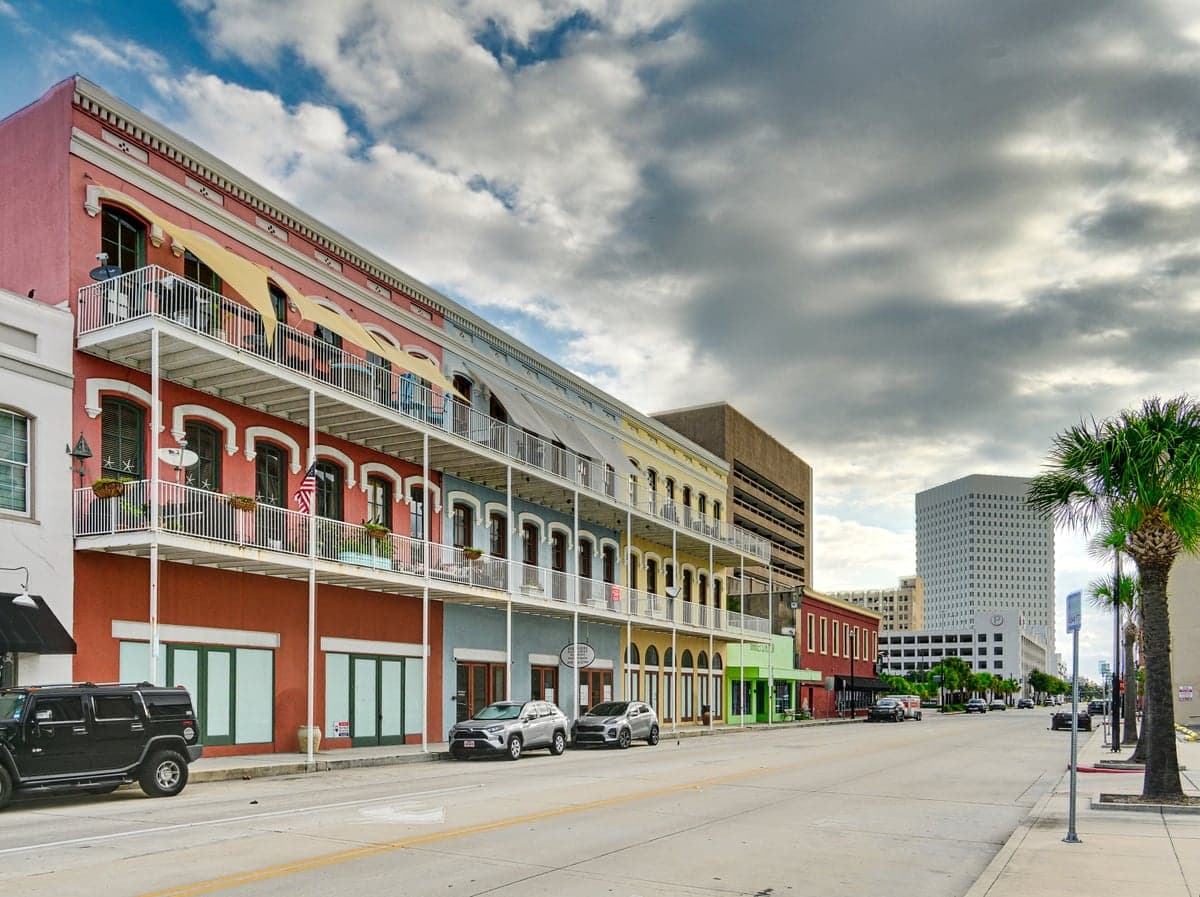
Photo: Wikipedia
Political ClimatePolitical Climate in Galveston County
Showing district-level results — no local-only data available.
Local Political AnalysisPolitical Analysis of Galveston County
Galveston County has been a reliably Republican stronghold for decades, but the political ground is shifting under its feet. The county carries a Cook Partisan Voting Index (PVI) of R+17, making it significantly more conservative than Texas as a whole, which sits at R+4. However, that headline number masks a dramatic realignment: the county is trending leftward faster than almost any other in the state, driven by explosive population growth in its mainland suburbs and a slow but steady blueing of the island itself.
How it compares
The R+17 rating puts Galveston County in a different political universe than the state average. To put it in perspective, a Republican running countywide can expect a built-in advantage roughly 13 points larger than they'd get in a typical Texas race. But that's the countywide average—the real story is the internal divide. The old Republican base is concentrated in the rural and exurban mainland: Santa Fe, Dickinson, and League City (especially south of FM 518) routinely deliver 65-70% of their votes to GOP candidates. Meanwhile, the city of Galveston itself has become a genuine swing area, with precincts on the island's east end and near the University of Texas Medical Branch (UTMB) now voting Democratic by 10-15 points. The most dramatic shift is in Texas City, a historically blue-collar, union-heavy town that was once reliably Democratic but has trended Republican in presidential races, though it still flips for strong local Democrats. The key swing precincts are in the newer master-planned communities of League City's west side (around Clear Creek) and the fast-growing Kemah/Seabrook corridor, where transplants from Harris County are bringing more moderate-to-liberal voting habits. This is why the county's PVI, while still deeply red, has moved 5 points toward Democrats since 2016—a pace that, if sustained, could make it a toss-up county within a decade.
What this means for residents
For conservative residents, the practical effect is that their votes still carry outsized weight in local primaries and down-ballot races, but they can no longer take general elections for granted. The county commissioners court remains 4-1 Republican, but the school board races in League City and Clear Creek ISD have become competitive, with conservative slates facing organized opposition from moderate and liberal parents. For liberal residents, the landscape is frustrating but improving. Running for countywide office as a Democrat is still a long shot, but winning a city council seat in Galveston or a school board position in League City is now realistic. The most tangible policy impact is on development and taxation: the county's Republican majority has kept property tax rates among the lowest in the Houston metro area, but it has also resisted expanding public transit and affordable housing initiatives that many new residents want.
The cultural and policy distinctions are most visible in two areas: hurricane preparedness and environmental regulation. Galveston County's political leadership has historically prioritized rapid rebuilding after storms and resisted strict coastal development restrictions, a stance that pleases property owners but frustrates environmental advocates. The county also remains a "Second Amendment sanctuary" jurisdiction, with local officials publicly vowing not to enforce certain state-level gun restrictions. Meanwhile, the city of Galveston has carved out its own identity, passing a non-discrimination ordinance protecting LGBTQ+ residents and investing heavily in bike infrastructure and historic preservation—policies that would never pass in Santa Fe or Dickinson. This patchwork of local governance means that where you live in Galveston County determines not just your vote's weight, but the very character of your daily life.

State Political ClimatePolitical Climate in Texas
State Political AnalysisPolitical Environment in the State
Texas has been a reliably Republican state for the past three decades, with a Cook Partisan Voting Index of R+4, meaning it typically votes about four points more Republican than the national average. The dominant coalition is a mix of suburban professionals, rural conservatives, and evangelical voters, but the last 10-20 years have seen a slow, steady shift toward competitiveness as the state’s explosive population growth—driven by transplants from California, New York, and Illinois—has turned once-safe red suburbs like Collin County (north of Dallas) and Fort Bend County (southwest of Houston) into battlegrounds. In 2020, Donald Trump still won Texas by 5.6 points, down from 9 points in 2016 and 16 points in 2012, and Democrats flipped two congressional seats in the Dallas-Fort Worth suburbs. The state is not trending blue overnight, but the margin is narrowing, and the political reality for a new resident is that you’ll find a deeply conservative state government in Austin that is increasingly at odds with the growing urban and suburban populations.
Urban vs. rural divide
The political map of Texas is a textbook case of the urban-rural split. The big five metros—Houston, Dallas-Fort Worth, San Antonio, Austin, and El Paso—are the Democratic strongholds, with Harris County (Houston) and Dallas County delivering margins of 10-15 points for Democrats in recent cycles. Austin is the bluest major city in the state, with Travis County going +42 for Biden in 2020, while El Paso County, heavily Latino and working-class, is reliably Democratic by similar margins. The rural and exurban counties, by contrast, are deeply red: places like East Texas’s Smith County (Tyler) and the Panhandle’s Lubbock County routinely vote 70-80% Republican. The suburbs are where the real action is. Collin County, once a GOP stronghold, voted for Trump by only 3 points in 2020, down from 18 points in 2016, and Tarrant County (Fort Worth) flipped to Biden by a hair. Meanwhile, the Rio Grande Valley, historically Democratic, has shifted right—Zapata County, which went for Hillary Clinton by 33 points in 2016, flipped to Trump by 5 points in 2020, driven by conservative Latino voters on economic and cultural issues. For a relocator, this means your political experience will vary dramatically: live in Austin or Houston’s inner loop, and you’re in a blue bubble; settle in a suburb like Frisco or a rural town like Marble Falls, and you’re in a red one.
Policy environment
Texas’s policy environment is defined by its no state income tax, a constitutional cap on property tax growth (enacted via Proposition 4 in 2023, which lowered the appraisal cap from 10% to 5%), and a light regulatory touch that attracts businesses. The state’s education policy is a flashpoint: the Texas Education Agency (TEA) has pushed school choice and charter expansion, but a 2023 voucher bill failed in the House after rural Republicans joined Democrats to block it, though Governor Greg Abbott has vowed to revive it. Healthcare is a perennial issue—Texas has the highest uninsured rate in the nation at roughly 17%, and the state has not expanded Medicaid under the Affordable Care Act. Election laws were tightened with Senate Bill 1 in 2021, which banned 24-hour and drive-through voting, added ID requirements for mail ballots, and gave partisan poll watchers more access. For a conservative-leaning relocator, the tax and regulatory posture is a major draw; for a liberal one, the lack of a safety net and restrictive voting laws are significant downsides.
Recent policy direction
The last five years have seen Texas push a distinctly conservative agenda on multiple fronts. On gun and self-defense law, the state enacted permitless carry (HB 1927) in 2021, allowing anyone over 21 who can legally own a firearm to carry it without a license. On parental and education rights, the 2023 law HB 900 (the “READER Act”) required book vendors to rate materials for “sexual content,” though it was blocked by a federal judge; the state also banned diversity, equity, and inclusion (DEI) offices at public universities (SB 17). On speech and privacy, a 2023 law (HB 20) prohibits social media platforms from moderating content based on “viewpoint,” a direct challenge to Section 230. On medical and bodily autonomy, Texas has one of the strictest abortion bans in the nation (SB 8, the “Heartbeat Act,” and a trigger law banning all abortions from conception), with no exceptions for rape or incest. On property rights, the state has strong eminent domain protections for landowners, but a 2023 law (SB 2039) restricted foreign ownership of land near military bases. On taxation, the 2023 property tax cut package (SB 2 and SB 3) sent $18 billion in relief, raising the homestead exemption to $100,000. On voting and ballot access, SB 1 remains the law, though federal lawsuits continue. For a relocator, the bottom line is that Texas is actively expanding gun rights and parental control while restricting abortion and ballot access—a trade-off that will feel liberating or constraining depending on your values.
Civil unrest & political movements
Texas has a history of high-profile political flashpoints. The 2020 protests after George Floyd’s murder in Minneapolis saw significant unrest in Austin, Houston, and Dallas, with Austin’s police budget being cut by a third in 2020, then restored in 2021 after a backlash. The state’s immigration politics are a constant source of tension: Governor Abbott’s Operation Lone Star, launched in 2021, deployed state troopers and National Guard to the border, bused migrants to Democratic-led cities like New York and Chicago, and led to the arrest of thousands on state trespassing charges. The “sanctuary city” debate is active—Texas banned sanctuary policies in 2017 (SB 4), and the law has been upheld in court. Secession rhetoric, while fringe, has a real presence: the Texas Nationalist Movement, led by Daniel Miller, has pushed for a 2024 referendum on secession, though it has no legal path. Election integrity controversies flared after 2020, with Attorney General Ken Paxton leading a failed lawsuit to overturn the results in four swing states. For a new resident, you’ll see these movements mostly in the news and at rallies—they don’t dominate daily life, but the border busing and abortion debates are inescapable in state politics.
Projection
Over the next 5-10 years, Texas is likely to become more competitive but not flip blue. The demographic drivers are clear: the state’s Hispanic population, which is growing fast, is not voting monolithically—younger, more liberal Latinos in cities are offset by older, more conservative ones in the Valley and rural areas. The suburban shift is the key: places like Williamson County (north of Austin) and Denton County (north of Dallas) are trending left as educated professionals move in, but the rural vote is hardening. The 2024 election will be a test—if Trump wins Texas by 4-5 points, the trend is slowing; if it’s under 3, the state is a true battleground by 2028. The state government will likely remain Republican-controlled, but the margin in the legislature is shrinking, which could force compromise on issues like school choice and property taxes. For a relocator moving in now, expect a decade of political tension: a conservative state government pushing against a growing liberal urban base, with the suburbs as the battlefield.
For a new resident, the practical takeaway is that Texas offers a low-tax, low-regulation environment that rewards economic ambition, but the political climate is increasingly polarized. If you’re a conservative, you’ll find a state government that aligns with your values on guns, taxes, and parental rights, and you’ll feel at home in most suburbs and rural areas. If you’re a liberal, you’ll find strong communities in the cities and inner suburbs, but you’ll be living under a state government that actively opposes many of your priorities—especially on abortion and voting. The key is to choose your location carefully: the political reality of Texas is not one state, but a collection of regions that feel like different countries.
* Values derived from national, state, county, city and local statistics and may differ in a specific area. Last updated: 2026-06-15T09:47:41.000Z
Narrative content on this page is AI-generated and may contain mistakes. Verify any details that matter before acting on them.
ReloMaps may earn a commission from affiliate links at no extra cost to you.

