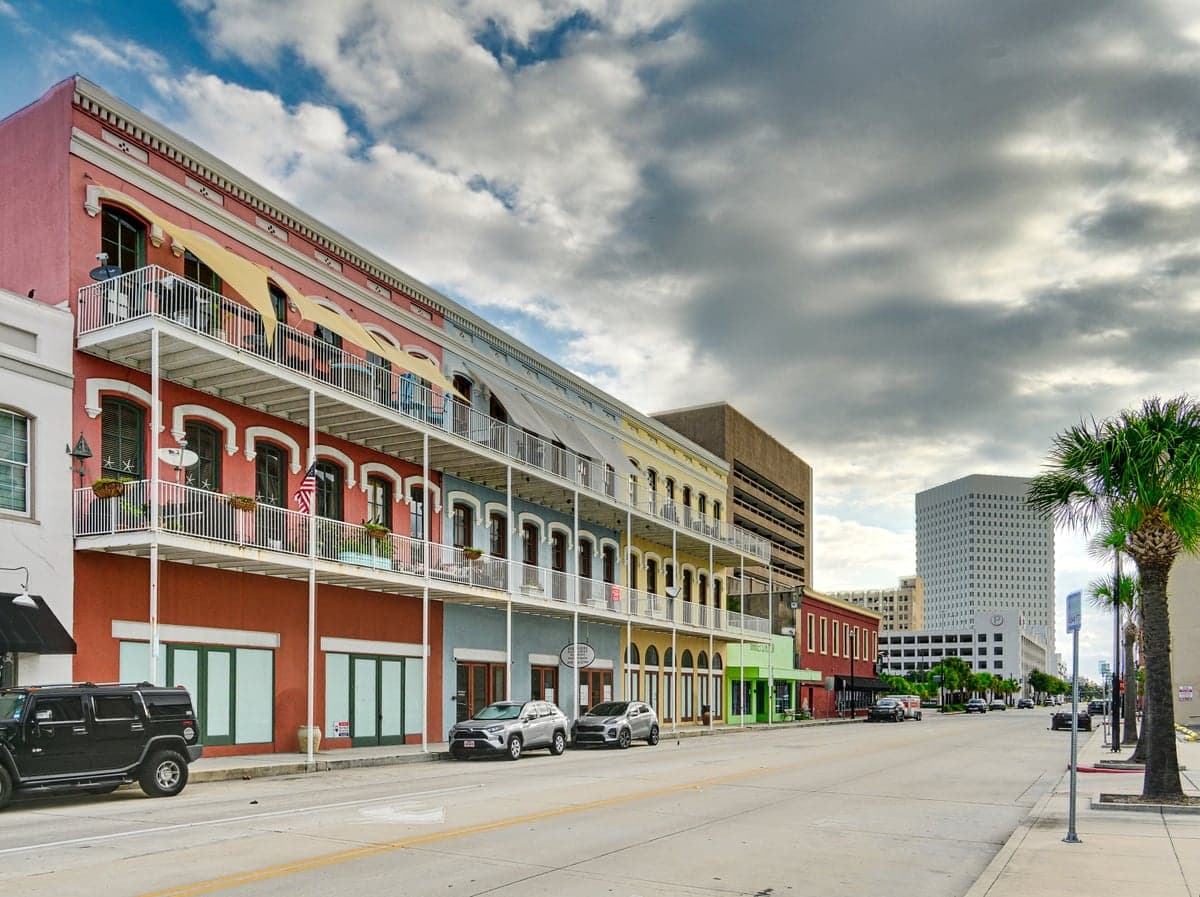
Photo: Wikipedia
Demographics of Galveston County
Affluence Level in Galveston County
A middle-class area roughly in line with national averages across income, home values, education, and employment.
People of Galveston County
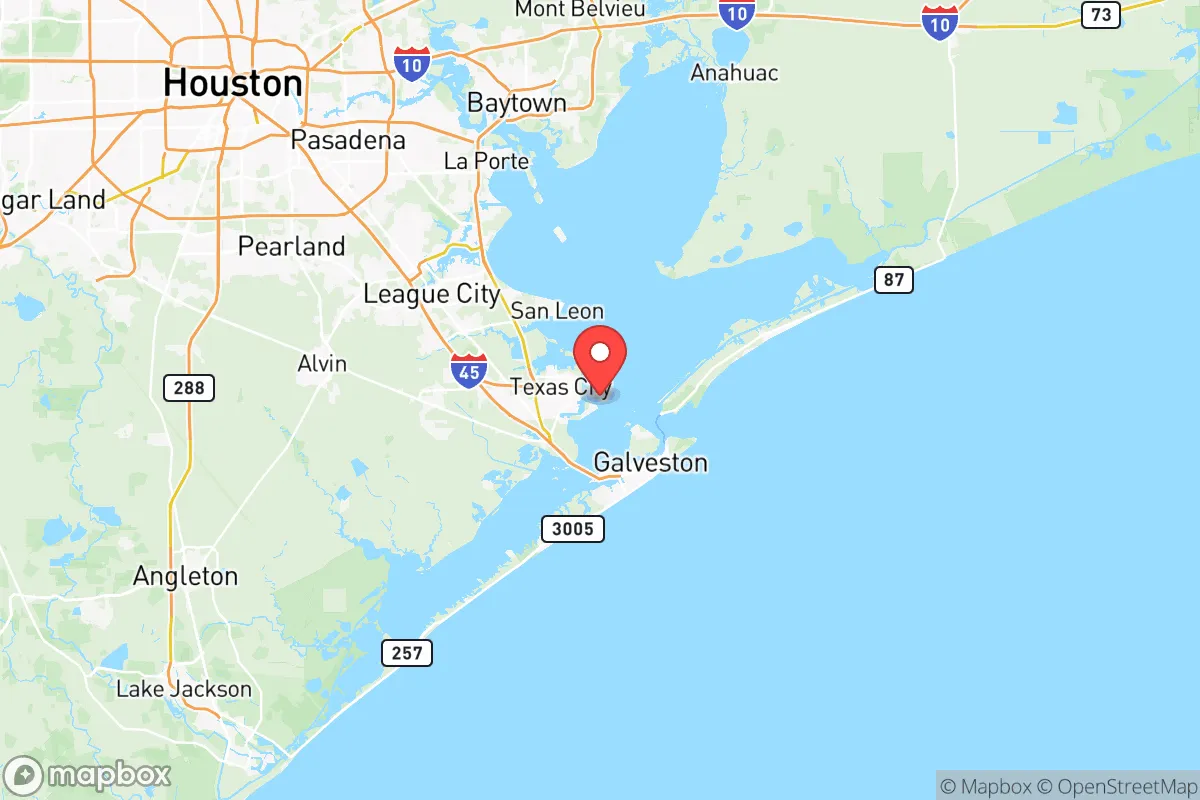
Galveston County’s 354,721 residents today form a coastal community shaped by centuries of maritime commerce, industrial booms, and storm-driven rebuilding. The population is 54.8% White, 25.9% Hispanic, 12.0% Black, 2.3% East/Southeast Asian, and 1.0% Indian, with only 5.1% foreign-born — a lower share than Texas overall, reflecting the county’s deep-rooted native-born character. The county’s identity is a blend of historic Gulf Coast port culture, petrochemical industry pragmatism, and growing suburban family life, with a slightly conservative tilt that aligns with its working-class and military-connected roots.
Settlement & growth (pre-1960)
Before European contact, the Karankawa people inhabited the Galveston Island and mainland coast for thousands of years, living as nomadic hunter-gatherers along the bays and barrier islands. Spanish explorers first mapped the area in the 16th century, but sustained European settlement did not begin until the 1820s, when Mexico granted land to Anglo-American colonists under Stephen F. Austin’s empresario system. The first permanent Anglo settlers arrived in the 1820s and 1830s, establishing Galveston City on the island’s east end as the Republic of Texas’s primary port and, briefly, its capital.
By the 1840s and 1850s, German and Irish immigrants poured into the county, drawn by shipping jobs and agricultural land. Germans clustered in Texas City and the mainland farming communities of Dickinson and Santa Fe, where they built churches and schools that still anchor those towns. Irish immigrants worked the docks and railroads in Galveston City, forming the city’s early Catholic backbone. The 1860 census recorded Galveston County as roughly 60% White and 40% enslaved Black people, the latter concentrated on cotton plantations along the mainland bayous near Hitchcock and La Marque.
After emancipation, freed Black families established independent communities in Galveston City’s west end and in rural settlements like Alta Loma (now part of Santa Fe). The 1900 Great Storm devastated Galveston Island, killing an estimated 6,000 people and prompting a massive rebuilding effort that included the construction of the seawall. This disaster shifted the county’s center of gravity toward the mainland. Texas City boomed after 1900 as a deepwater port and oil refining hub, drawing White workers from the rural South and Midwest, as well as Mexican laborers who built the refineries and railroads. By 1930, the county’s population had grown to roughly 60,000, with a solid White majority, a Black minority of about 20%, and a small but growing Mexican-origin community centered in Texas City and Galveston City’s north side.
World War II brought a second industrial surge. The U.S. Army Air Forces built Scholes Field in Galveston City and expanded the Texas City shipyards, drawing thousands of workers from across Texas and the South. The 1947 Texas City disaster — a ship explosion that killed 581 people — temporarily slowed growth but did not stop it. By 1960, the county’s population had reached 140,000, with a demographic profile that was still overwhelmingly White (75%), with a 20% Black minority and a 5% Hispanic share, concentrated in the industrial working-class neighborhoods of Texas City and the island’s east end.
Modern era (post-1965)
The 1965 Hart-Cellar Act had a modest direct effect on Galveston County compared to Houston or Dallas, because the county’s economy — dominated by petrochemicals, shipping, and tourism — did not attract the same scale of new immigration. Instead, the county’s post-1965 demographic shifts came primarily from domestic migration and natural increase. The most significant change was the growth of the Hispanic population, which rose from 5% in 1960 to 25.9% by 2025. This growth came from two sources: Mexican-American families who had lived in the county for generations, concentrated in Texas City’s north side and Galveston City’s central neighborhoods, and newer arrivals from Central America and Mexico who moved into the affordable housing stock of La Marque and Hitchcock.
The Black population share declined from 20% in 1960 to 12.0% today, as middle-class Black families moved to Harris County suburbs like Missouri City and Pearland for better schools and newer housing. The remaining Black population is concentrated in Galveston City’s historic west-end neighborhoods and in Texas City, where the refinery workforce has become more diverse. The East/Southeast Asian population (2.3%) and Indian population (1.0%) are small but growing, with families drawn to the county’s lower housing costs compared to Houston. Most Asian and Indian residents live in the newer subdivisions of Dickinson and League City, where the school districts are highly rated and commute times to Houston’s Texas Medical Center are manageable.
Suburbanization reshaped the county after 1980. League City grew from a farming village of 3,000 in 1970 to a master-planned suburb of over 115,000 by 2025, drawing White and Hispanic families from Houston and from within the county. Dickinson and Santa Fe also expanded, attracting families who wanted larger lots and lower taxes than Harris County offered. The island itself — Galveston City — became more of a tourist and second-home destination, with its year-round population aging slightly and becoming more White and affluent in the historic east end, while the west end remained more diverse and working-class.
The future
Galveston County is becoming slightly more diverse, but at a slower pace than Texas as a whole. The Hispanic share is projected to reach 30-32% by 2040, driven by natural increase and continued migration from the Rio Grande Valley and Central America. The White share will continue to decline gradually, from 54.8% to roughly 48-50%, as older White residents age and younger White families move to exurban counties like Brazoria and Fort Bend. The Black share is likely to stabilize around 11-12%, as outmigration to Harris County suburbs slows and a small number of Black professionals move into League City and Dickinson. The East/Southeast Asian and Indian populations will grow modestly, reaching perhaps 4-5% combined by 2040, concentrated in the same suburban corridors.
The most significant demographic trend is the continued suburbanization of the mainland. League City and Dickinson will absorb most new housing construction, while Texas City and La Marque will see slower growth or slight population declines as their older housing stock and industrial tax base struggle to attract new residents. The island’s population will remain stable, constrained by flood risk and limited developable land. Culturally, the county is becoming more politically competitive: the suburban mainland is trending slightly more moderate, while the island and industrial towns remain reliably conservative. For a family or individual moving in now, Galveston County offers a lower-cost, slower-paced alternative to Houston, with a population that is still majority native-born, English-dominant, and grounded in the maritime and industrial economy that built it.
Bottom line: Galveston County is a coastal community in transition — diversifying slowly, suburbanizing steadily, and retaining a distinct Gulf Coast identity that is neither fully urban nor fully rural. New arrivals will find a place where the old port-town character still lingers in Galveston City and Texas City, while the mainland suburbs offer the same amenities as any Sun Belt exurb. The county’s future is one of gradual change, not dramatic transformation, making it a stable choice for those who value affordability, proximity to Houston, and a sense of place rooted in the sea and the refinery.

* Values derived from national, state, county, city and local statistics and may differ in a specific area. Last updated: 2026-06-15T09:47:41.000Z
Narrative content on this page is AI-generated and may contain mistakes. Verify any details that matter before acting on them.
ReloMaps may earn a commission from affiliate links at no extra cost to you.

