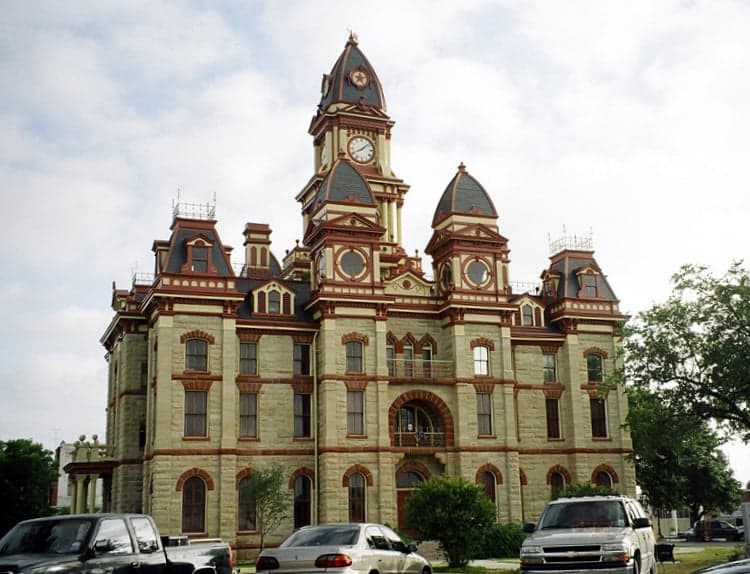
Photo: Wikipedia
Political ClimatePolitical Climate in Caldwell County
Showing district-level results — no local-only data available.
Local Political AnalysisPolitical Analysis of Caldwell County
Caldwell County, Texas, is a reliably Republican stronghold with a Cook Partisan Voting Index (PVI) of R+14, meaning it votes about 14 percentage points more Republican than the national average. This is a significant shift from just a decade ago, when the county was more of a lean-red area, and it now sits well to the right of the state of Texas itself, which has a PVI of R+4. The county's political trajectory is clearly trending redder, driven by a mix of rural conservative values and the influx of new residents from more liberal areas who often seek out the county's lower taxes and slower pace of life, but who don't necessarily change the voting patterns.
How it compares
Compared to Texas as a whole, Caldwell County is a political outlier to the right. While Texas is a solidly Republican state, its urban centers like Austin, Houston, and Dallas create a more competitive statewide environment. Caldwell County, by contrast, has no such large liberal counterweight. The county's R+14 PVI is more in line with deeply red rural counties in West Texas or East Texas than with the state's average. Within the county, there's a clear urban-rural split. The county seat, Lockhart, is the most politically moderate area, with some precincts near the town center occasionally voting Democratic in local races, though still reliably Republican in presidential elections. In contrast, smaller towns like Luling and Martindale are deeply conservative, with precincts routinely delivering 70-80% of the vote for Republican candidates. The unincorporated areas and farming communities, such as those around McMahan and Fentress, are even more solidly red. The swing precincts are almost nonexistent; the county's political divide is less about competition and more about degrees of Republican support.
What this means for residents
For conservative residents, Caldwell County feels like a natural fit. Local government, school boards, and county commissions are overwhelmingly Republican, and policies around taxes, land use, and Second Amendment rights reflect that. You'll find a strong sense of community around local churches, rodeos, and the county fair, all of which are deeply woven into the conservative social fabric. For liberal residents, the reality is more nuanced. While you won't face overt hostility, you'll be in a clear minority. Political discussions at the local coffee shop or PTA meeting will likely lean right, and your vote in local elections will rarely be on the winning side. However, the proximity to Austin (about 30 minutes from Lockhart) provides a cultural and political escape valve. Many liberal residents commute to Austin for work and social life, treating Caldwell County as a quiet, affordable home base. The county's politics are not aggressively confrontational; it's more of a quiet, consistent conservatism than a loud, activist one.
The most distinctive cultural and policy distinction in Caldwell County is its fierce independence from Austin's influence. While the city of Austin pushes progressive policies on housing, environmental regulations, and policing, Caldwell County's commissioners court has repeatedly passed resolutions opposing state mandates perceived as overreach, particularly on property rights and local control. This isn't just partisan posturing; it reflects a deep-seated belief in limited government that predates the current political climate. The county's economy, heavily reliant on agriculture, oil and gas, and the burgeoning barbecue tourism in Lockhart, reinforces this self-reliant ethos. For anyone moving here, understanding that local politics is less about national culture wars and more about practical issues like road maintenance, water rights, and school funding is key. The political climate is stable, predictable, and unlikely to shift dramatically in the near future, making it a comfortable choice for those who align with its values and a manageable one for those who don't.

State Political ClimatePolitical Climate in Texas
State Political AnalysisPolitical Environment in the State
Texas has been a reliably Republican state for decades, but the political reality is far more nuanced than a simple "red state" label suggests. The state’s Cook Partisan Voting Index (PVI) of R+4 reflects a solid but not overwhelming GOP advantage, and the 10-20 year trajectory shows a slow but steady shift toward competitiveness, driven by explosive growth in the urban and suburban cores of Houston, Dallas-Fort Worth, San Antonio, and Austin. While Republicans still dominate statewide elections — no Democrat has won a statewide office since 1994 — the margins have tightened, and the political landscape is increasingly defined by a stark urban-rural divide that makes Texas feel like two different countries depending on where you live.
Urban vs. rural divide
The political map of Texas is a patchwork of deep-blue urban islands surrounded by deep-red rural and exurban seas. The major metros — Austin (Travis County), Dallas (Dallas County), Houston (Harris County), San Antonio (Bexar County), and El Paso (El Paso County) — all vote reliably Democratic, often by double-digit margins. In 2024, Harris County went for the Democratic presidential candidate by roughly 15 points, while Travis County pushed closer to 30 points. Meanwhile, rural counties like Lubbock (Lubbock County) and Amarillo (Potter County) vote Republican by 30-40 points. The real battleground is the suburban ring — places like Collin County (north of Dallas), Fort Bend County (southwest of Houston), and Williamson County (north of Austin) have been trending purple as educated, diverse, and often moderate voters move in. Collin County, once a GOP stronghold, now sees competitive races at the local level, while Fort Bend County flipped to Democratic in 2018 and has stayed competitive. This urban-suburban-rural split means a resident in Plano experiences a very different political climate than someone in Wichita Falls.
Policy environment
Texas’s policy environment is defined by a low-tax, low-regulation posture that appeals strongly to conservative relocators. There is no state income tax, and property taxes are among the highest in the nation — a trade-off that benefits high-earners but can squeeze homeowners. The state’s regulatory climate is business-friendly, with minimal zoning in many areas and a right-to-work law that limits union power. On education, Texas has a school choice voucher program (the Texas Education Savings Account program, passed in 2023) that allows parents to use public funds for private or homeschool expenses, though it remains capped and contested. Healthcare policy is notably hands-off: Texas did not expand Medicaid under the Affordable Care Act, leaving roughly 1.5 million uninsured residents, and abortion is effectively banned after six weeks under the 2021 Heartbeat Act (SB 8) and a near-total trigger ban (HB 1280) that took effect in 2022. Election laws have been tightened: SB 1 (2021) added ID requirements for mail-in ballots, limited drive-through and 24-hour voting, and gave poll watchers greater access. For a conservative relocator, this environment offers low taxes, parental control in education, and strict abortion restrictions; for a liberal one, it means limited social services, high property tax burdens, and restricted reproductive rights.
Recent policy direction
Recent legislation in Texas has pushed the state decisively toward a conservative-libertarian hybrid on several fronts. On gun and self-defense law, Texas became a permitless carry state in 2021 (HB 1927), allowing most adults to carry a handgun without a license or training. On parental and education rights, the 2023 "Parental Bill of Rights" (HB 900) requires schools to notify parents of instructional materials involving sexuality, and the state has banned diversity, equity, and inclusion (DEI) programs at public universities (SB 17, 2023). Speech and privacy laws have tightened: a 2023 law (HB 20) prohibits social media platforms from moderating content based on viewpoint, though it faces legal challenges. Medical and bodily autonomy is sharply restricted on abortion but relatively open on other fronts — Texas has no vaccine mandate for adults, and COVID-era restrictions were lifted early. Property rights remain strong, with no statewide rent control and limited eminent domain use. Taxation remains static — no income tax, but property tax relief was passed in 2023 (Proposition 4) that increased the homestead exemption to $100,000. Voting access has been restricted but not suppressed: early voting hours remain generous, and voter ID laws are strict but not prohibitive. The overall direction is toward more individual liberty in economic and self-defense matters, with tighter controls on social and medical issues.
Civil unrest & political movements
Texas has seen its share of political flashpoints. The 2020-2021 period was marked by significant protests in Austin and Houston over racial justice and police reform, with the Austin City Council cutting the police budget by $150 million (later partially restored). On the right, the "Operation Lone Star" border security initiative, launched by Governor Greg Abbott in 2021, has deployed state troopers and National Guard to the border, leading to legal clashes with the Biden administration over immigration enforcement. Sanctuary city policies are effectively banned statewide (SB 4, 2017), which requires local law enforcement to cooperate with federal immigration authorities. Secession rhetoric — "Texit" — is a fringe but vocal movement, with the Texas Nationalist Movement pushing for a referendum, though it has no serious political traction. Election integrity controversies flared after 2020, with the state conducting a forensic audit of four counties (including Dallas and Harris) that found no evidence of widespread fraud. A new resident would notice the heavy police presence in border areas, the occasional protest in downtown Austin, and the omnipresent political signage during election season — it’s a state where politics is never far from the surface.
Projection
Over the next 5-10 years, Texas is likely to become more politically competitive, but not necessarily more liberal. The key driver is demographic change: the state is growing by roughly 1,000 new residents per day, many from California and other blue states, and these newcomers tend to be younger, more diverse, and more moderate than the existing population. The suburban counties around Dallas, Houston, and Austin will continue to shift toward the center, potentially flipping some state legislative seats and congressional districts. However, rural and exurban areas are also growing, and the GOP is likely to maintain its grip on statewide offices through 2030, albeit with narrower margins. The state’s policy direction will probably remain conservative on social issues (abortion, education) but may see incremental shifts on economic issues — property tax reform is a perennial issue, and Medicaid expansion could become a bargaining chip. A relocator moving in now should expect a state that remains Republican-led but with a more visible and vocal Democratic minority, especially in the cities. The culture war battles over school curriculum and border security will likely intensify, but the overall business climate and tax structure will remain stable.
For a new resident, the bottom line is that Texas offers a politically diverse experience depending on where you land. If you’re conservative, you’ll find a state government that largely aligns with your values on taxes, guns, and education, with plenty of like-minded communities in the suburbs and rural areas. If you’re liberal, you’ll find vibrant blue cities with strong cultural and economic opportunities, but you’ll be living under a state government that opposes many of your priorities. The key is to choose your location carefully — Austin and El Paso are Democratic strongholds, while Lubbock and Amarillo are deeply conservative. The political climate is active and engaged, but not chaotic; most residents go about their daily lives without feeling the weight of partisan battles, unless they choose to engage. Texas is a big, diverse state where you can find your political tribe — just know that the state government will lean right, no matter where you live.
* Values derived from national, state, county, city and local statistics and may differ in a specific area. Last updated: 2026-06-18T04:15:41.000Z
Narrative content on this page is AI-generated and may contain mistakes. Verify any details that matter before acting on them.
ReloMaps may earn a commission from affiliate links at no extra cost to you.

