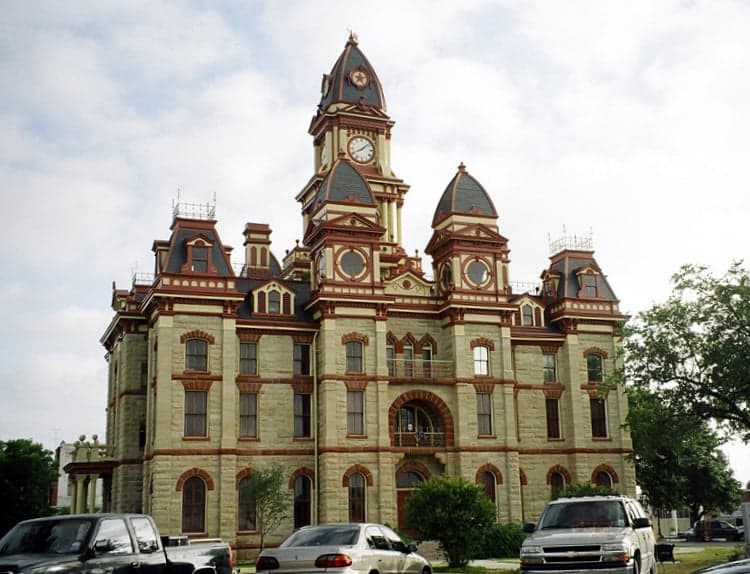
Photo: Wikipedia
Personal Sovereignty in Caldwell County
Strong independent fundamentals that actively favor personal liberty and low regulation.
What does Personal Sovereignty tell us?
Personal Sovereignty measures your capacity for self-reliance and independence with minimal government friction. Higher scores mean fewer barriers between you and the way you want to live... but it assumes you have the space you need and good neighbors.
What does this tell us?
Personal Sovereignty measures your capacity for self-reliance and independence with minimal government friction. Higher scores mean fewer barriers between you and the way you want to live... but it assumes you have the space you need and good neighbors.
State Policy
Energy independence: Net exporter (220% of energy produced in-state)
Personal Liberty
Homesteading

Personal Liberty Analysis
Caldwell County, Texas, offers a notably high degree of personal sovereignty relative to the Austin metro area it borders, with a regulatory environment that leans heavily toward individual autonomy. While the county is experiencing growth pressures from nearby San Marcos and Austin, its rural character and local governance structures preserve a strong sense of self-reliance. For individuals and families prioritizing freedom from overreach, the county presents a compelling balance of low taxes, permissive gun laws, and viable homesteading options, though the degree of autonomy varies significantly between the county seat of Lockhart and smaller communities like Luling and Martindale.
Tax burden and regulatory posture: How property taxes and local rules compare
Caldwell County benefits from Texas’s lack of a state income tax, but the property tax burden is a key consideration. The county’s effective property tax rate hovers around 2.0–2.2% of assessed value, which is moderate for the state but higher than in more rural counties to the west. However, the regulatory posture is notably light-touch. The county has no comprehensive zoning code outside of incorporated cities, meaning unincorporated areas—such as those near McMahan or Fentress—allow for a wide range of land uses without bureaucratic hurdles. Lockhart and Luling have their own zoning ordinances, but these are generally permissive compared to Austin’s strict land-use rules. For example, Lockhart’s city council has resisted aggressive annexation and density mandates, preserving a small-town feel. The county’s tax assessor-collector office is known for efficient, no-nonsense processing, and there are no county-level business license requirements for most small operations. This combination of moderate taxes and minimal red tape makes Caldwell County attractive for those who want to avoid the regulatory creep seen in Travis County.
Self-defense and gun law specifics: What the Second Sanctuary designation means
Caldwell County is a strong Second Amendment jurisdiction, having passed a Second Amendment Sanctuary resolution in 2021. This symbolic but meaningful stance signals that local law enforcement will not enforce any future state or federal gun control measures deemed unconstitutional. In practice, this means that open carry of handguns is widely accepted, and concealed carry permit holders face no unusual restrictions. The county sheriff’s office, led by Sheriff Tony Crumley, has publicly stated its commitment to protecting gun rights. For residents, this translates to a culture where firearms are a normal part of daily life. Shooting ranges are accessible near Lockhart and Luling, and there are no county-level restrictions on magazine capacity or firearm types. The legal climate for self-defense is further bolstered by Texas’s Castle Doctrine and Stand Your Ground laws, which apply fully in Caldwell County. For those moving from restrictive states, the contrast is stark: no waiting periods, no handgun roster, and no requirement to register firearms. The county’s gun-friendly environment is a major draw for individuals who view self-defense as a fundamental personal responsibility.
Self-reliance and homesteading viability: Lot sizes, zoning, and off-grid feasibility
Homesteading and off-grid living are highly viable in Caldwell County, particularly in its unincorporated areas. Minimum lot sizes in the county’s rural zones are typically 1 to 5 acres, with no county-wide minimum for septic systems beyond state health requirements. This allows for small-scale farming, livestock, and even alternative energy setups. Communities like Martindale and Dale are known for their mix of hobby farms and off-grid homes, where solar panels and rainwater collection are common. The county does not prohibit composting toilets or greywater systems, though they must meet Texas Commission on Environmental Quality standards. Zoning in unincorporated areas is virtually nonexistent, meaning you can build a workshop, keep chickens, or operate a small farm stand without permits. However, within Lockhart and Luling, city ordinances may restrict livestock and require building permits. For those seeking maximum self-reliance, the area around Stairtown offers large parcels (10+ acres) with minimal oversight. The county’s agricultural exemption for property taxes further incentivizes homesteading, reducing tax burdens for those who use land for farming or ranching. Overall, Caldwell County is one of the more permissive areas within commuting distance of Austin for off-grid living.
Personal liberties: Parental rights, medical autonomy, speech, and property
Caldwell County’s culture strongly supports parental rights in education and medical decisions. The local school districts—Lockhart ISD, Luling ISD, and Prairie Lea ISD—have generally resisted controversial curriculum mandates, and school board meetings are often forums for parental input. There is no county-level mask or vaccine mandate, and medical autonomy is respected, with several direct-primary-care clinics operating in Lockhart and Luling. Free speech is robustly protected; the county has no noise ordinances that restrict political or religious expression, and public protests are uncommon but tolerated. Property rights are a cornerstone of local governance. The county’s appraisal district is known for being responsive to homestead exemption appeals, and there are no county-level rent control or short-term rental bans outside of city limits. In Lockhart, short-term rentals are regulated but not prohibited, while Luling has a more hands-off approach. For those who value the ability to use their property as they see fit—whether for a home business, a workshop, or a family compound—Caldwell County’s light regulatory touch is a clear advantage over more urbanized areas.
In the broader context of Central Texas, Caldwell County stands out as a bastion of personal sovereignty. Compared to Travis County’s dense regulations and high taxes, or Hays County’s growing restrictions, Caldwell offers a more permissive environment for those who prioritize autonomy. The county’s combination of low regulatory burden, strong gun rights, homesteading viability, and respect for personal liberties makes it a strong choice for conservative-leaning individuals and families seeking a self-reliant lifestyle. While growth pressures from the I-35 corridor may eventually shift the balance, for now, Caldwell County remains a place where personal freedom is the default, not the exception.

* Values derived from national, state, county, city and local statistics and may differ in a specific area. Last updated: 2026-06-18T04:15:41.000Z
Narrative content on this page is AI-generated and may contain mistakes. Verify any details that matter before acting on them.
ReloMaps may earn a commission from affiliate links at no extra cost to you.

