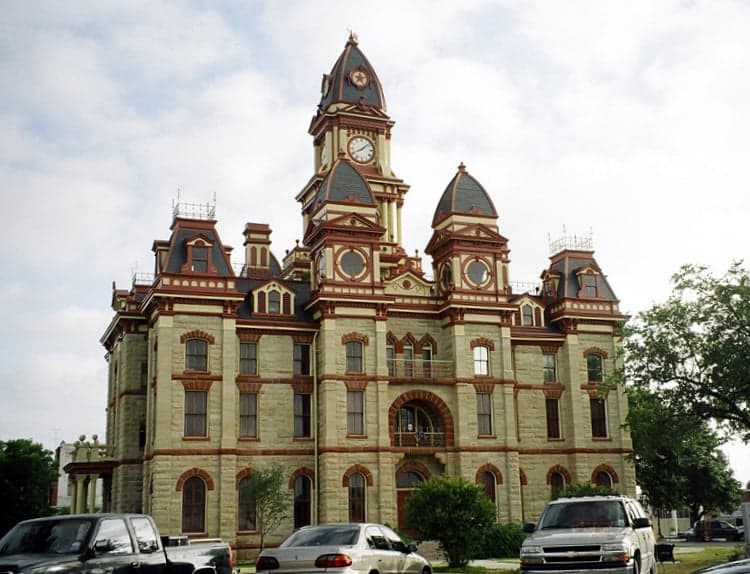
Photo: Wikipedia
Demographics of Caldwell County
Affluence Level in Caldwell County
A middle-class area roughly in line with national averages across income, home values, education, and employment.
People of Caldwell County
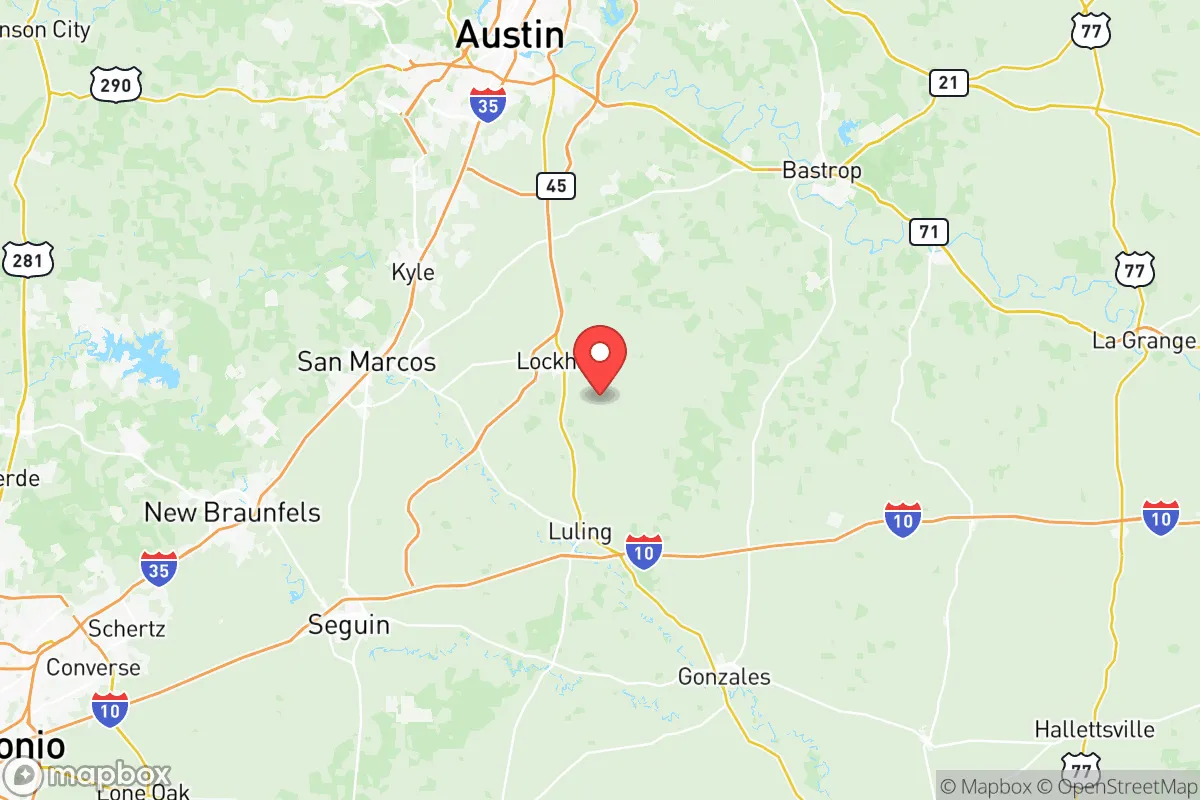
The people of Caldwell County, Texas, today form a predominantly Hispanic (56.3%) and working-class community of 47,184 residents, anchored by the county seat of Lockhart and the smaller towns of Luling, Martindale, and Uhland. With a foreign-born population of 9.0% and a college attainment rate of just 16.4%, the county is characterized by a strong agricultural and industrial heritage, a growing Latino majority, and a relatively small but stable Black and White population. Its identity is rooted in a history of ranching, cotton, and oil, now evolving into a bedroom community for Austin and San Antonio commuters.
Settlement & growth (pre-1960)
Before Anglo-American settlement, the area now known as Caldwell County was inhabited by the Tonkawa and Lipan Apache peoples, who used the region's rivers and prairies for seasonal hunting. Spanish and Mexican land grants in the early 1800s brought a few ranching families, but sustained European-American settlement began only after Texas independence in 1836. The county was formally created in 1848 from parts of Bastrop and Gonzales counties, named after Mathew Caldwell, a signer of the Texas Declaration of Independence.
The first major wave of settlers were Anglo-Americans from the U.S. South, primarily from Tennessee, Kentucky, and the Deep South, who arrived in the 1840s and 1850s. They were drawn by cheap land grants and the promise of cotton cultivation along the fertile bottomlands of the San Marcos River. Lockhart, founded in 1848, became the county seat and a trading hub for cotton and cattle. These early settlers were overwhelmingly Protestant, slaveholding, and Democratic in the antebellum period.
A second wave arrived after the Civil War, when freed African Americans established small farming communities, particularly around the Martindale and Luling areas. By 1880, Black residents made up roughly 25% of the county's population, working as sharecroppers and tenant farmers. The arrival of the railroad in the 1870s spurred the growth of Luling as a shipping point for cotton and cattle, and later for oil after the 1922 Luling oil boom. That boom brought a transient influx of Anglo and Mexican laborers to work the oil fields, with many Mexican families settling permanently in Luling's east side.
The Great Depression and Dust Bowl of the 1930s pushed more Anglo families out of the rural South and into Caldwell County, but the county's population actually declined slightly as mechanized agriculture reduced the need for farm labor. By 1950, the county's population was roughly 60% White, 20% Black, and 20% Hispanic, with the Hispanic share concentrated in Lockhart and Luling as migrant farmworkers transitioned to permanent residence.
Modern era (post-1965)
The 1965 Hart-Cellar Act had a modest direct effect on Caldwell County, as the area was not a primary destination for the post-1965 immigration waves that reshaped Houston or Dallas. Instead, the county's demographic transformation since 1965 has been driven by two forces: domestic migration from the Rust Belt and coastal California, and natural increase among the existing Hispanic population.
Beginning in the 1970s, Anglo families from the Midwest and Northeast began moving to Caldwell County for lower housing costs and a slower pace of life, settling in new subdivisions around Lockhart and Uhland. This was a trickle, not a flood, and the county remained overwhelmingly rural. More significantly, the Hispanic population grew from about 20% in 1970 to over 56% today, driven by high birth rates and continued immigration from Mexico and Central America. Many of these families settled in Lockhart's historic barrio and in Luling, where they work in construction, meatpacking, and service industries.
The Black population, which peaked at around 25% in 1900, has declined to 4.1% today, as younger generations moved to larger cities like Austin and San Antonio for better economic opportunities. The Asian population remains tiny at 0.6%, and the Indian-subcontinent population is negligible at 0.1%. The White (non-Hispanic) share has fallen from roughly 60% in 1970 to 35.6% today, as older Anglo residents age and younger families are replaced by Hispanic households.
Suburbanization from Austin and San Antonio accelerated after 2000, with new subdivisions sprouting in Martindale and Uhland for commuters seeking affordable housing within an hour's drive of both metro areas. This has brought a small influx of younger, more educated Anglo and Asian professionals, but the county's college attainment rate remains low at 16.4%, reflecting its working-class character.
The future
Caldwell County is projected to become more Hispanic and more suburban over the next 10-20 years. The Hispanic share is likely to rise from 56% to 65-70% by 2040, driven by natural increase and continued immigration from Latin America. The White share will continue to decline, while the Black and Asian shares are expected to remain stable or grow only slightly as Austin's housing costs push more diverse populations southward.
New residential development is concentrating in the Lockhart and Uhland corridors along Highway 130, where master-planned communities are attracting families priced out of Austin. This will slowly raise the county's educational attainment and income levels, but Caldwell County is unlikely to become a majority-college-educated area in the near term. The county's cultural identity is evolving from a rural, Anglo-dominated ranching and oil community to a bilingual, working-class Hispanic suburb with a strong sense of local tradition.
For someone moving in now, Caldwell County offers a lower-cost, slower-paced alternative to Austin, with a growing Hispanic cultural presence and a still-strong rural character. The population is becoming more diverse in terms of ethnicity, but remains relatively homogeneous in terms of class and education. The next decade will likely see continued suburbanization, a gradual increase in Asian and Black residents, and a deepening of the county's Latino identity, while the Anglo population ages and declines in relative share.

* Values derived from national, state, county, city and local statistics and may differ in a specific area. Last updated: 2026-06-18T04:15:41.000Z
Narrative content on this page is AI-generated and may contain mistakes. Verify any details that matter before acting on them.
ReloMaps may earn a commission from affiliate links at no extra cost to you.

