Political ClimatePolitical Climate in St Albans, VT
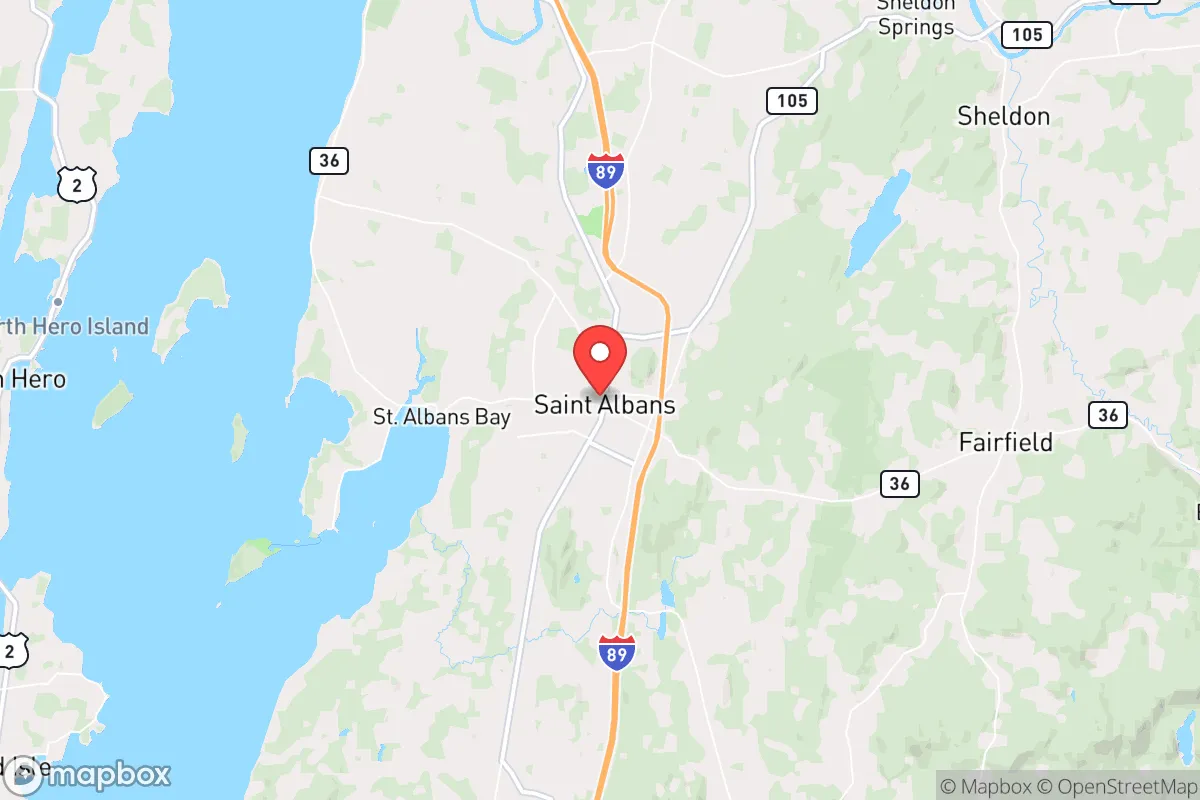
District shown is the primary district for this city’s centroid. Cities may span multiple districts.
Inherited from parent state — no local data available.
Local Political AnalysisPolitical Analysis of St Albans, VT
St. Albans, Vermont, has long been a bit of a political outlier within a deeply blue state. While Vermont as a whole carries a Cook PVI of D+17, making it one of the most reliably Democratic states in the country, St. Albans and the surrounding Franklin County have a much more moderate-to-conservative reputation. The city itself leans slightly left in presidential elections, but the county has voted for Republican governors and senators more often than almost anywhere else in the state. Over the last decade, the area has shifted slightly leftward with an influx of remote workers from Chittenden County, but it still feels noticeably more purple than Burlington or Montpelier.
How it compares
The contrast between St. Albans and the rest of Vermont is starkest when you look at the rural-urban divide. Neighboring Burlington, just 30 miles south, is a progressive stronghold with a D+30 lean, while towns like Enosburg and Swanton to the north and west are reliably Republican at the local level. St. Albans sits right in the middle — it's the county seat and the largest population center, so it attracts a mix of state workers, dairy farmers, and new arrivals from out of state. In the 2022 gubernatorial race, Franklin County gave Republican Phil Scott over 60% of the vote, while the state average was closer to 55%. That gap is real, and it shows up in local school board and selectboard races too, where nonpartisan candidates often split along cultural lines.
What this means for residents
For conservative residents, St. Albans offers a rare pocket where their views aren't automatically dismissed. You'll find plenty of Trump signs in the surrounding farm country, and the local gun culture is strong — the annual Vermont Gun Owners' rally draws a crowd from all over the county. For liberal residents, the city itself is generally welcoming, with a growing number of young families and remote workers pushing for more bike lanes, local food systems, and climate action. The practical effect is that most local debates — from school budgets to zoning reforms — are genuinely contested, not predetermined by party affiliation. Property taxes are a perennial flashpoint, with conservative voters pushing back against school spending increases that liberal residents see as necessary investments.
One thing that hasn't changed much is the area's independent streak. St. Albans has a long history of electing moderate Republicans and conservative Democrats to local office, and party labels matter less than a candidate's stance on local issues like the Lake Champlain cleanup or downtown revitalization. The city's small size — around 7,000 people — means that most political disagreements happen face-to-face at the hardware store or the farmers market, not through partisan media echo chambers. That keeps things civil, even when opinions are far apart.

State Political ClimatePolitical Climate in Vermont
State Political AnalysisPolitical Environment in the State
Vermont is one of the most reliably Democratic states in the nation, with a Cook Partisan Voting Index of D+17, meaning it votes about 17 points more Democratic than the country as a whole. But that number hides a much more complicated reality: the state has a deep urban-rural split, a strong libertarian streak on local issues, and a Republican governor who has won repeatedly in a legislature dominated by Democrats and Progressives. Over the last 20 years, the state has shifted left on social and environmental policy, but it has also seen a growing conservative backlash in the more rural, northern, and eastern counties — places like Orleans, Essex, and Rutland — that feel left behind by the Burlington-dominated political machine.
Urban vs. rural divide
The political map of Vermont is essentially a story of Chittenden County versus everything else. Chittenden County, home to Burlington, South Burlington, and Winooski, is the state’s Democratic stronghold — it cast about 75% of its vote for Joe Biden in 2020. Burlington itself is a classic college town with the University of Vermont and Champlain College, and it drives the state’s progressive energy, including the Vermont Progressive Party, which holds seats in the legislature and city council. Drive an hour east to the Northeast Kingdom — towns like Newport, St. Johnsbury, and Island Pond — and you’ll find a very different world: more rural, more working-class, and reliably Republican at the local level. In 2020, Donald Trump won Essex County by 18 points and Orleans County by 12. The divide isn’t just partisan; it’s cultural. The rural areas resent the tax-and-regulate attitude coming out of Montpelier and Burlington, while the urban core sees those areas as backward on climate and social issues. The suburbs — places like Williston, Colchester, and Essex Junction — are the swing ground, trending Democratic but with a significant moderate Republican presence.
Policy environment
Vermont’s policy environment is shaped by a Democratic supermajority in the legislature and a Republican governor, Phil Scott, who has vetoed many of the most progressive bills. The result is a state that is high-tax but not as far-left as its legislative majority would suggest. Vermont has a progressive income tax with rates up to 8.75%, and property taxes are among the highest in the nation, driven largely by school funding. There is no sales tax on most goods, but there is a 6% sales tax on prepared food, lodging, and some other items. The state has a single-payer healthcare system in name — Green Mountain Care — but it’s not fully implemented; instead, Vermont runs a state-based health insurance exchange and has some of the highest per-capita healthcare costs in the country. On education, Vermont spends more per pupil than almost any other state, and it has a school choice system that includes public schools, independent schools, and homeschooling options, though the latter has faced increasing regulation. Election laws are among the most accessible in the nation: Vermont has same-day voter registration, no-excuse absentee voting, and automatic voter registration at the DMV. Gun laws are relatively strict: universal background checks, a 10-round magazine limit, a red flag law, and a ban on carrying firearms in public buildings and schools. There is no permitless carry, and the state does not recognize out-of-state concealed carry permits from most states.
Recent policy direction
In the last few years, Vermont has moved decisively left on several fronts, but with notable exceptions. In 2023, the legislature passed a bill creating a state-run retirement savings program for private-sector workers without access to a 401(k), and in 2024, it passed a law requiring all new residential buildings to be heated with electric heat pumps by 2030 — a major step in the state’s aggressive climate goals. On gun policy, the legislature passed a ban on carrying firearms in hospitals, schools, and state buildings in 2024, overriding Governor Scott’s veto. On parental rights, Vermont has been a flashpoint: in 2023, the legislature passed a law requiring schools to notify parents if a student changes their name or pronouns, but it was vetoed by Scott and the veto was sustained. The state also passed a law in 2024 banning conversion therapy for minors, and it has some of the strongest abortion protections in the country, including a 2022 law that codified the right to abortion and contraception into state law. On property rights, Vermont has a statewide land-use law, Act 250, that is widely seen as restrictive and has been a source of tension between developers and conservationists. On voting, the state passed a law in 2023 that allows 16- and 17-year-olds to pre-register to vote, and it has no voter ID requirement — a point of contention for conservatives who worry about election integrity. On privacy and surveillance, Vermont has a strong data privacy law, and it was one of the first states to ban the use of facial recognition technology by law enforcement without a warrant.
Civil unrest & political movements
Vermont is not known for large-scale civil unrest, but it has its share of political activism. The most visible flashpoint in recent years has been around the issue of homeless encampments in Burlington, which led to clashes between the city and activists over the right to camp in public spaces. In 2023, the city of Burlington passed an ordinance banning camping on public property, which was met with protests and legal challenges. On the right, the Vermont Republican Party has been energized by the issue of parental rights in education, and there have been small but vocal protests at school board meetings over curriculum and library books. The state has a small but active secessionist movement — the Second Vermont Republic — which advocates for Vermont to leave the United States, but it has no real political power. On immigration, Vermont is not a sanctuary state in the legal sense, but Burlington has a "Welcoming City" ordinance that limits cooperation with federal immigration enforcement. There have been no major election integrity controversies in Vermont; the state’s all-mail voting system has been widely accepted, and there is no evidence of widespread fraud. The most notable political movement in recent years has been the rise of the Vermont Progressive Party, which holds about 10% of the seats in the legislature and has pushed for a state-level wealth tax and a single-payer healthcare system.
Projection
Over the next 5-10 years, Vermont is likely to continue its leftward drift on social and environmental policy, but the pace will be moderated by Governor Scott’s veto power and the state’s fiscal constraints. The biggest demographic trend is the influx of remote workers from New York and Boston, who are driving up housing prices in Chittenden County and the southern part of the state, particularly around Brattleboro and Bennington. This in-migration is likely to make the state more Democratic, as these newcomers tend to be younger and more liberal. However, the rural areas are also seeing an influx of conservative-leaning retirees and second-home owners, particularly in the Northeast Kingdom and the southern Green Mountains. The state’s population is aging and shrinking overall, which will put pressure on the tax base and could lead to a backlash against high property taxes. The most likely scenario is that Vermont remains a D+15 to D+20 state, with the urban-rural divide deepening. A new resident moving in now should expect to live in a state where the government is actively involved in your life — from your heating system to your child’s school curriculum — but where the pace of change is slow enough that you can still find plenty of space to live as you please, especially if you’re willing to live outside the Burlington orbit.
For a conservative-leaning individual or family, Vermont offers a mixed bag: low crime, beautiful scenery, and a strong sense of community in the rural areas, but high taxes, restrictive gun laws, and a political culture that can feel hostile to traditional values. If you’re moving here, the practical takeaway is to choose your town carefully — a place like Stowe or Manchester might feel welcoming, while Burlington or Montpelier will feel like a different country. The state’s political trajectory is unlikely to change dramatically, so you should be comfortable with a government that is active, expensive, and increasingly progressive, even if the day-to-day reality in your town is more moderate.
* Values derived from national, state, county, city and local statistics and may differ in a specific area. Last updated: 2026-10-21T14:33:53.000Z
Narrative content on this page is AI-generated and may contain mistakes. Verify any details that matter before acting on them.
ReloMaps may earn a commission from affiliate links at no extra cost to you.

