Photo: Wikipedia
Political ClimatePolitical Climate in Spanish Fort, AL
District shown is the primary district for this city’s centroid. Cities may span multiple districts.
Local Political AnalysisPolitical Analysis of Spanish Fort, AL
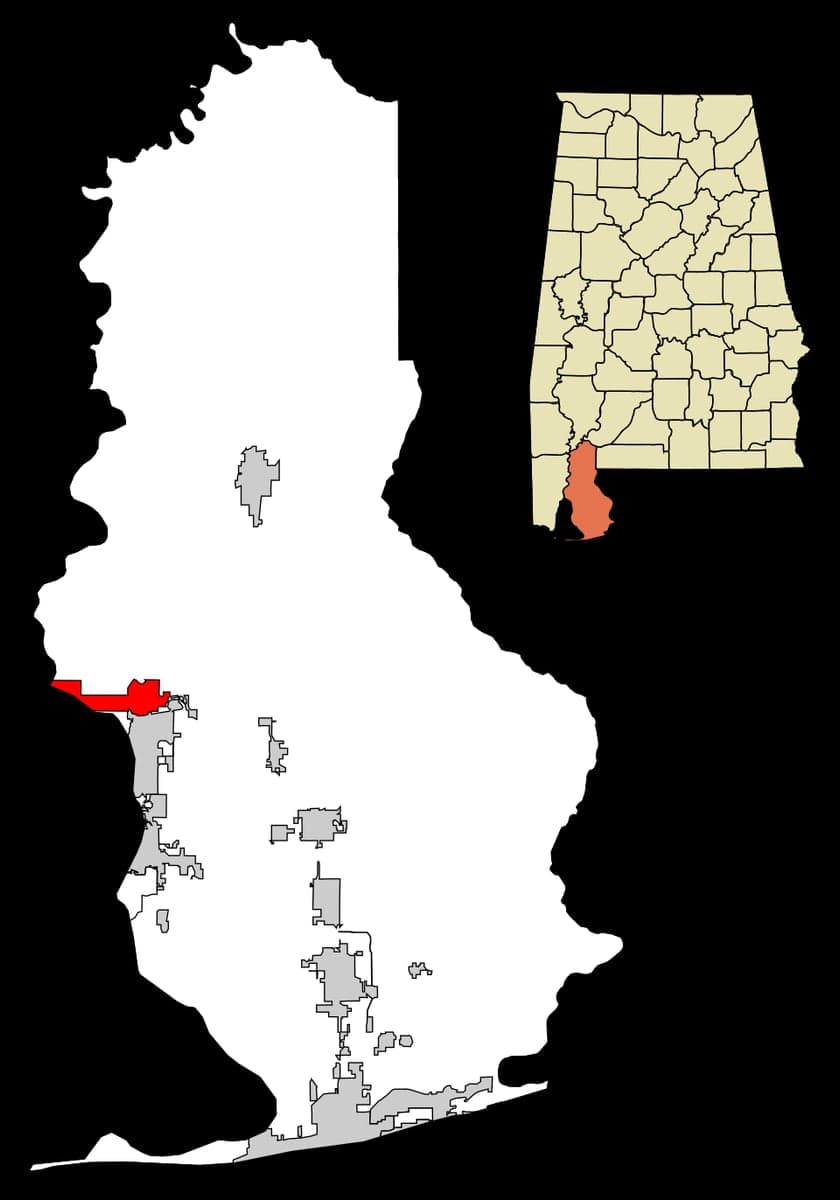
Spanish Fort is one of the most reliably Republican areas in Alabama, anchored by a Cook Partisan Voting Index (PVI) of R+27, meaning it votes about 27 points more Republican than the national average. That’s not just a red dot on a map; it’s a deep, consistent shade of crimson that has only deepened over the last decade. The city sits in Baldwin County, which has been a GOP stronghold for generations, and the trend is accelerating as new residents—many from more conservative parts of the Midwest and Florida Panhandle—move into the master-planned subdivisions along the Eastern Shore. If you look at the 2024 presidential race, Baldwin County went roughly +35 for the Republican ticket, and Spanish Fort itself likely ran even higher than that. The trajectory is clear: this area is getting redder, not bluer, as the population grows and the local economy booms.
How it compares
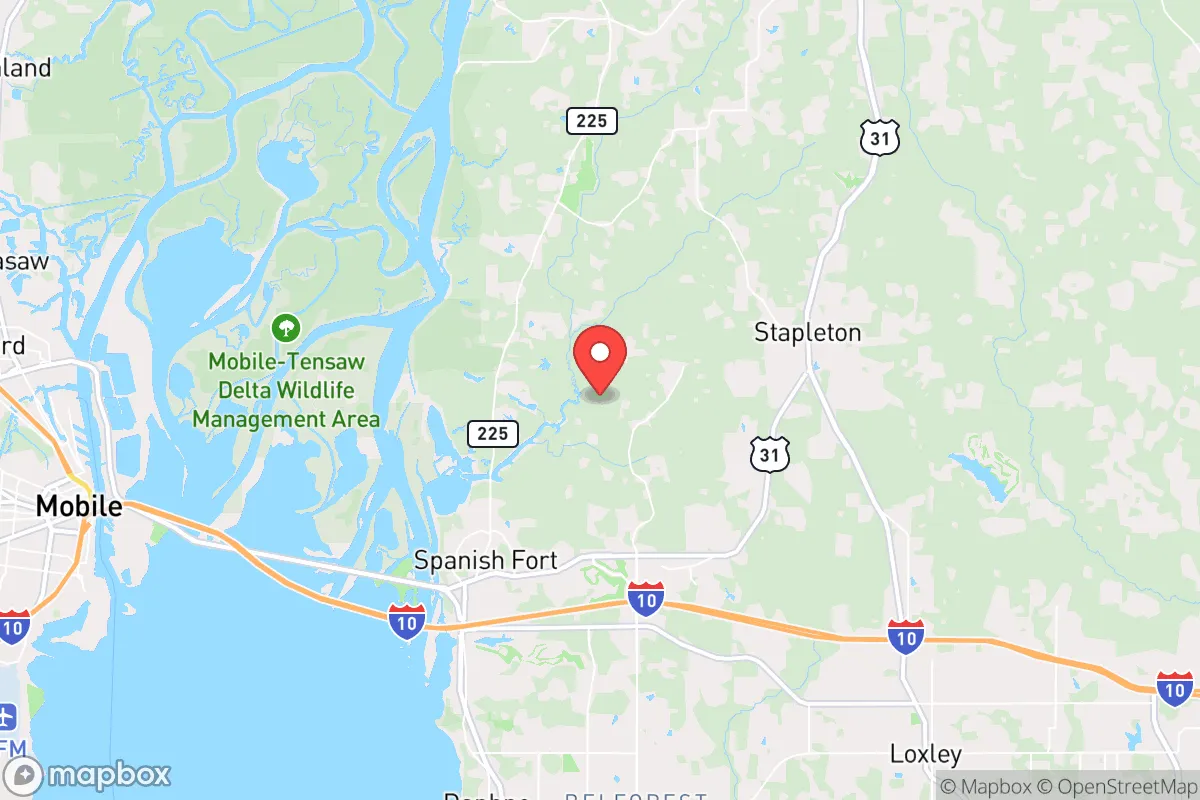
Compared to the rest of Alabama, Spanish Fort is an outlier in its intensity. The state as a whole is solidly Republican—Alabama’s Cook PVI is unknown in the data you provided, but historically it sits around R+15 to R+17, depending on the cycle. That means Spanish Fort is roughly 10 to 12 points more Republican than the state average. For context, that’s like the difference between a reliably red state and a deep-red county within it. Nearby cities like Mobile (just across the bay) lean more moderate, with a Cook PVI closer to R+10, and parts of downtown Mobile have even voted for Democratic candidates in local races. Daphne and Fairhope, the other two big Eastern Shore towns, are also very red but slightly less intense than Spanish Fort—Fairhope has a small but vocal progressive community, while Spanish Fort’s politics are more uniformly conservative. The contrast is sharpest when you cross the bay into Mobile County, where the city of Mobile itself has a sizable Black population and a more competitive local political scene. In Spanish Fort, you just don’t see that kind of split.
What this means for residents
For conservative residents, the political climate is a comfortable fit. Local government, school board decisions, and zoning policies tend to reflect a limited-government, pro-business ethos. Taxes are low (Baldwin County has one of the lowest property tax rates in the state), and there’s little appetite for new regulations on development or housing. For liberal residents, the reality is more isolating. You’re unlikely to find many like-minded neighbors in the HOA meetings or at the local coffee shop, and national political conversations can feel one-sided. That said, the area is not hostile—people are generally polite, and the “live and let live” attitude of the Gulf Coast means most folks keep politics at the dinner table. The practical effect is that liberal residents often drive to Mobile for cultural events, progressive church communities, or political organizing, while conservatives enjoy a local ecosystem of GOP clubs, conservative churches, and business networks that align with their values.
One cultural distinction worth noting: Spanish Fort’s politics are deeply tied to its identity as a family-oriented, suburban bedroom community. There’s a strong emphasis on school quality (the Spanish Fort school system is consistently top-rated in the state), low crime, and property rights. You won’t find the same kind of rural populism or anti-government sentiment that you might in parts of north Alabama or the Wiregrass. Instead, it’s a more suburban, country-club conservatism—pro-business, pro-military (the area has a strong Navy and Coast Guard presence), and generally supportive of local infrastructure spending as long as it doesn’t raise taxes. The long-term outlook is for this to continue: as more families move in from out of state, the political character will likely stay the same, just with a slightly more affluent, educated flavor. If you’re moving here, know that the politics are baked into the lifestyle—but they’re also predictable, which for many people is a feature, not a bug.

State Political ClimatePolitical Climate in Alabama
State Political AnalysisPolitical Environment in the State
Alabama is one of the most reliably Republican states in the country, with a deep-red lean that has only solidified over the past 20 years. The state hasn’t voted for a Democratic presidential candidate since 1976 (Jimmy Carter), and in 2024, Donald Trump carried it by roughly 30 points. The dominant coalition is a mix of rural white evangelicals, suburban conservatives, and a growing number of transplants from other red states, while the Democratic base is overwhelmingly concentrated among Black voters in the Black Belt and a handful of urban centers. Over the last decade, the shift has been subtle but real: the rural areas have gotten redder, the suburbs have held steady, and the cities have become more reliably blue, creating a sharper urban-rural divide than at any point since the 1960s.
Urban vs. rural divide
The political map of Alabama is a study in contrasts. The state’s largest metro, Birmingham (Jefferson County), is a Democratic stronghold—Jefferson County went for Joe Biden by about 20 points in 2020 and has trended bluer as the city’s professional class and Black population have grown. Montgomery and Mobile are more competitive but still lean Democratic at the county level, driven by Black voters and a shrinking white working-class base. Meanwhile, the rural Black Belt counties—like Greene, Sumter, and Macon—are among the most Democratic in the nation, often voting 80%+ for Democrats, but they have tiny populations. The real engine of Republican dominance is the sprawling exurban and rural territory: Madison County (Huntsville) is a fascinating exception—it’s a purple-to-light-red area thanks to the high-skill, transplant-heavy workforce at Redstone Arsenal and Cummings Research Park, but it still leans Republican in statewide races. The rest of the state—places like Auburn (Lee County), Tuscaloosa, and the Wiregrass—is solidly red, with rural precincts often hitting 80%+ for Republicans. The divide isn’t just about race; it’s about density and economic base. The few blue pockets are either majority-Black or anchored by universities and tech, while the vast majority of the state’s landmass votes like a deep-red rural stronghold.
Policy environment
Alabama’s policy environment is among the most conservative in the nation, with a low-tax, low-regulation posture that attracts businesses but offers thin public services. There is no state income tax on retirement income, and the state’s top marginal income tax rate (5%) kicks in at just $3,000 of taxable income—meaning most workers pay a flat 5% on earnings above that floor. Property taxes are among the lowest in the country, averaging about 0.4% of home value, which keeps housing affordable but starves local schools. The state has a right-to-work law, no minimum wage above the federal $7.25, and a regulatory climate that the American Legislative Exchange Council (ALEC) consistently ranks as one of the most business-friendly. Education policy is a flashpoint: the state has a robust school choice program (the Alabama Accountability Act and the newly expanded Education Savings Account program), but public school funding per pupil remains near the bottom nationally. Healthcare is a major gap—Alabama did not expand Medicaid under the Affordable Care Act, leaving roughly 300,000 low-income adults in the coverage gap, and rural hospital closures have been a persistent crisis. Election laws are restrictive by national standards: voter ID is required, early voting is limited (no no-excuse absentee voting), and the state has strict rules on ballot harvesting and drop boxes. The state’s abortion ban (the Human Life Protection Act of 2019) is one of the most stringent in the country, with no exceptions for rape or incest.
Recent policy direction
The last five years have seen Alabama double down on conservative priorities across the board. In 2022, the legislature passed a near-total abortion ban (triggered by Dobbs) that makes performing an abortion a Class A felony, with life in prison for providers—no exceptions for rape or incest, only for the life of the mother. Gun laws have been loosened: in 2022, the state passed constitutional carry (permitless carry of a concealed handgun), and there is no state-level red flag law. Parental rights in education gained traction with the 2022 “Don’t Say Gay” style law (the Alabama School Choice and Parental Rights Act), which restricts classroom discussion of sexual orientation and gender identity in K-5. On the privacy front, the state passed a data privacy law (the Alabama Data Breach Notification Act) but it’s weaker than many states—no private right of action. Property rights are strongly protected: the state has a robust eminent domain statute that limits takings, and there’s no statewide rent control. Taxation has been trending downward: in 2023, the legislature cut the state’s grocery tax from 4% to 3% (with a plan to phase it out entirely), and there’s a growing push to eliminate the state income tax entirely, though that’s unlikely in the near term. Voting access has tightened: in 2024, the state passed a law banning curbside voting and limiting the use of drop boxes, and it continues to defend its congressional map against Voting Rights Act challenges. For a relocator, the bottom line is that Alabama is moving in a consistently conservative direction on guns, abortion, education, and taxes, with no sign of a pivot.
Civil unrest & political movements
Alabama has a history of civil rights activism that remains a living part of its political landscape, but large-scale civil unrest is rare. The most visible flashpoints in recent years have been around Confederate monuments and voting rights. In 2020, protests in Birmingham and Montgomery over George Floyd’s death led to the removal of a Confederate monument in Birmingham’s Linn Park (the city paid a $25,000 fine to the state for doing so, under the Alabama Memorial Preservation Act). The state’s immigration politics are hardline: there is no sanctuary city policy anywhere in Alabama, and the 2011 HB 56 (the Beason-Hammon Alabama Taxpayer and Citizen Protection Act) remains one of the toughest anti-immigration laws in the country, though parts were struck down in court. Election integrity controversies have been a recurring theme: in 2022, the state’s congressional map was struck down for diluting Black voting power, leading to a court-ordered redraw that created a second majority-Black district (the 7th) for the 2024 cycle. There’s a small but vocal secessionist/nullification movement on the far right, but it has no serious political traction. A new resident would notice that political activism is mostly channeled through churches, local civic groups, and the state legislature—street protests are uncommon outside of college towns like Tuscaloosa and Auburn. The most visible political movements are the pro-life and school choice coalitions, which are well-organized and influential in the statehouse.
Projection
Over the next 5-10 years, Alabama’s political trajectory is likely to remain deeply conservative, but with some demographic wrinkles. The state is growing slowly (about 1% per year), and the growth is concentrated in the Huntsville metro, which is attracting a younger, more educated, and slightly more moderate population. Huntsville’s shift from red to purple could make the 5th Congressional District more competitive, but it won’t flip the state. The Black Belt is losing population, which further dilutes the Democratic base. In-migration is mostly from other red states (Florida, Georgia, Texas), so new arrivals are reinforcing the conservative lean. The biggest wildcard is the ongoing Voting Rights Act litigation: if courts force the creation of a second majority-Black district, it could flip one or two U.S. House seats to Democrats, but it won’t change the state-level balance of power. On policy, expect continued tax cuts (especially on income and groceries), further expansion of school choice, and no movement on Medicaid expansion. The abortion ban is unlikely to be softened unless federal law changes. A relocator moving in now should expect that in a decade, Alabama will be slightly more diverse in its urban centers, but the state as a whole will be just as red—possibly redder—with a policy environment that remains among the most conservative in the country.
For someone moving to Alabama, the practical takeaway is straightforward: if you align with conservative values on taxes, guns, abortion, and education, you’ll find a state that is actively moving in your direction. If you’re a liberal, you’ll be in a clear minority, but you’ll find like-minded communities in Birmingham, Montgomery, and Huntsville. The state’s low cost of living and business-friendly climate are real advantages, but they come with trade-offs in public services, especially healthcare and education. The political climate is stable, predictable, and unlikely to surprise you—Alabama is what it looks like, and it’s not changing anytime soon.
* Values derived from national, state, county, city and local statistics and may differ in a specific area. Last updated: 2026-08-18T00:28:01.000Z
Narrative content on this page is AI-generated and may contain mistakes. Verify any details that matter before acting on them.
ReloMaps may earn a commission from affiliate links at no extra cost to you.

