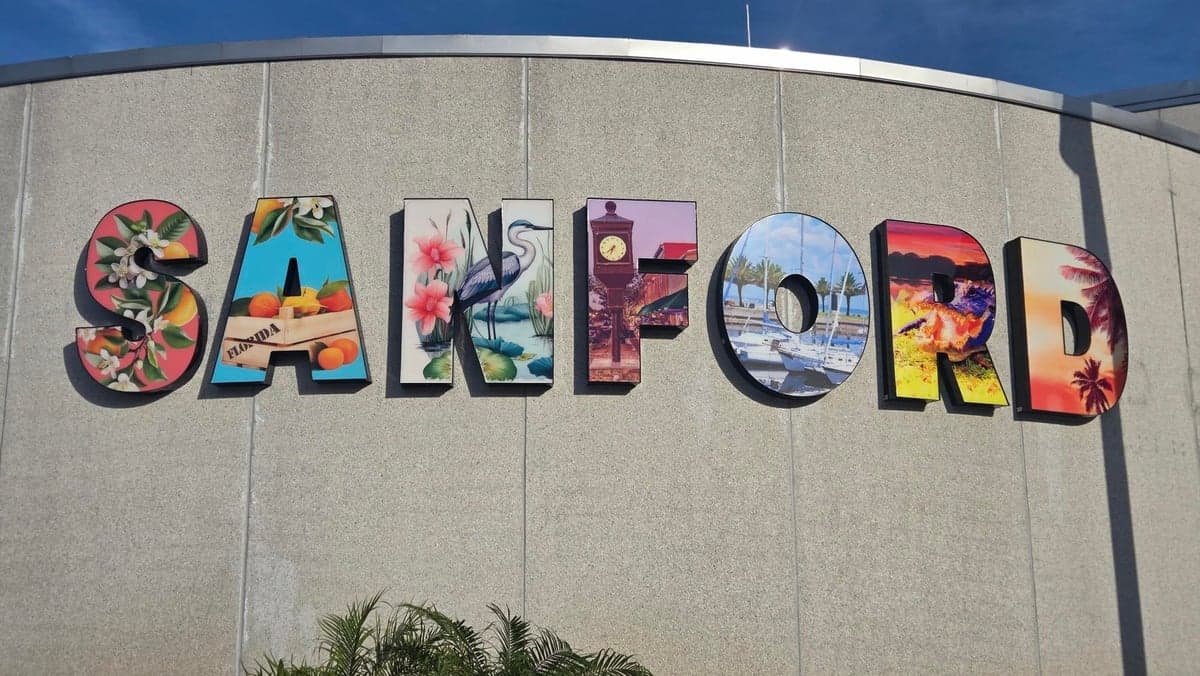
Photo: Wikipedia
Political ClimatePolitical Climate in Sanford, FL
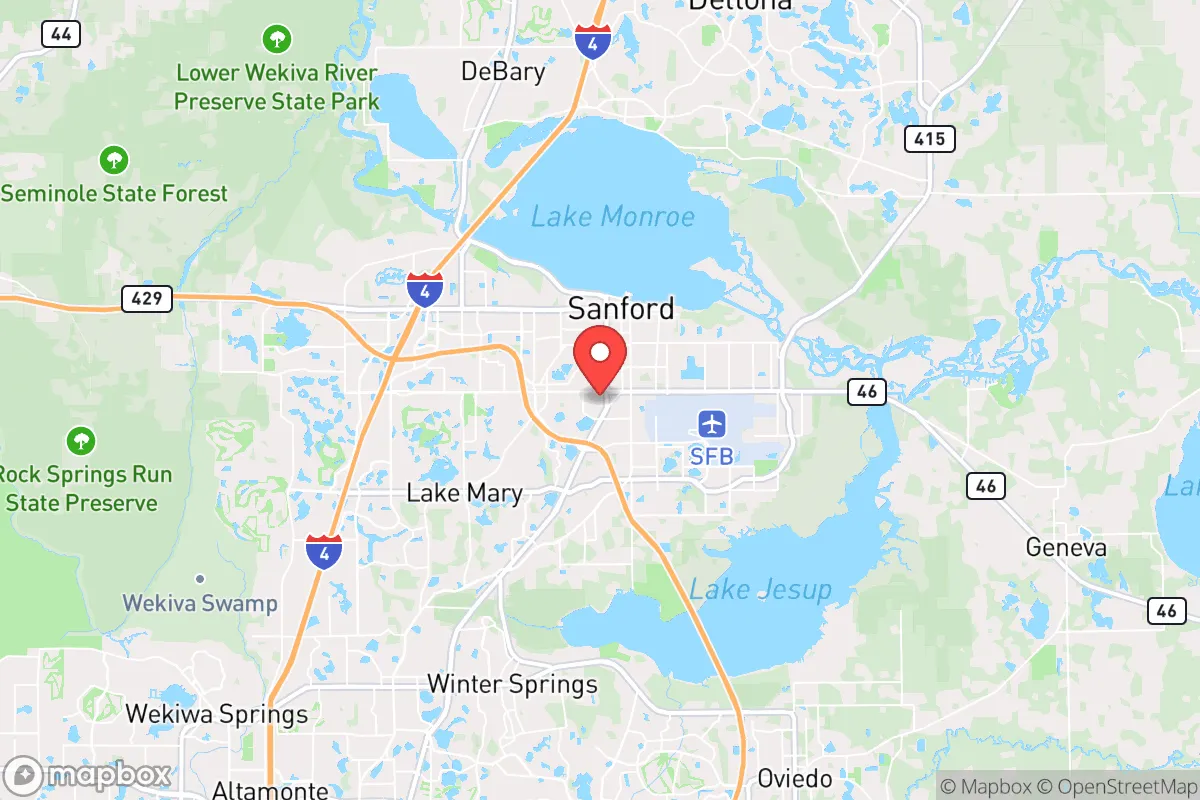
District shown is the primary district for this city’s centroid. Cities may span multiple districts.
Local Political AnalysisPolitical Analysis of Sanford, FL
Sanford, Florida, sits in a reliably Republican part of the state, with a Cook PVI of R+5, meaning the area votes about five points more Republican than the national average. But if you’ve lived here a while, you know that number only tells part of the story. The city itself has been trending bluer in recent cycles, especially in local races, while the unincorporated parts of Seminole County and the bedroom communities to the north and east remain deeply red. It’s a classic Florida split: a historic river town with a growing Democratic base surrounded by suburbs that lean hard right.
How it compares
Compared to the rest of Florida, Sanford is more conservative than Orlando (just 20 minutes south, a solidly blue city) but noticeably more moderate than nearby towns like Lake Mary or Heathrow, where Republican registration often tops 50%. In the 2024 presidential race, Seminole County as a whole went for Trump by about 8 points, but Sanford’s precincts were closer to a 50-50 split. That’s a shift from even 2016, when the city leaned red by a wider margin. The surrounding state-level data is murky—Florida’s overall Cook PVI is listed as unknown, but statewide results have been consistently Republican in recent cycles, with Trump winning the state by 3.4 points in 2024. So Sanford is slightly more competitive than the state average, but still sits firmly in the GOP column for federal and statewide contests.
What this means for residents
For conservative residents, Sanford is a comfortable place to live. You’ll find plenty of like-minded neighbors, especially in the newer subdivisions west of I-4, and local Republican clubs are active. The Seminole County Commission has a solid GOP majority, which keeps property taxes relatively low and development-friendly policies in place. For liberal residents, the picture is more nuanced. You’re not isolated—Orlando’s progressive energy is a short drive away—but you’ll feel the political tilt in everyday life. Local school board meetings can get heated over curriculum issues, and city council debates often split along party lines. That said, Sanford’s historic downtown and its growing arts scene have attracted younger, more diverse residents, and the city’s Democratic base is slowly expanding. If you’re liberal, you’ll find your people, but you’ll also need to be comfortable with a community where conservative views are the default in many social and civic settings.
Culturally, Sanford stands out from the surrounding suburbs in a few key ways. The city has a larger African American population (about 30%) than most of Seminole County, and that history shapes local politics—civil rights issues and economic equity get more airtime here than in, say, Winter Springs. The city also has a more relaxed attitude toward small businesses and live music venues, which gives it a slightly bohemian edge compared to the manicured lawns of Heathrow. Policy-wise, Sanford has been slower to adopt the kind of growth restrictions you see in places like Oviedo, and the city government tends to be pragmatic rather than ideological. If you’re moving here, expect a place where the political climate is Republican-leaning but not monolithic, and where the real dividing line is often between the old downtown and the new subdivisions rather than between parties.

State Political ClimatePolitical Climate in Florida
State Political AnalysisPolitical Environment in the State
Florida has transformed from a quintessential swing state into a solidly Republican-leaning powerhouse over the past decade, driven by a massive influx of conservative-leaning migrants from the Northeast and Midwest. The state now consistently votes Republican in statewide elections, with Governor Ron DeSantis winning re-election by nearly 20 points in 2022, and the GOP holding supermajorities in both legislative chambers. This shift is not just a blip—it reflects a deep demographic and cultural realignment that began around 2010 and accelerated sharply after 2020, making Florida a national laboratory for conservative governance.
Urban vs. rural divide
The political map of Florida is a study in stark contrasts. The major urban centers—Miami-Dade, Broward (Fort Lauderdale), and Orange County (Orlando)—remain Democratic strongholds, but their influence is waning. Miami-Dade, once a blue bastion, has been trending right for years; in 2020, Donald Trump won it with 46% of the vote, and by 2022, DeSantis carried the county outright. This shift is driven by Cuban-American and Venezuelan-American voters who lean heavily Republican on foreign policy and economic freedom. Meanwhile, the sprawling suburbs of Tampa (Hillsborough County), Jacksonville (Duval County), and the I-4 corridor (Polk, Volusia, and Seminole counties) have flipped decisively red, powered by families fleeing high-tax states. Rural North Florida—places like Lake City, Ocala, and the Panhandle—is deeply conservative, while the southwest coast (Naples, Fort Myers, Sarasota) is a retiree-heavy Republican stronghold. The only reliably blue pockets left are the core of Miami-Dade, Broward, and Alachua County (Gainesville), home to the University of Florida.
Policy environment
Florida’s policy environment is aggressively pro-business and low-tax, with no state income tax, a corporate tax rate of 5.5%, and a homestead property tax exemption that caps annual assessment increases at 3% for primary residences. The regulatory climate is famously light—permitting for new construction is fast, and occupational licensing has been slashed for dozens of professions. Education policy is a flashpoint: the state has the nation’s largest school voucher program (the Family Empowerment Scholarship), universal school choice, and a ban on “critical race theory” and DEI initiatives in public schools and universities. Healthcare is market-driven, with no state Medicaid expansion under the ACA, a robust telehealth industry, and a growing number of direct-primary-care clinics. Election laws have been tightened: voter ID is required, drop boxes are restricted, and ballot harvesting is banned. The state also has a “stand your ground” self-defense law, a permitless carry law (effective July 2023), and a six-week abortion ban (the Heartbeat Protection Act, signed in 2023).
Recent policy direction
The last three years have seen an avalanche of legislation that defines Florida’s current trajectory. On gun rights, the permitless carry law (HB 543) allows any law-abiding adult to carry a concealed firearm without a permit, while the “stand your ground” statute remains among the broadest in the nation. Parental rights are central: the Parental Rights in Education Act (HB 1557, dubbed “Don’t Say Gay” by critics) restricts classroom instruction on sexual orientation and gender identity through third grade, and a 2023 law bans gender-affirming care for minors. Speech and privacy have been reshaped by the Individual Freedom Act (HB 7), which prohibits workplace training that suggests systemic racism or sexism, and a law requiring social media platforms to allow users to opt out of content moderation. Property rights are strong—Florida has no state-level rent control, and the “Live Local Act” (2023) preempts local zoning to fast-track affordable housing development. Taxation remains low, but sales tax has crept up to 6% (local add-ons can push it to 8.5%). Voting access has been restricted: the 2021 election law (SB 90) limits drop boxes, requires ID for mail ballots, and bans private funding for elections. Medical autonomy is sharply constrained by the six-week abortion ban, though a 2024 ballot initiative (Amendment 4) to enshrine abortion rights up to viability is pending a court challenge.
Civil unrest & political movements
Florida has seen its share of political flashpoints, but large-scale civil unrest is rare. The 2020 Black Lives Matter protests in Miami, Orlando, and Tampa were significant but quickly dissipated, and the state’s “law and order” posture—including the creation of the Office of Election Crimes and Security—has been popular with conservatives. Immigration politics are front and center: Governor DeSantis has bused migrants to Martha’s Vineyard and signed a law (SB 1718) that requires hospitals to ask about immigration status and bans local “sanctuary” policies. This has energized both supporters and opponents, with immigrant-rights groups filing lawsuits. Election integrity remains a hot-button issue: the 2020 election in Florida was widely seen as smooth, but the 2022 law and the creation of a state election police unit have drawn accusations of voter suppression from Democrats. The “Don’t Say Gay” law sparked protests at the state capitol and boycotts from Disney, which led to a high-profile feud with DeSantis and the dissolution of Disney’s special tax district (the Reedy Creek Improvement District). On the right, the “Moms for Liberty” movement has been highly active in school board elections, while on the left, groups like the Florida Rising and the Dream Defenders organize around voting rights and racial justice.
Projection
Over the next 5-10 years, Florida is likely to become more conservative, not less. The in-migration pattern—roughly 1,000 new residents per day, mostly from blue states—favors Republicans, as these newcomers tend to be older, wealthier, and seeking lower taxes and looser regulations. The state’s Hispanic population, now over 26%, is shifting rightward, particularly among Cuban, Venezuelan, and Nicaraguan communities. The GOP’s supermajority in the legislature means that policy will continue to move in the same direction: more school choice, tighter abortion restrictions, expanded gun rights, and further preemption of local government authority. The biggest wild card is climate change—rising sea levels and hurricane risk could eventually slow growth in coastal areas like Miami Beach and the Keys, but inland cities like Ocala, Lakeland, and Gainesville are booming. For a new resident, expect a state that is increasingly ideologically homogeneous at the state level, with local pockets of blue resistance in college towns and dense urban cores. The political culture will remain combative but stable, with no serious threat to GOP dominance for at least a decade.
For a new resident, the bottom line is this: Florida offers a low-tax, low-regulation environment with a strong conservative tilt that affects everything from your child’s education to your healthcare options. If you lean right, you’ll find a government that actively supports your values—school choice, gun rights, and limited bureaucracy. If you lean left, you’ll face an uphill battle on issues like abortion access, LGBTQ+ rights, and voting rules, but you’ll still find vibrant blue communities in Miami, Orlando, and Gainesville. The state is not for everyone, but for those who prioritize economic freedom and a hands-off government, it’s hard to beat. Just be prepared for the heat—both political and meteorological.
* Values derived from national, state, county, city and local statistics and may differ in a specific area. Last updated: 2026-10-15T16:18:29.000Z
Narrative content on this page is AI-generated and may contain mistakes. Verify any details that matter before acting on them.
ReloMaps may earn a commission from affiliate links at no extra cost to you.

