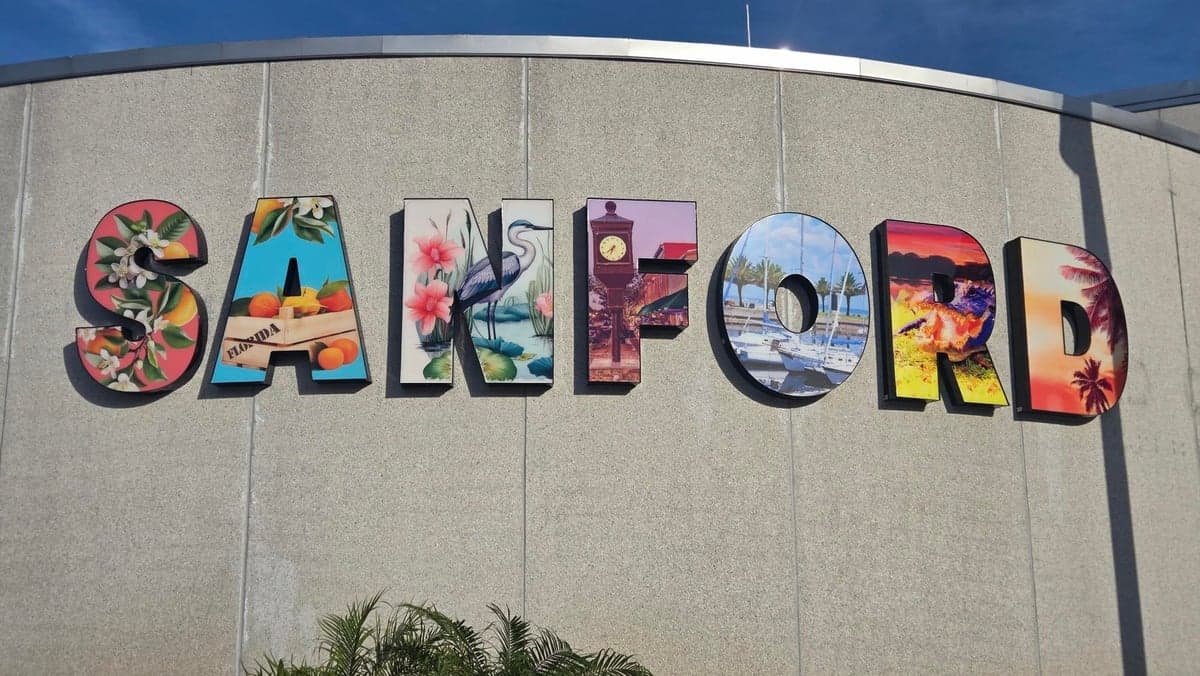
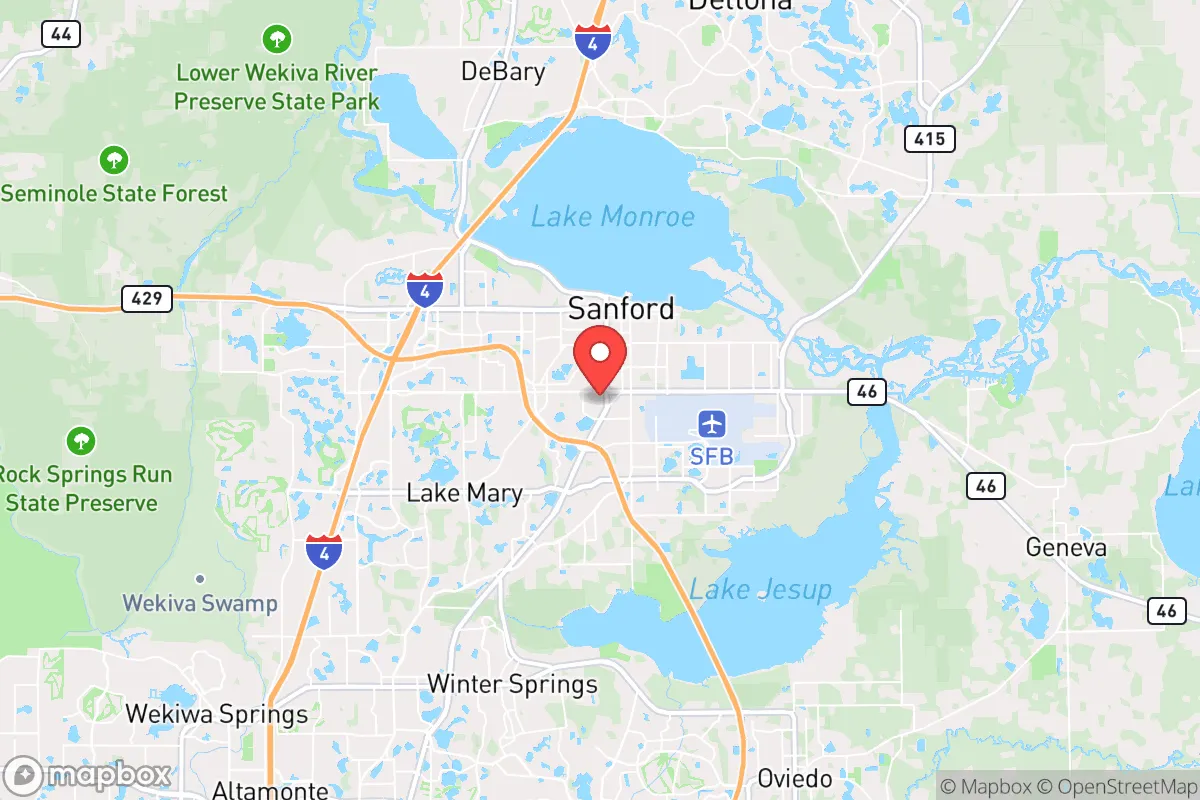
Photo: Wikipedia
Demographics of Sanford, FL
Affluence Level in Sanford, FL
A middle-class area roughly in line with national averages across income, home values, education, and employment.
People of Sanford, FL
Sanford, Florida, is a city of 62,292 residents defined by its tri-ethnic balance: 38.3% White, 27.4% Hispanic, and 25.6% Black, with smaller but distinct East/Southeast Asian (2.3%) and Indian-subcontinent (2.3%) communities. The city’s character is shaped by its historic role as a steamboat and railroad hub on Lake Monroe, a legacy that produced a dense, walkable downtown and a patchwork of neighborhoods settled by different waves of migrants. With a foreign-born share of 9.5% and a college attainment rate of 26.8%, Sanford is more working-class and ethnically diverse than its suburban neighbors, yet it retains a distinctly Southern small-city feel. For a relocation audience, Sanford offers a place where distinct ethnic enclaves and historic districts coexist, but where the overall population is becoming younger and more Hispanic.
How the city was settled and grew
Sanford was founded in the 1870s as a steamboat port on Lake Monroe, the head of navigation on the St. Johns River. The city’s original population was drawn by the citrus and celery industries, with the first major wave being White settlers from the U.S. South and Midwest who built the Historic Downtown and the Sanford Avenue corridor as the commercial and civic core. Simultaneously, newly emancipated Black families moved to Sanford for work in the fields and packing houses, establishing Georgetown (the historic Black neighborhood just west of downtown) and Goldsboro, a separate town founded by Black settlers in 1891 that was later annexed by Sanford. By the early 1900s, a small wave of Greek immigrants arrived to work in the sponge and fishing industries, settling near the lakefront around First Street. The city’s population remained majority White and Black through the mid-20th century, with the citrus industry peaking in the 1940s and 1950s before a series of freezes devastated the groves and triggered an economic shift toward tourism and services.
Modern era (post-1965)
The 1965 Immigration and Nationality Act opened the door for new populations that reshaped Sanford’s ethnic map. The most significant change has been the growth of the Hispanic community, which now makes up 27.4% of the population. The first wave of Puerto Rican and Mexican migrants arrived in the 1970s and 1980s to work in the remaining agricultural sector and in construction during Central Florida’s boom. They concentrated in the Midtown area along 13th Street and in the Lake Monroe neighborhoods south of downtown, where Hispanic-owned businesses now line the commercial strips. A smaller but notable wave of East/Southeast Asian immigrants (2.3%) — primarily Vietnamese and Filipino families — arrived in the 1980s and 1990s, settling in the Wekiva Park area in the city’s western reaches. The Indian-subcontinent community (2.3%) is a more recent arrival, growing since 2000 as professionals moved into the Preserve at Lake Monroe and other newer subdivisions near the Seminole Towne Center. Domestically, the post-1965 period saw White flight from the city core to unincorporated Seminole County and neighboring Lake Mary, leaving Sanford’s White share at 38.3% — lower than the county average. The Black population, historically concentrated in Georgetown and Goldsboro, has remained stable in share but has dispersed somewhat into the Sanford Heights and Bristol Park neighborhoods as older housing stock became available.
The future
Sanford’s population is trending younger and more Hispanic. Between 2010 and 2024, the Hispanic share rose from roughly 20% to 27.4%, while the White share declined from the mid-40s to 38.3%. The Black share has held steady near 25-26%, and the combined Asian and Indian share (4.6%) is growing slowly from a small base. The city’s annexation of the Preserve at Lake Monroe and other new subdivisions on the western edge is drawing a mix of first-time homebuyers and Hispanic families, while downtown revitalization is attracting a small but visible cohort of younger White professionals. The foreign-born share (9.5%) is below the national average but rising, driven primarily by Latin American immigration. Over the next 10-20 years, Sanford is likely to become a majority-minority city with a Hispanic plurality, a stable Black population, and a smaller but growing Asian and Indian presence. The cultural identity is shifting from a historically Black-and-White Southern town to a tri-ethnic Central Florida city with a strong Puerto Rican and Mexican influence visible in its restaurants, festivals, and storefronts.
For someone moving in now, Sanford offers a more affordable and ethnically grounded alternative to the homogenized suburbs of Lake Mary and Heathrow. The city is becoming younger, more Hispanic, and more diverse, with distinct neighborhoods that still carry the imprint of their founding populations. The trade-off is a lower college attainment rate (26.8%) and a more working-class character than the surrounding area, but for families and individuals who value authentic urban fabric and ethnic diversity over master-planned uniformity, Sanford represents a genuine Central Florida community with a clear trajectory.

* Values derived from national, state, county, city and local statistics and may differ in a specific area. Last updated: 2026-10-15T16:18:29.000Z
Narrative content on this page is AI-generated and may contain mistakes. Verify any details that matter before acting on them.
ReloMaps may earn a commission from affiliate links at no extra cost to you.

