
Photo: Wikipedia
Political ClimatePolitical Climate in Redding, CA
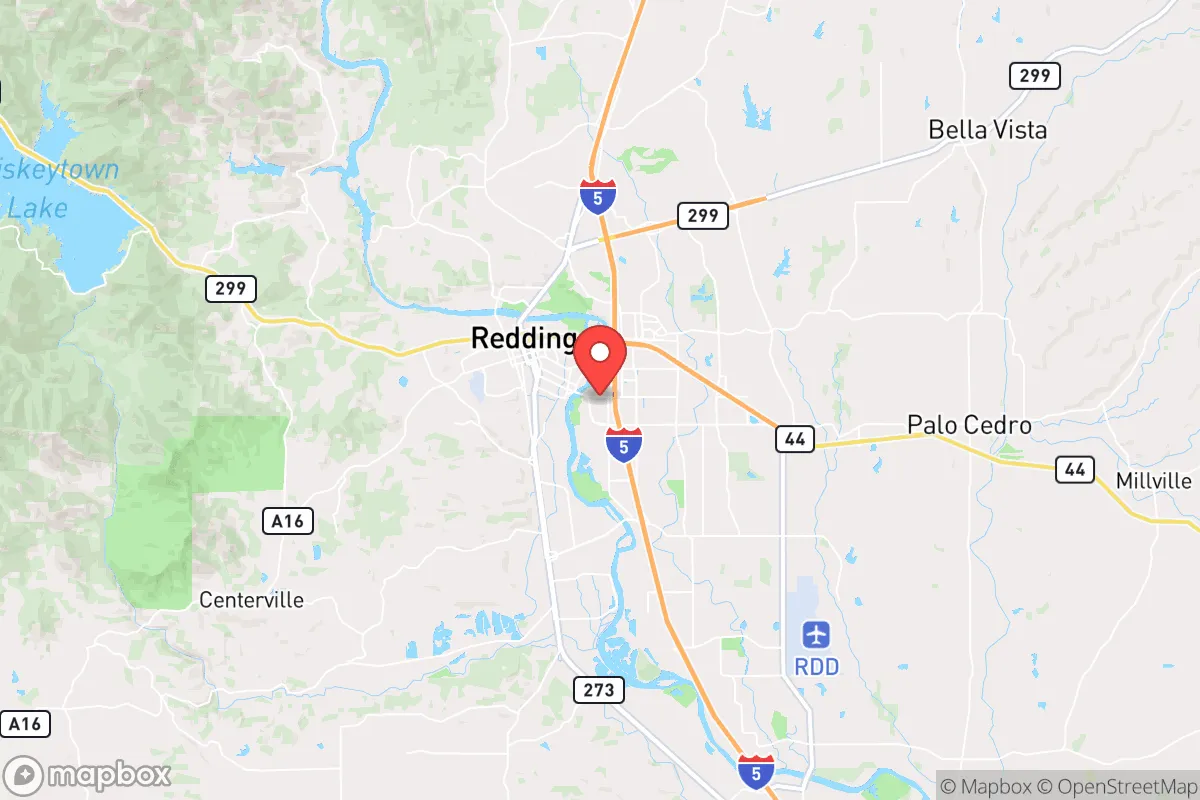
District shown is the primary district for this city’s centroid. Cities may span multiple districts.
Local Political AnalysisPolitical Analysis of Redding, CA
Redding is a deep red island in a deep blue state. While California as a whole carries a Cook PVI of D+24, meaning it leans more than 24 points toward Democrats in presidential elections, Redding and Shasta County are solidly Republican. The city itself votes about 60-65% Republican in most statewide races, and the surrounding unincorporated areas are even more conservative. This isn't a recent shift—Redding has been a conservative stronghold for decades, but the gap between it and the rest of California has widened significantly since the 2010s, driven by a steady influx of people from the Bay Area and Southern California who are fleeing high costs and progressive policies.
How it compares
Drive 45 minutes south to Anderson or 20 minutes east to Burney, and you'll find similar politics—rural, gun-friendly, and skeptical of Sacramento. But head 90 minutes south to Chico, and you hit a blue-leaning college town. The contrast is stark: Chico's Butte County voted for Biden in 2020, while Shasta County went for Trump by nearly 30 points. Within Redding itself, the political divide is mostly between the city proper and the unincorporated county. The city council is reliably conservative, but not as far-right as the county board of supervisors, which has made national news in recent years for election integrity disputes and a push to hand-count ballots. Statewide, Redding is an outlier: it's one of the few places in California where you can reliably see Trump flags year-round, and where the local Republican Party is the dominant political force.
What this means for residents
For conservatives, Redding feels like a refuge. You can openly display political signs, attend church without judgment, and find like-minded neighbors easily. Local businesses often cater to this base—think gun shops, outdoor gear stores, and conservative-leaning coffee shops. For liberals, it's more isolating. There's no active Democratic Party presence to speak of, and progressive candidates rarely win local office. That said, the city is not hostile to everyone; it's more of a live-and-let-live vibe in daily life. You won't get harassed for a Biden sticker, but you'll definitely be in the minority. The practical effect is that local policy leans heavily toward low taxes, minimal regulation, and a strong police presence. Redding's crime rate is higher than the state average, and the city council has responded with a tough-on-crime approach, including support for more sheriff's deputies and a new jail. For families, this means a sense of safety in the suburbs, but downtown can feel edgy after dark.
The cultural and policy distinctions are what really set Redding apart. This is one of the few places in California where you can buy a semi-automatic rifle without a special permit, where the local paper endorses Republicans, and where the biggest annual event is the Redding Rodeo. The city's identity is tied to the outdoors—the Sacramento River, Whiskeytown Lake, and the Trinity Alps—and that draws a certain type of resident: self-reliant, anti-government, and deeply attached to the Second Amendment. The long-term trajectory? Redding will likely stay red as long as California stays blue. The people moving here are doing so specifically to escape the state's politics, so the conservative tilt is self-reinforcing. But the city is also growing, and with growth comes diversity of thought. If the state's housing crisis pushes more moderate Democrats north, Redding could shift slightly purple over the next decade—but for now, it's as reliably Republican as any city in California.

State Political ClimatePolitical Climate in California
State Political AnalysisPolitical Environment in the State
California is a deeply blue state, with Democrats holding every statewide office and supermajorities in both legislative chambers, but its reputation as a monolithic liberal bastion oversimplifies a far more complex reality. The state’s overall partisan lean is roughly D+20 in presidential elections, a shift that has solidified over the past 20 years as the GOP’s once-stronghold in Southern California suburbs has eroded. However, this blue dominance masks a fierce urban-rural divide, a growing moderate pushback in certain policy areas, and a political trajectory that is anything but static for someone considering a move here.
Urban vs. rural divide
The political map of California is essentially a war between its massive coastal metros and its vast, sparsely populated interior. The state’s blue majority is driven overwhelmingly by the San Francisco Bay Area and Los Angeles County, which together account for nearly half the state’s population and vote margins that can exceed 70% Democratic. In contrast, the Central Valley and far northern counties are deeply red. Bakersfield (Kern County) is a conservative stronghold, voting +20 R in 2024, while Redding (Shasta County) is even more pronounced, with a libertarian-leaning, anti-government streak. The Inland Empire, including Riverside and San Bernardino, has become a key battleground—these counties are trending blue but still host significant conservative populations, especially in exurban areas like Temecula and Murrieta, where school board fights over parental rights have become flashpoints. The Central Coast, including San Luis Obispo, remains a purple-to-light-blue area, with a mix of agriculture, tech, and military influence.
Policy environment
California’s policy environment is defined by high taxes, heavy regulation, and a progressive social agenda, but it’s not a one-size-fits-all system. The state has a progressive income tax with a top marginal rate of 13.3%, the highest in the nation, and a state sales tax that can exceed 10% in some cities. Property taxes are capped at 1% of assessed value under Proposition 13, but annual increases are limited to 2%, which benefits long-term homeowners but creates a tax burden disparity for new buyers. The regulatory posture is aggressive: California has its own environmental standards (e.g., CARB), strict labor laws (e.g., AB 5 on gig worker classification), and a powerful public employee union influence. On education, the state funds schools well above the national average, but outcomes are mixed, with San Francisco and Oakland school districts facing chronic underperformance and enrollment declines. Healthcare is heavily regulated, with a state-run exchange (Covered California) and a push toward single-payer that has stalled. Election laws are among the most accessible in the country: universal mail-in ballots, same-day registration, and no-excuse absentee voting are standard, which has boosted turnout but also fueled GOP concerns about ballot security.
Recent policy direction
The last five years have seen California double down on its progressive identity, but with notable exceptions that matter to relocators. On gun and self-defense law, the state has passed some of the nation’s strictest measures: SB 2 (2023) effectively bans concealed carry in most public places, and the state’s assault weapons ban and magazine capacity limits remain in place, though they face ongoing court challenges. On parental and education rights, the state has moved in the opposite direction from many red states: AB 1955 (2024) prohibits school districts from requiring parental notification of a student’s gender identity, a direct response to conservative school board victories in places like Temecula. On speech and privacy, California has a strong shield law for journalists and a strict data privacy law (CCPA), but it also has a hate speech law that some conservatives argue chills political speech. On medical and bodily autonomy, the state is a fortress for abortion rights (Prop 1, 2022) and has expanded gender-affirming care access for minors, including a 2024 law allowing out-of-state families to travel here for such care. On property rights, rent control has been tightened statewide (AB 1482), and the state has preempted local single-family zoning in favor of density (SB 9), which has angered suburban homeowners. On taxation, there’s no sign of a rollback—the state’s budget deficit has led to talk of new taxes on wealth and corporate income. On voting and ballot access, the state has expanded mail-in voting permanently and made it easier to register, but this has also led to a persistent GOP narrative of election integrity issues, particularly in close legislative races.
Civil unrest & political movements
California has a long history of political activism, and the last decade has been no exception. The 2020 George Floyd protests were massive in Los Angeles and Oakland, with property damage and looting that reshaped downtown retail. The state’s sanctuary law (SB 54) limits local law enforcement cooperation with federal immigration authorities, and this has been a flashpoint in inland counties like Riverside, where sheriffs have openly resisted. The secession movement (Calexit) has fizzled, but the “State of Jefferson” movement in far northern counties like Shasta and Siskiyou remains a symbolic protest against Sacramento’s control. Election integrity controversies have been less explosive than in other states, but the 2021 recall election of Governor Gavin Newsom saw a surge of grassroots conservative organizing, particularly in the Central Valley and Orange County. Visible flashpoints for a new resident include the constant presence of homeless encampments in San Francisco and Los Angeles, which have become a political symbol of failed progressive governance, and the ongoing battles over school curriculum in suburban districts like Placentia-Yorba Linda.
Projection
Over the next 5-10 years, California’s political trajectory is likely to see a continued leftward drift on social issues, but with a growing fiscal and housing crisis that could force moderation. The state’s population has declined for three consecutive years, driven by out-migration to Texas and Arizona, and the people leaving are disproportionately middle-income and conservative-leaning. This will likely make the state even bluer, but also more economically stratified. The housing crisis is the wild card: if the state fails to build enough housing, it could trigger a backlash against the regulatory regime, potentially electing more moderate Democrats or even a Republican in a gubernatorial race. The 2026 gubernatorial election will be a key test—if a progressive like Attorney General Rob Bonta wins, expect more of the same; if a moderate like former Los Angeles Mayor Antonio Villaraigosa prevails, there could be a slight pivot on business regulation. For a new resident, the realistic expectation is that California will remain a high-tax, high-regulation state with a progressive social agenda, but the intensity of that agenda may be tempered by the need to keep the state functional.
For a conservative-leaning relocator, the bottom line is that California is not a place where you will find political allies in power, but it is a place where you can find communities that share your values—if you choose carefully. The Central Valley cities like Bakersfield and Fresno offer a more affordable, family-oriented lifestyle with a conservative tilt, while the Inland Empire exurbs like Temecula and Murrieta provide a suburban environment where school board and local elections are genuinely contested. For a liberal relocator, the state offers a policy environment that aligns with your values, but you will pay for it in taxes and cost of living. Either way, the key is to understand that California’s political reality is not a monolith—it’s a collection of fiercely independent regions, and your experience will depend entirely on which one you choose to call home.
* Values derived from national, state, county, city and local statistics and may differ in a specific area. Last updated: 2026-10-05T17:06:14.000Z
Narrative content on this page is AI-generated and may contain mistakes. Verify any details that matter before acting on them.
ReloMaps may earn a commission from affiliate links at no extra cost to you.

