
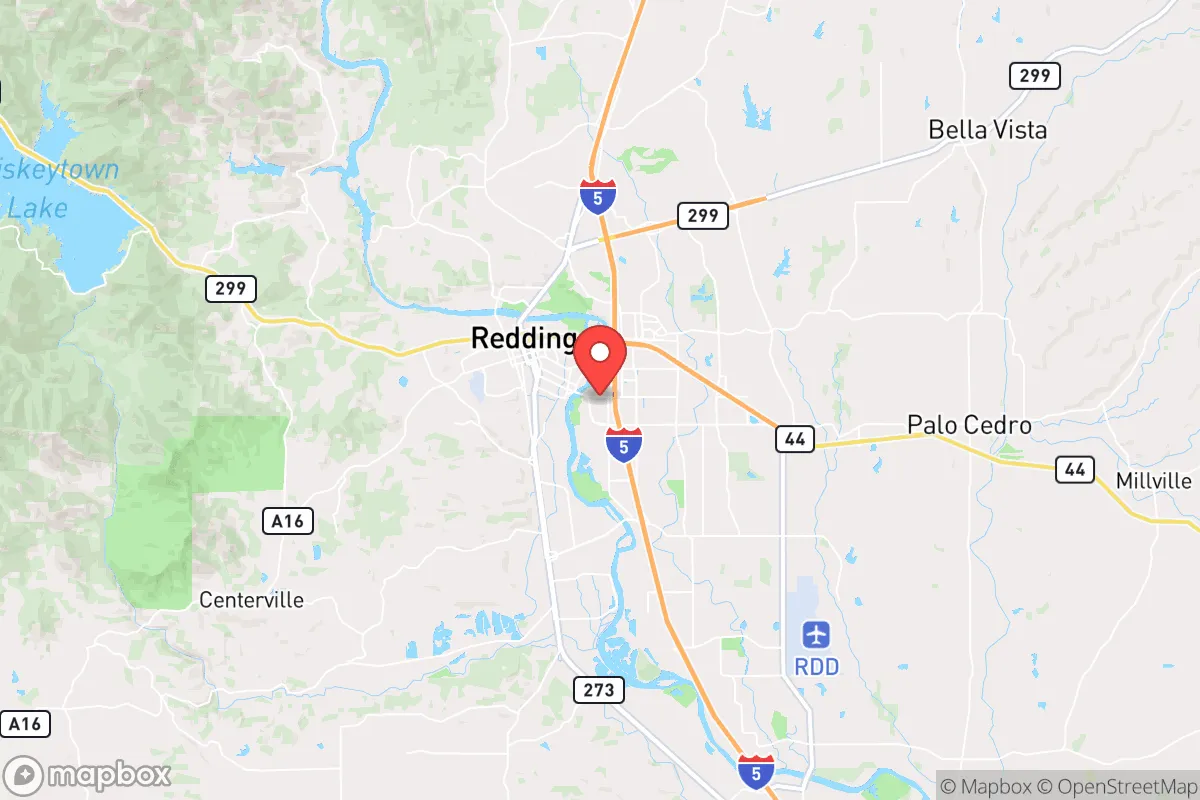
Photo: Wikipedia
Demographics of Redding, CA
Affluence Level in Redding, CA
A middle-class area roughly in line with national averages across income, home values, education, and employment.
People of Redding, CA
The people of Redding, California, today number 93,268 and form a predominantly white, family-oriented community with a distinctly conservative, outdoor-recreation identity. The city is notably less diverse than the state average, with a foreign-born population of just 2.6% and a college attainment rate of 26.1%, reflecting a blue-collar and service-economy base. Residents often describe the area as a "big small town," where a shared culture of hunting, fishing, and faith—particularly evangelical Christianity—shapes daily life more than ethnic or cosmopolitan influences.
How the city was settled and grew
Redding was founded in 1872 as a railroad town, a terminus for the Central Pacific Railroad that drew a wave of Anglo-American settlers from the Midwest and South seeking land and work in the Sacramento Valley. The original population was overwhelmingly white, with a small number of Chinese laborers who built the rail lines and later formed a short-lived enclave near the historic Market Street corridor. By the early 1900s, the timber and mining industries—copper from the nearby Iron Mountain mine—brought additional white working-class families, many of whom settled in the Benton Tract neighborhood, a grid of modest homes near the downtown rail yards. The 1930s and 1940s saw a second wave of Dust Bowl migrants from Oklahoma and Arkansas, who established a rural, self-sufficient culture in what is now the Lake Redding area, along the Sacramento River. These groups cemented Redding’s white, Protestant, and politically conservative character, a foundation that remains largely intact today.
Modern era (post-1965)
After the 1965 Hart-Cellar Act, Redding saw almost no international immigration compared to coastal California cities. Instead, the city’s post-1965 growth came from domestic in-migration: white retirees from the Bay Area and Southern California seeking cheaper housing and a slower pace, plus younger families drawn to the region’s outdoor recreation. The Hispanic population grew modestly from the 1980s onward, reaching 12.5% today, with many families settling in the Shasta View and Enterprise neighborhoods east of Interstate 5, where older, more affordable housing stock exists. East and Southeast Asian communities (3.5% of the population) are concentrated in the Hilltop Drive corridor, near the medical centers and retail hubs that employ many in healthcare and service roles. The Indian-subcontinent population remains tiny at 0.5%, and the Black population at 1.3%, both largely dispersed rather than clustered. The city’s racial and ethnic composition has shifted only slightly since 2000: the white share has declined from about 82% to 73.9%, while the Hispanic share has risen from roughly 7% to 12.5%, but the overall character remains overwhelmingly white and culturally conservative.
The future
Redding’s population is projected to grow slowly, reaching roughly 100,000 by 2035, driven primarily by continued domestic migration from more expensive parts of California. The Hispanic share is expected to rise to 15-17% over the next decade, with new arrivals—many from the Central Valley and Southern California—settling in the expanding Churn Creek Bottom area, where new subdivisions and apartment complexes are being built. The white population will likely continue a gradual relative decline, but the city will remain majority white and culturally conservative for the foreseeable future. East/Southeast Asian and Indian communities are expected to grow only marginally, as Redding lacks the high-tech or academic job base that attracts these groups to other California metros. The city’s cultural identity is evolving slowly: the old timber-and-mining economy has been replaced by healthcare (Mercy Medical Center is the largest employer), retail, and government, but the political and social ethos—low taxes, gun rights, evangelical churches—remains deeply entrenched.
For someone moving in now, Redding offers a stable, affordable, and safe environment where the population is aging slightly but still family-oriented. The city is becoming slightly more diverse, but not dramatically so; the dominant culture remains white, conservative, and rooted in outdoor life. New residents will find a community that values self-reliance and neighborliness, but one that is unlikely to develop the ethnic or cosmopolitan texture of California’s coastal cities.

* Values derived from national, state, county, city and local statistics and may differ in a specific area. Last updated: 2026-10-05T17:06:14.000Z
Narrative content on this page is AI-generated and may contain mistakes. Verify any details that matter before acting on them.
ReloMaps may earn a commission from affiliate links at no extra cost to you.

