
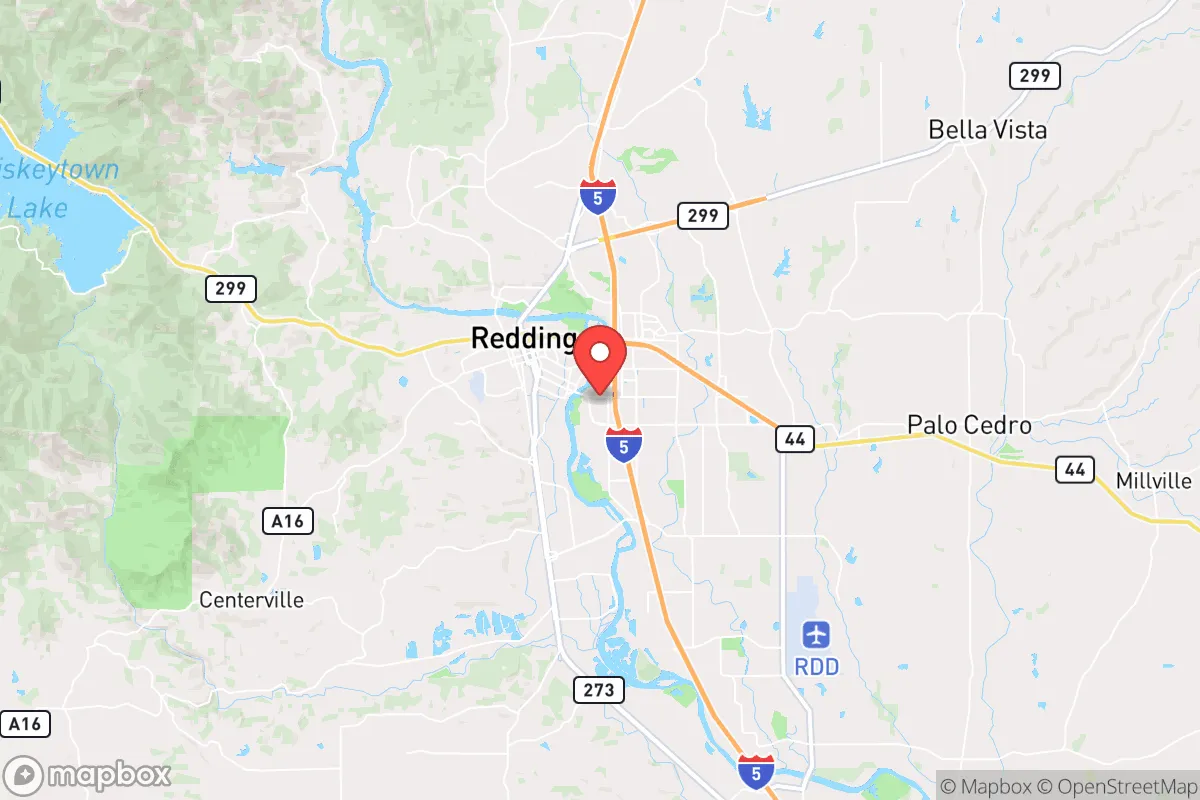
Photo: Wikipedia
Personal Sovereignty in Redding, CA
Viable for self-reliance. Generally workable, though some barriers may limit total independence.
What does Personal Sovereignty tell us?
Personal Sovereignty measures your capacity for self-reliance and independence with minimal government friction. Higher scores mean fewer barriers between you and the way you want to live... but it assumes you have the space you need and good neighbors.
What does this tell us?
Personal Sovereignty measures your capacity for self-reliance and independence with minimal government friction. Higher scores mean fewer barriers between you and the way you want to live... but it assumes you have the space you need and good neighbors.
State Policy
Energy independence: Importer (33% of energy produced in-state)
Personal Liberty
Homesteading

Personal Liberty Analysis
Redding, California, offers a notably higher degree of personal sovereignty than most of the state, functioning as a practical stronghold of self-reliance within a heavily regulated state framework. While California’s state-level laws impose significant constraints on taxation, gun ownership, and land use, Shasta County’s local culture, enforcement priorities, and political leadership create a buffer that allows residents to exercise more autonomy than in coastal or urban areas. For individuals and families who prioritize independence, Redding represents a strategic compromise: you accept California’s baseline regulatory structure, but you gain a community where local officials, law enforcement, and neighbors generally respect and protect personal freedom.
Tax burden and regulatory posture: how California’s rules feel different in Redding
California’s state income tax—with a top marginal rate of 13.3%—and its 7.25% base sales tax (plus local add-ons) are inescapable facts of life in Redding, just as they are in Los Angeles or San Francisco. However, the practical burden feels lighter here because property taxes are effectively capped at 1% of assessed value under Proposition 13, and Shasta County’s median home price of roughly $400,000 means the annual tax bill on a typical single-family home is around $4,000—far less than in the Bay Area or Southern California. The regulatory posture is also markedly different: Shasta County’s Board of Supervisors and city council have consistently pushed back against state mandates, particularly on housing and business licensing. For example, Redding has a streamlined permitting process for accessory dwelling units (ADUs) and small-scale home businesses, and the county has resisted California’s push for high-density zoning, preserving low-density residential neighborhoods. The result is a regulatory environment that, while still subject to state oversight, is administered with a light touch—permits are processed faster, code enforcement is complaint-driven rather than proactive, and local officials are generally skeptical of new regulations. For a self-reliant individual, this means you can operate a home-based trade, build a workshop, or run a small farm with far less bureaucratic friction than in most of California.
Self-defense and gun law specifics: what the Second Amendment looks like in Shasta County
California’s state gun laws are among the strictest in the nation—requiring a 10-day waiting period, a Firearm Safety Certificate, and a background check for all purchases, and banning most semiautomatic rifles with “assault weapon” features. However, Redding sits in Shasta County, where the sheriff’s office and local courts have a strong record of issuing concealed carry permits (CCWs) to law-abiding residents. As of 2025, Shasta County’s CCW issuance rate is among the highest in California, with the sheriff’s office processing applications in roughly 60–90 days and requiring only a basic firearms safety course. This stands in stark contrast to coastal counties like Santa Clara or Los Angeles, where CCWs are effectively impossible to obtain. Additionally, Redding has a robust culture of firearms ownership: there are multiple indoor and outdoor shooting ranges, several gun shops, and a strong community of competitive shooters and hunters. Castle Doctrine protections apply statewide, meaning there is no duty to retreat in one’s home, but local juries in Shasta County are generally sympathetic to self-defense claims. For a family moving to Redding, the practical reality is that you can legally own a wide range of firearms (subject to state restrictions), carry concealed with a permit, and expect that local law enforcement will respect your Second Amendment rights—a significant advantage over most of California.
Self-reliance and homesteading viability: lot sizes, zoning, and off-grid feasibility
Redding and its surrounding unincorporated areas offer genuine opportunities for self-reliant living that are rare in California. Within the city limits, standard residential lots range from 6,000 to 10,000 square feet, but many neighborhoods have larger parcels—especially in the older, established areas near the Sacramento River or on the outskirts like Lake Redding Estates. In unincorporated Shasta County, zoning allows for rural residential parcels as small as 1 acre, and many properties in areas like Palo Cedro, Millville, or Igo are 5 to 20 acres, suitable for small-scale farming, livestock, or a substantial garden. The county’s zoning code explicitly permits “agricultural accessory uses” on parcels of 1 acre or more, including keeping chickens, goats, and up to two horses without a conditional use permit. Off-grid feasibility is mixed: while California’s building code requires connection to the electrical grid for new construction, many existing rural homes operate on solar with battery backup, and the county does not aggressively enforce grid-connection requirements for additions or accessory structures. Water is a more significant constraint—much of Shasta County relies on groundwater, and well permits are generally available but require a minimum lot size of 1 acre in most areas. Septic systems are permitted on parcels of 1 acre or larger, and the county’s environmental health department processes permits within 4–6 weeks. For a family serious about self-reliance, the combination of affordable land (rural parcels often sell for $10,000–$20,000 per acre), lenient animal-keeping rules, and a tolerant attitude toward alternative energy makes Redding one of the most viable locations in California for a homesteading lifestyle.
Personal liberties: parental rights, medical autonomy, speech, and property
Redding’s personal liberties environment is shaped by a local culture that strongly values parental authority, medical freedom, and property rights. Parental rights are respected in practice: Shasta County’s school board has resisted state-mandated curricula on gender identity and sexual education, and parents have broad latitude to opt their children out of specific lessons or activities. The county’s public health department has also taken a hands-off approach to vaccine mandates, and many local pediatricians and family doctors are willing to work with parents on alternative vaccination schedules or exemptions. Medical autonomy extends to adult choices: Redding has a thriving community of naturopathic doctors, functional medicine practitioners, and holistic health clinics, and the local hospital (Mercy Medical Center) generally respects patient-directed care within legal limits. Free speech is robustly protected—Redding’s public forums, including the city council meetings and the downtown plaza, regularly host speakers with a wide range of political views, and there is no local ordinance restricting expressive activity beyond state law. Property rights are perhaps the strongest liberty: Shasta County has no rent control, no inclusionary zoning mandates, and no short-term rental bans (though the city requires a permit for Airbnb-style rentals). The county’s approach to code enforcement is complaint-driven, meaning you can build a fence, add a shed, or modify your home without a permit as long as no one complains—a stark contrast to the proactive inspection regimes in many California cities. For a family that values the ability to make decisions about their children’s education, their own healthcare, and their property without government interference, Redding offers a level of personal sovereignty that is increasingly rare in the state.
Overall, Redding provides a unique balance: you accept California’s high state taxes and some regulatory overhead, but you gain a local environment where personal sovereignty is the default rather than the exception. Compared to other parts of California—where gun permits are impossible, homesteading is zoned out, and parental rights are contested—Redding feels like a different state entirely. For a family or individual who prioritizes self-reliance and personal freedom, and who can manage the state-level tax burden, Redding is arguably the most sovereignty-friendly city of its size in California, rivaled only by a few other inland communities like Yreka or Susanville. It is not a libertarian utopia—California’s long arm still reaches—but it is a place where you can live largely on your own terms, with a community that supports your right to do so.

* Values derived from national, state, county, city and local statistics and may differ in a specific area. Last updated: 2026-10-05T17:06:14.000Z
Narrative content on this page is AI-generated and may contain mistakes. Verify any details that matter before acting on them.
ReloMaps may earn a commission from affiliate links at no extra cost to you.

