Photo: Wikipedia
Political ClimatePolitical Climate in Palmetto, GA
District shown is the primary district for this city’s centroid. Cities may span multiple districts.
Local Political AnalysisPolitical Analysis of Palmetto, GA
Palmetto, Georgia, is a deep-blue island in a red sea. With a Cook Partisan Voting Index of D+25, this small city in southern Fulton County is one of the most reliably Democratic communities in the state. That’s a stark contrast to the surrounding counties—Coweta and Fayette—which have voted Republican by wide margins in every recent presidential election. If you’ve lived here a while, you’ve seen the shift firsthand: Palmetto used to be a quiet, mostly rural crossroads, but as metro Atlanta’s sprawl pushed south, new residents brought a more progressive voting bloc with them. The city itself hasn’t flipped so much as it’s been transformed by newcomers who work in the city or at the airport, and that trend shows no sign of slowing down.
How it compares
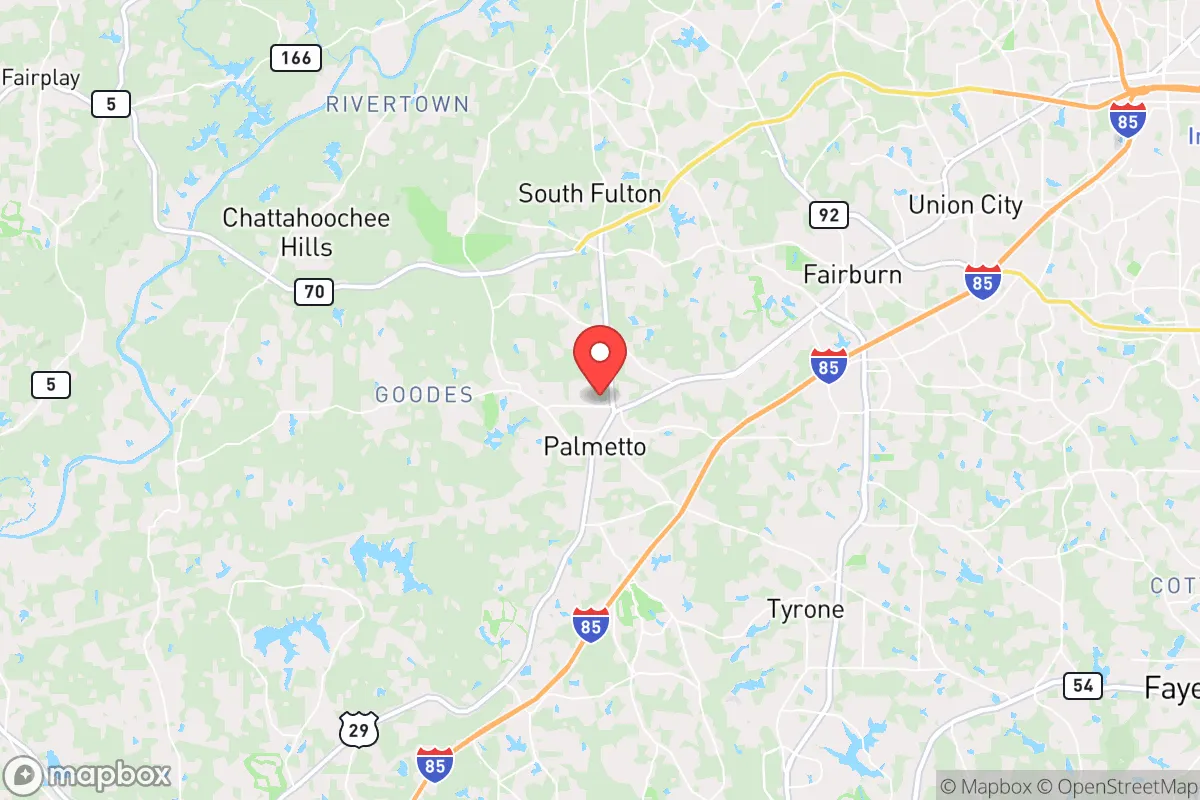
Georgia as a whole is a classic swing state, with a statewide Cook PVI that’s essentially even (D+0 or R+0 depending on the cycle). In 2020, Biden won Georgia by about 12,000 votes out of 5 million cast—a razor-thin margin. Palmetto, by contrast, is a Democratic stronghold. To get a sense of the political geography, drive 10 miles south to Newnan in Coweta County, and you’re in solidly Republican territory where Trump won by double digits in 2020. Head east to Peachtree City in Fayette County, and you’ll find a well-heeled, conservative-leaning suburb that’s reliably red. Palmetto sits right on the border of these two worlds. In practice, this means that while the city council and local school board in Palmetto lean progressive, the county-level government in Fulton is also Democratic—but the moment you cross into Coweta or Fayette, the political signage, the local ordinances, and even the tenor of community meetings change noticeably.
What this means for residents
For liberal residents, Palmetto offers a comfortable political home base without the high cost of living inside Atlanta’s perimeter. You can reliably expect your neighbors to share your views on most issues, and local representation tends to align with Democratic priorities on housing, transit, and public services. For conservative residents, the situation is more nuanced. You’re not going to find a local Republican club meeting on every corner, but you’re also not isolated—your county and state representatives are likely Republican, and you’re a short drive from deeply red communities where your views are the majority. The practical effect is that Palmetto’s politics are less contentious day-to-day than you might expect from a D+25 rating. People here tend to focus on local concerns—the new mixed-use development near the train station, the condition of the schools, the traffic on Roosevelt Highway—rather than national culture wars. That said, the city’s trajectory is clearly leftward, and longtime conservative residents sometimes express frustration that the area’s rural character is giving way to denser, more urban-style development favored by the newer, more liberal arrivals.
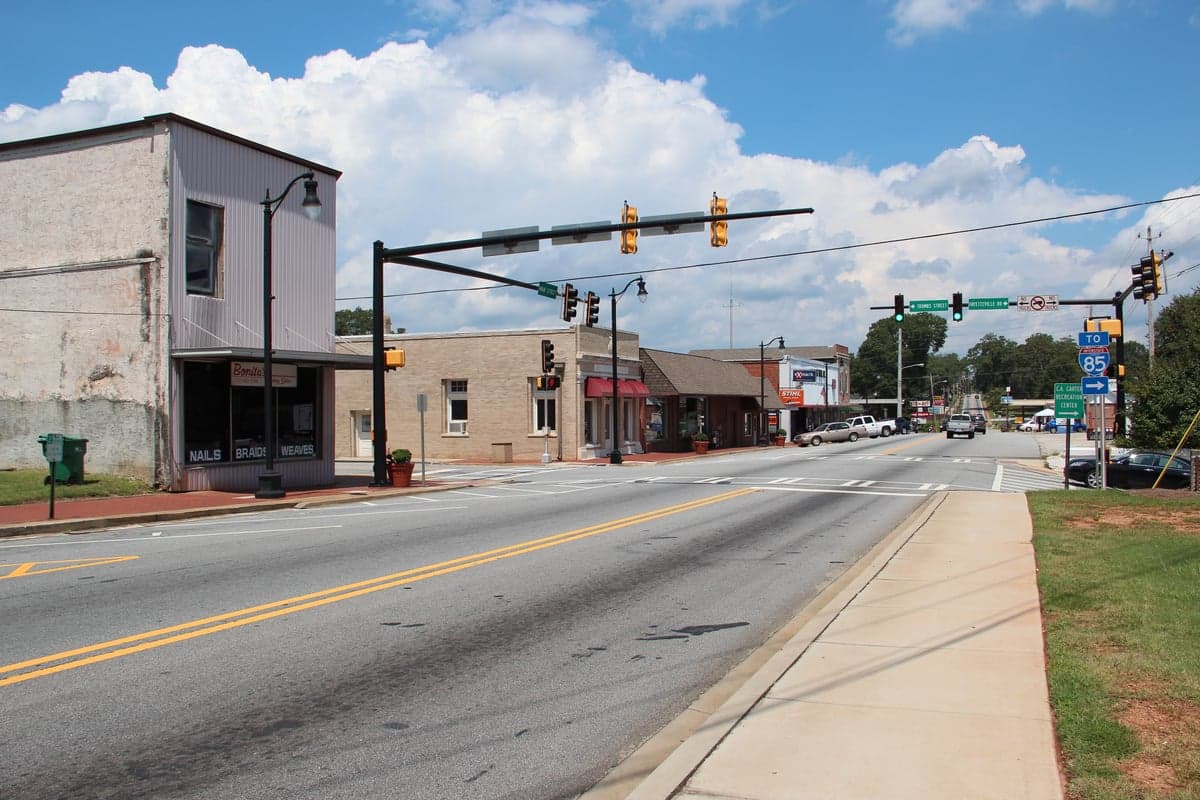
Culturally, Palmetto feels more like a working-class southern town than a progressive enclave, despite its voting record. The downtown still has a small-town feel, with a historic train depot and a few family-run businesses that have been there for decades. Policy-wise, the city has been more open to transit-oriented development than its neighbors—the Palmetto MARTA station is a key asset that sets it apart from Newnan or Peachtree City, which have resisted heavy rail expansion. That station has become a symbol of the area’s changing identity: it brings in commuters who work in Atlanta but want cheaper housing, and those commuters tend to vote blue. Looking ahead, if Georgia continues to trend toward competitiveness at the statewide level, Palmetto’s deep-blue vote will only become more significant. For now, it remains a distinct political outlier—a place where the national Democratic platform feels locally relevant, even as the surrounding counties hold the line for the GOP.

State Political ClimatePolitical Climate in Georgia
State Political AnalysisPolitical Environment in the State
Georgia has transformed from a reliably Republican stronghold into the nation’s most competitive swing state, a shift driven by explosive growth in the Atlanta metro and a diversifying electorate. The state voted for Joe Biden in 2020 by a razor-thin margin of 0.2%, then re-elected both Democratic Senator Raphael Warnock and Republican Governor Brian Kemp in 2022, cementing its 50/50 status. Over the past 20 years, the GOP’s once-commanding 17-point presidential margin in 2004 has evaporated, replaced by a dead-even partisan split where control of the state legislature and governor’s mansion remains Republican, but federal races are toss-ups.
Urban vs. rural divide
The political map of Georgia is a stark contrast between the booming, diverse Atlanta metro and the rest of the state. The core of Democratic power is Metro Atlanta, specifically the counties of Fulton (Atlanta), DeKalb, Cobb, and Gwinnett. Gwinnett County, once a conservative suburban bastion, flipped blue in 2016 and now delivers Democratic margins of 15-20 points. The city of Atlanta itself is overwhelmingly Democratic, but the real story is the suburbs: Marietta, Sandy Springs, and Alpharetta have shifted left as educated, out-of-state transplants have moved in. Outside the metro, the state is deeply red. Rural South Georgia, anchored by cities like Valdosta, Albany, and Thomasville, votes Republican by 30-40 points. The exurbs, such as Buford and Braselton along the I-85 corridor, remain conservative but are seeing demographic churn. The "flip" counties that decided 2020 were the Atlanta suburbs—Cobb, Gwinnett, and Henry—which swung from Romney to Biden. Meanwhile, deep-red rural turnout in places like Dalton and Rome in Northwest Georgia remains the GOP’s firewall.
Policy environment
Georgia’s state-level policy is firmly conservative, even as federal elections are competitive. The state has a flat income tax rate of 5.49%, which is set to drop to 4.99% by 2029 under legislation signed by Governor Kemp. Property taxes are locally set and generally moderate, with a statewide homestead exemption that caps assessment increases. The regulatory posture is business-friendly; Georgia is a right-to-work state with a low 5.75% corporate income tax. On education, Georgia has a robust school choice program, including the Georgia Promise Scholarship Act, which provides state funds for private school tuition. The state also has a constitutional amendment banning same-sex marriage, though it is unenforceable due to federal law. Healthcare policy is a flashpoint: Georgia did not expand Medicaid under the Affordable Care Act, leaving a coverage gap for roughly 300,000 low-income adults. Election laws have been tightened; the 2021 Election Integrity Act (SB 202) added voter ID requirements for absentee ballots, limited drop boxes, and restricted third-party ballot collection. Gun laws are permissive: Georgia is a permitless carry state as of 2022 (SB 319), with no state-level red flag law.
Recent policy direction
The last five years have seen Georgia’s Republican legislature push a distinctly conservative agenda on multiple fronts. On gun and self-defense law, the 2022 permitless carry law allows any legal gun owner to carry a concealed firearm without a license, and the state has a strong "stand your ground" statute. On parental and education rights, the 2022 "Parents’ Bill of Rights" (HB 1178) codifies parental access to curriculum and library materials, and a 2023 law restricts instruction on gender identity in K-3 classrooms. Speech and privacy saw the passage of the "Heartbeat Bill" (HB 481) in 2019, banning abortion after roughly six weeks; this law was blocked by courts but reinstated in 2022 after the Dobbs decision. Medical and bodily autonomy is heavily restricted: abortion is banned after six weeks with narrow exceptions for rape, incest, and life of the mother. Property rights are generally strong, with no statewide rent control and limited eminent domain abuse. On voting and ballot access, SB 202 shortened the runoff period from nine weeks to four, which some argue benefits incumbents. The overall direction is a state that is culturally conservative on social issues but economically pro-business, with a growing tension between the Atlanta metro’s progressive lean and the rural legislature’s priorities.
Civil unrest & political movements
Georgia has been a focal point for political activism on both sides. The 2020 election saw massive "Stop the Steal" protests at the state capitol, culminating in the January 5, 2021 Senate runoff elections that drew national attention. The Atlanta metro has seen significant Black Lives Matter protests, particularly after the 2020 killing of Rayshard Brooks by Atlanta police. Immigration politics are heated: Georgia passed HB 87 in 2011, one of the strictest anti-immigration laws in the country, though parts were struck down. There are no sanctuary cities in Georgia; state law (HB 452) prohibits local governments from adopting sanctuary policies. Election integrity remains a live issue; the 2021 audit of absentee ballots in Cobb County and the ongoing debate over the state’s voting machines (Dominion) keep the topic in the news. A new resident would notice the political polarization in yard signs, bumper stickers, and local news coverage, but the state is not experiencing widespread civil unrest—rather, it’s a simmering partisan tension that flares during election cycles.
Projection
Over the next 5-10 years, Georgia is likely to become even more competitive, with the Atlanta metro’s growth continuing to pull the state left while rural areas hold firm. The state is projected to add 1.5 million residents by 2030, with most settling in the Atlanta suburbs, Athens, and the Savannah area. This in-migration, largely from blue states, will likely push the state toward a purple equilibrium, but the Republican legislature’s gerrymandering of congressional and state districts will keep the GOP in power at the state level for the foreseeable future. A relocator moving in now should expect a state where federal elections are toss-ups, state government remains conservative, and the cultural divide between Atlanta and the rest of Georgia widens. The 2026 gubernatorial race will be a key bellwether: if a Democrat can win the governor’s mansion, Georgia will be considered a true swing state; if not, it will remain a state with a Republican legislature and a competitive presidential vote.
For a new resident, the bottom line is that Georgia offers a conservative policy environment at the state level—low taxes, business-friendly regulation, and strong gun rights—while the Atlanta metro provides a liberal cultural and political counterweight. If you are a conservative, you will find the state legislature and governor aligned with your views, and the rural areas will feel familiar. If you are a liberal, you will find your political home in Atlanta, Decatur, or Savannah, but you will face a state government that is often hostile to your priorities. The practical takeaway: Georgia is a state where your local experience depends heavily on which county you choose to live in, and the state’s political future is genuinely up for grabs.
* Values derived from national, state, county, city and local statistics and may differ in a specific area. Last updated: 2026-10-14T23:20:11.000Z
Narrative content on this page is AI-generated and may contain mistakes. Verify any details that matter before acting on them.
ReloMaps may earn a commission from affiliate links at no extra cost to you.

