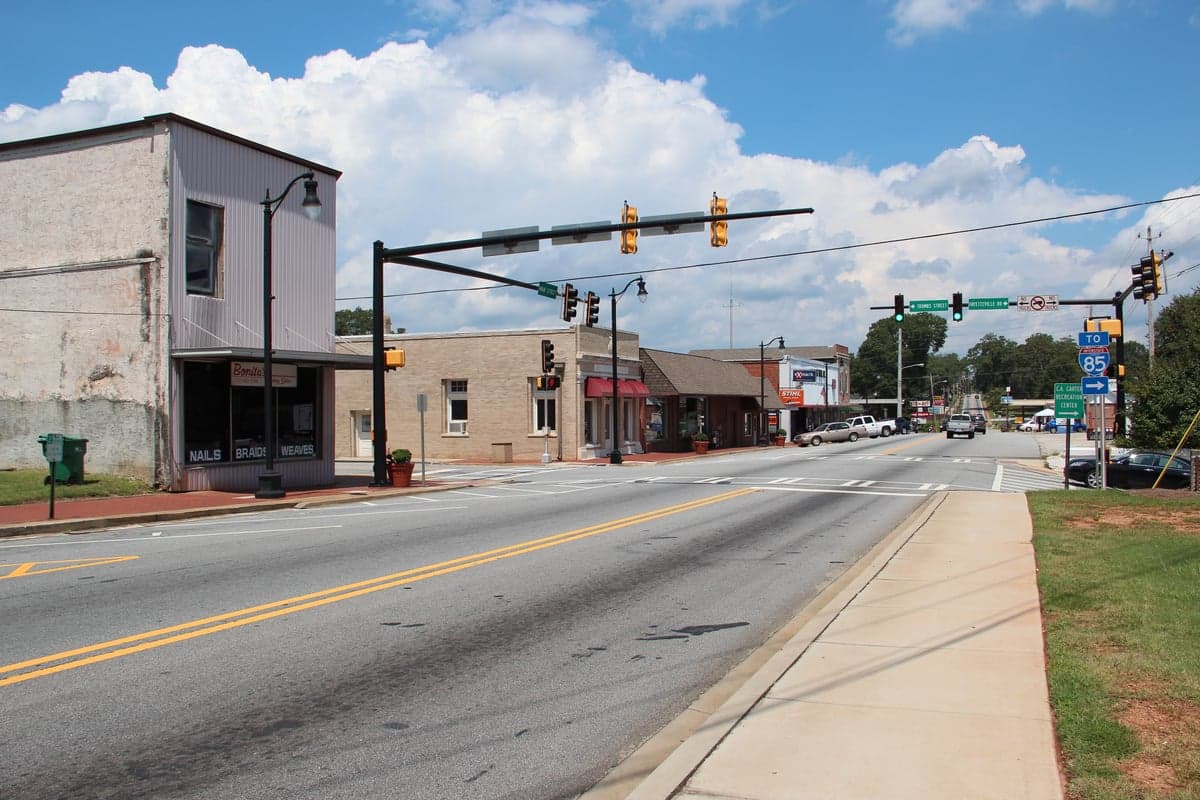
Photo: Wikipedia
Personal Sovereignty in Palmetto, GA
Viable for self-reliance. Generally workable, though some barriers may limit total independence.
What does Personal Sovereignty tell us?
Personal Sovereignty measures your capacity for self-reliance and independence with minimal government friction. Higher scores mean fewer barriers between you and the way you want to live... but it assumes you have the space you need and good neighbors.
What does this tell us?
Personal Sovereignty measures your capacity for self-reliance and independence with minimal government friction. Higher scores mean fewer barriers between you and the way you want to live... but it assumes you have the space you need and good neighbors.
State Policy
Energy independence: Importer (12% of energy produced in-state)
Personal Liberty
Homesteading

Personal Liberty Analysis
Palmetto, Georgia, offers a notably high degree of personal sovereignty, anchored in Georgia’s broader legal framework that emphasizes limited government, strong property rights, and robust self-defense protections. For individuals and families prioritizing autonomy, the city’s regulatory environment is light-touch relative to metro Atlanta suburbs, with no city-level income tax and a zoning code that permits a range of self-reliant activities on residential lots. The combination of state preemption laws, a constitutional carry regime, and relatively low property taxes creates a baseline for personal freedom that is competitive with other exurban communities in the Southeast, though not as permissive as rural counties in the Deep South.
Tax burden and regulatory posture in Palmetto
Palmetto’s tax burden is moderate by Georgia standards, with no city income tax and a property tax millage rate that typically falls between 10 and 12 mills for the city portion, depending on the specific district. The total effective property tax rate in Fulton County (which includes most of Palmetto) is around 1.1% of assessed value, slightly above the state average but still below many Northern states. Georgia’s state income tax is a flat 5.49% as of 2026, with no local income tax overlay, meaning residents keep more of their earnings than in states with progressive or city-level income taxes. The regulatory posture is generally business-friendly: Palmetto has no rent control, no city-level minimum wage above the state’s $7.25/hour, and no zoning overlay that restricts home-based businesses beyond basic nuisance ordinances. Building permits are required for structural changes, but the city’s planning department processes most residential permits within 10–15 business days, and there are no county-level environmental impact reviews for single-family homes. The city does not impose a stormwater utility fee or tree protection ordinance that would limit property use, which is a meaningful difference from more regulated Atlanta suburbs like Decatur or Sandy Springs.
Self-defense and gun law specifics for Palmetto residents
Georgia is a constitutional carry state, meaning no permit is required to carry a concealed or open handgun for anyone 21 or older who is legally allowed to possess a firearm. Palmetto does not impose any additional local restrictions beyond state law, and the city’s police department does not maintain a separate firearms registry or require reporting of lost or stolen guns. Stand-your-ground laws apply statewide, with no duty to retreat in any place where a person is lawfully present, including public streets and businesses. Castle doctrine protections extend to occupied vehicles and workplaces, not just homes. For those who want a permit for reciprocity purposes, Georgia issues a Weapons Carry License (WCL) that is valid in 33 other states, and the application process in Fulton County typically takes 30–60 days. There are no city-level restrictions on magazine capacity, ammunition types, or firearm storage requirements. The only notable limitation is that firearms are prohibited in certain government buildings and on school grounds (with a valid WCL, you can store a firearm in a locked vehicle on school parking lots). Palmetto’s proximity to the Chattahoochee River National Recreation Area means federal land rules apply there, but state law preempts local gun ordinances, so the city cannot create its own gun-free zones beyond what state law allows.
Self-reliance and homesteading viability in Palmetto
Palmetto’s zoning code permits a range of self-reliance activities on residential lots, though with some constraints. Minimum lot sizes in the city’s R-1 district are 12,000 square feet (roughly 0.28 acres), which is larger than typical suburban subdivisions in Fulton County and allows room for gardens, small livestock, and workshops. Chickens are allowed on lots of 12,000 square feet or more, with a limit of six hens and no roosters; beekeeping is permitted with a simple registration. Goats and other small livestock are not explicitly allowed in residential zones, but the city’s agricultural zoning (A-1) on the outskirts permits larger animals and requires a minimum of 2 acres. Off-grid feasibility is limited by building code requirements: all new homes must connect to municipal water and sewer if available, but in the city’s more rural southern sections, well and septic systems are permitted where public utilities are not present. Solar panels are allowed without special permits, and rainwater collection is not restricted by city ordinance. The city does not have a composting mandate or ban, and there are no restrictions on clotheslines or outdoor drying. For those seeking true homesteading, the unincorporated areas of south Fulton County and neighboring Coweta County offer larger parcels (5+ acres) with fewer restrictions, but Palmetto itself provides a middle ground where suburban convenience and self-reliance can coexist without significant regulatory friction.
Personal liberties in Palmetto: parental rights, medical autonomy, speech, and property
Georgia law provides strong protections for parental rights, including a 2022 law that requires school districts to notify parents of any changes to a student’s mental, emotional, or physical health services, and to obtain parental consent for any medical treatment provided by school staff. Palmetto’s school system (Fulton County Schools) follows these state mandates, and there are no local policies that override them. Medical autonomy is generally respected: Georgia does not have a state-level vaccine mandate for adults, and Palmetto has not imposed any local vaccine requirements for employment or public accommodation. The state’s 2019 “Right to Try” law allows terminally ill patients access to experimental treatments, and there are no city-level restrictions on alternative medicine practices. Free speech protections are robust, with no local noise ordinances that target political or religious expression specifically, and the city’s public forum areas (like the Palmetto City Park) are open for demonstrations without a permit for groups under 50 people. Property rights are well-protected: Georgia is a “title theory” state, meaning lenders hold title until a mortgage is paid, but eminent domain is limited to public use projects (no economic development takings), and Palmetto has not engaged in any controversial condemnations in recent years. Short-term rentals (Airbnb/VRBO) are allowed in residential zones with a business license, but the city caps the number of rental nights at 90 per year for unhosted units, which is a moderate restriction compared to some Atlanta suburbs that ban them outright.
Overall, Palmetto’s personal sovereignty environment is strong for a metro Atlanta exurb, offering a lighter regulatory touch than most Fulton County cities while still providing municipal services. The tax burden is manageable, self-defense rights are among the best in the nation, and homesteading is viable on larger lots. The main trade-offs are the city’s moderate short-term rental restrictions and the need to connect to public utilities in denser areas, but these are minor compared to the autonomy found in more rural Georgia counties. For a conservative-leaning individual or family who wants suburban convenience without sacrificing personal freedom, Palmetto ranks favorably against comparable cities like Fayetteville or Newnan, and significantly better than more regulated suburbs like Alpharetta or Roswell.

* Values derived from national, state, county, city and local statistics and may differ in a specific area. Last updated: 2026-10-14T23:20:11.000Z
Narrative content on this page is AI-generated and may contain mistakes. Verify any details that matter before acting on them.
ReloMaps may earn a commission from affiliate links at no extra cost to you.

