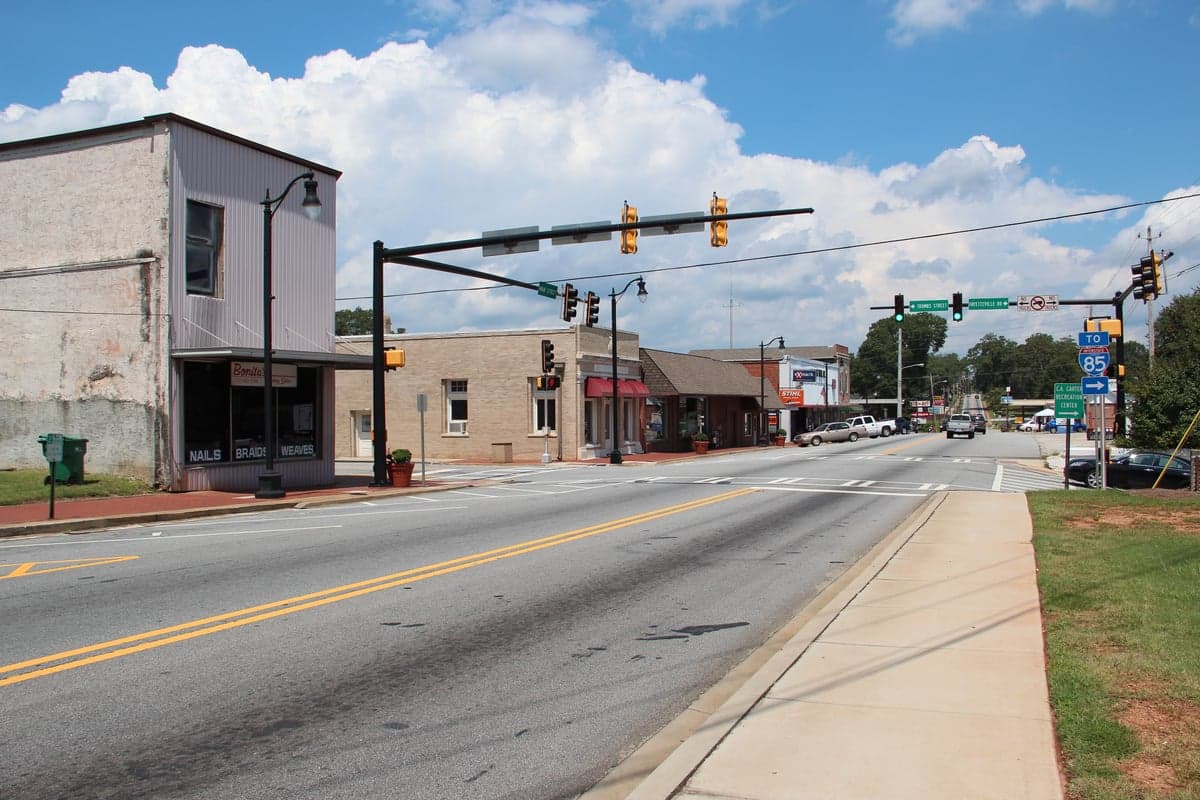
Photo: Wikipedia
Strategic Assessment of Palmetto, GA
Meaningful friction. Expect exposure to either population pressure, blast zones, or natural disaster risk. Consider buying a retreat property.
What does the Strategic Assessment tell us?
Our Strategic Assessment grades tactical survivability of an area. Major population centers, military targets, fallout zones, natural disasters, and border exposure all drive risk — lower exposure means a more defensible position in a crisis.
This is heavily inspired by Joel Skousen's Strategic Relocation book. Highly recommended you checkout the book ($)What does this tell us?
Our Strategic Assessment grades tactical survivability of an area. Major population centers, military targets, fallout zones, natural disasters, and border exposure all drive risk — lower exposure means a more defensible position in a crisis.
This is heavily inspired by Joel Skousen's Strategic Relocation book. Highly recommended you checkout the book ($)Strategic Pillars
Key Distances
Regional Safe Places
Below is our recommended "safe zones" in Georgia and the surrounding area based on our strategic heuristics. For most people, it's unrealistic to live in a “safe zone” full-time due to work, family or other personal reasons. They tend to be more rural. However, many of these areas are perfect for second homes and retreat properties that double as a vacation home or even a short-term rental.
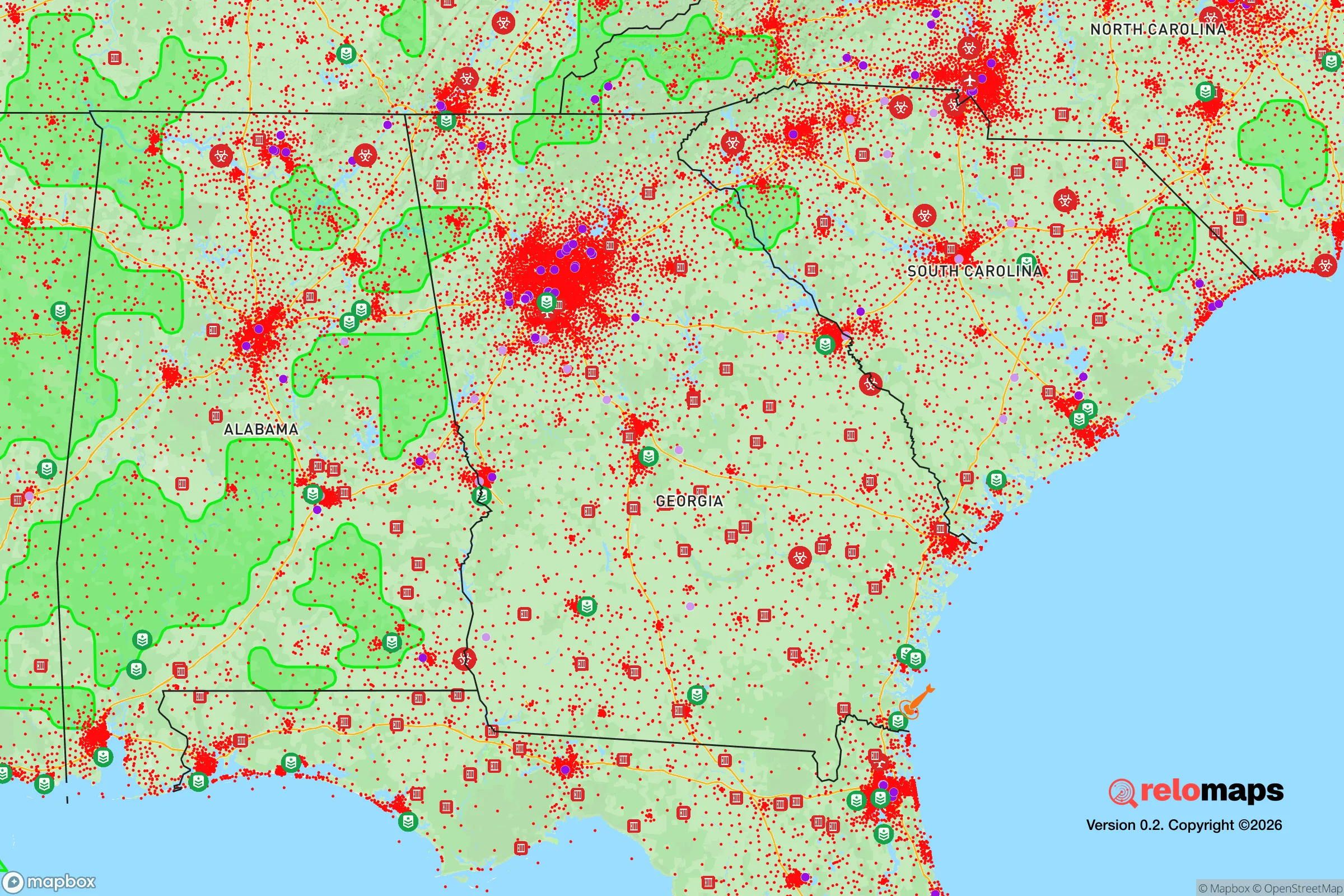
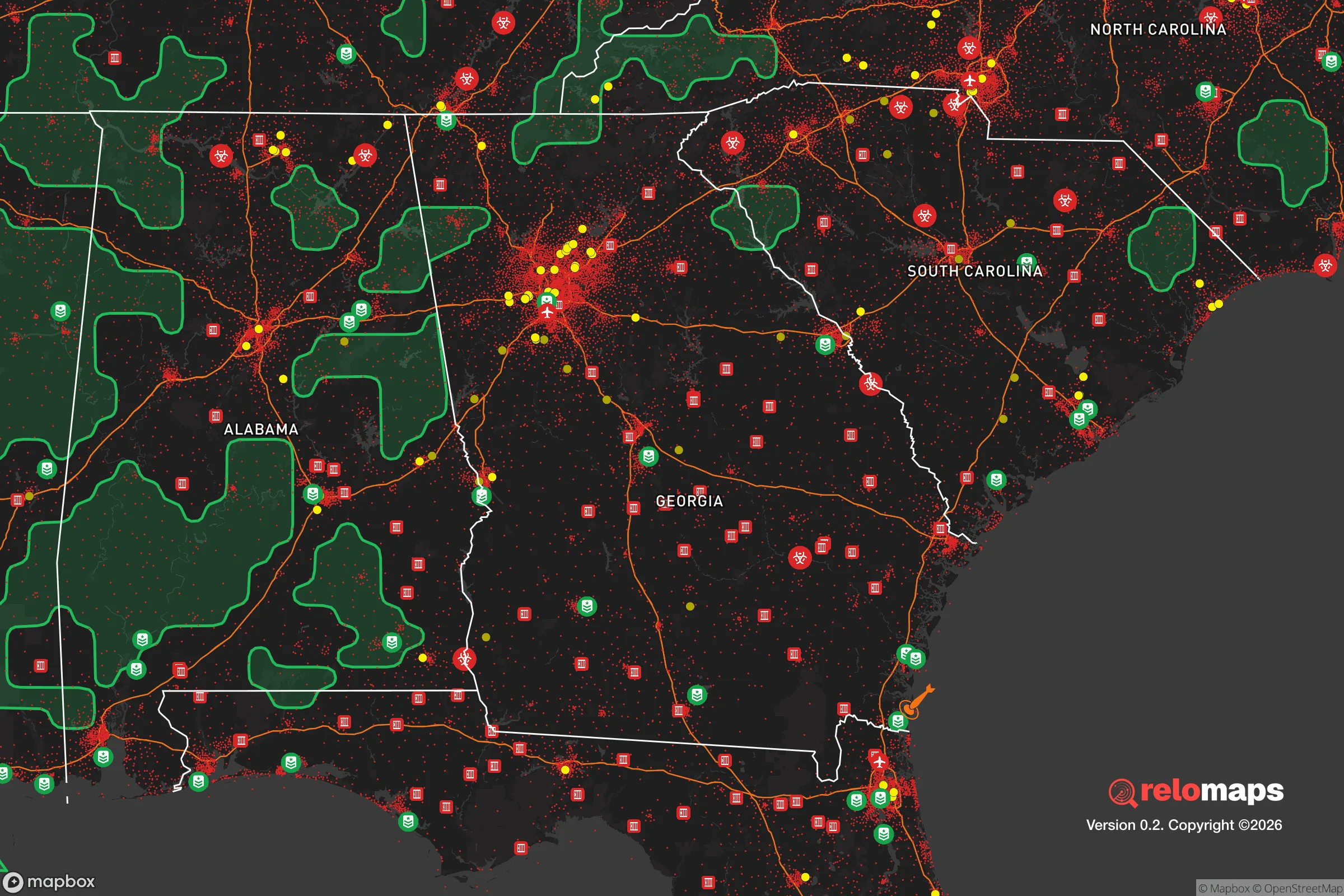


Important Note: For informational purposes only. This does not mean nothing bad ever happens in the green zones. Please use common sense. This is based on public data and modeled with AI. We tried to take a conservative approach but mistakes happen. We update this regularly as new information becomes available.
Solar Generator Recommendations
Backup power matters more here than in safer locations. We've picked three solar generators across budgets and capacity tiers — start with the budget unit if you only need a few essentials, or step up if you want to run a fridge and HVAC for days at a time.

Jackery Portable Power Station Explorer 300
Budget OptionPower on the Go: Weighing only 11 lbs, it's convenient to set up and store with book-sized foldable solar panels

BLUETTI Portable Power Station AC180
Designed for both indoor and outdoor scenarios, AC180 is highly capable as it has a robost capacity and continuous output power.

EF ECOFLOW DELTA Pro Ultra Power Station
Upgraded PickEcoFlow DELTA Pro Ultra is a whole-home energy system designed to grow with your family. Integrated with the Smart Home Panel 2, it scales to meet your evolving energy needs — keeping your home powered, intelligent, and secure through every stage of life.
We earn a commission, at no additional cost to you.
Strategic Assessment Analysis
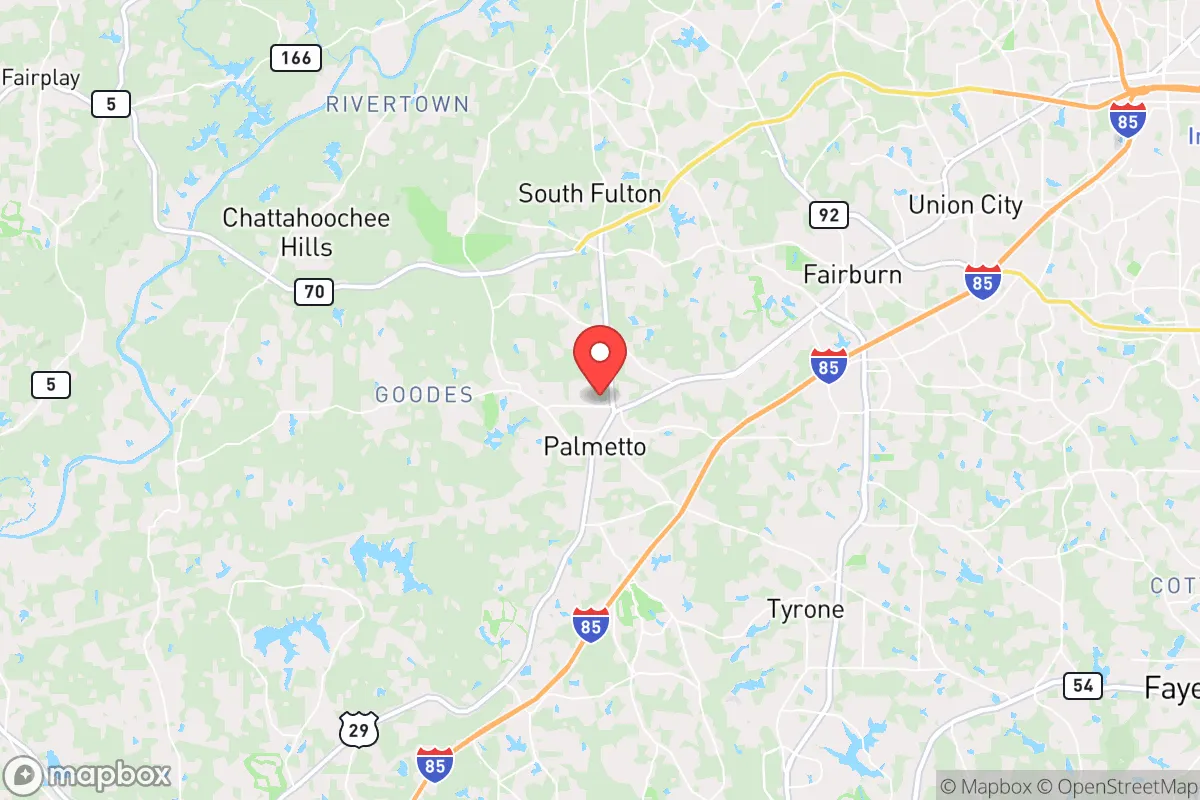
Palmetto, Georgia, offers a compelling strategic position for those prioritizing resilience and self-sufficiency, balancing proximity to Atlanta's economic engine with a distinctly rural character that provides meaningful buffer from major metropolitan vulnerabilities. Located roughly 30 miles southwest of downtown Atlanta along the I-85 corridor, this small city of approximately 5,000 residents sits at the edge of the Atlanta metropolitan area's suburban sprawl, where development gives way to farmland and forest. For a relocator thinking seriously about disaster readiness, Palmetto's location provides a rare combination: access to urban resources within a 35-45 minute drive, while maintaining enough distance to avoid the worst of a major metropolitan crisis, whether natural or man-made.
Geographic position and natural advantages for long-term security
Palmetto sits in southern Fulton County, near the border with Coweta and Fayette counties, placing it in the Piedmont region of Georgia—a landscape of rolling hills, mixed hardwood and pine forests, and clay-based soils that offer several inherent resilience advantages. The area's elevation, roughly 900-1,000 feet above sea level, provides natural drainage that significantly reduces flood risk compared to low-lying areas closer to the Chattahoochee River or coastal Georgia. The local terrain is not mountainous, but the gentle hills and valleys offer modest defensive advantages, including good line-of-sight for communications and natural barriers that slow the spread of ground-level hazards.
The region's climate is humid subtropical, with hot summers and mild winters, which supports year-round food production and reduces the heating energy demands that burden northern locations during grid-down scenarios. Average annual rainfall of roughly 50 inches provides reliable water recharge, and the area sits atop the Piedmont aquifer system, which, while not as productive as the coastal Floridan aquifer, offers viable well water at depths of 100-300 feet in most locations. The growing season extends from late March through early November, allowing for substantial home food production. Palmetto's position places it outside the primary hurricane impact zones of the Gulf and Atlantic coasts, though remnants of tropical systems can bring heavy rain and wind. Tornado risk is moderate, consistent with the broader southeastern U.S., but the rolling terrain reduces the likelihood of the kind of catastrophic, long-track tornadoes seen in the Great Plains.
Risk exposure and proximity to fallout-relevant landmarks
The most significant risk factor for Palmetto is its location within the broader Atlanta metropolitan area, which presents both natural and man-made exposure concerns. The city lies approximately 12 miles from Hartsfield-Jackson Atlanta International Airport, one of the world's busiest aviation hubs, and within 30 miles of multiple major transportation corridors, rail yards, and industrial facilities that could be targets in a conflict scenario or sources of hazardous material incidents. The proximity to Atlanta means that a major event—whether a terrorist attack, grid-down electromagnetic pulse (EMP) scenario, or large-scale civil unrest—would likely produce significant secondary effects in Palmetto, including refugee flow, supply chain disruption, and potential security challenges as people flee the urban core.
On the natural disaster front, the area's primary exposures are severe thunderstorms, occasional tornadoes, and the risk of extended power outages from ice storms or high wind events. The 2021 winter storm that crippled Texas demonstrated that the southeastern grid, while more robust than Texas's isolated system, is not immune to cascading failures during extreme weather. Palmetto is not located near any nuclear power plants—the closest is Plant Hatch in Baxley, Georgia, roughly 180 miles southeast—which reduces one specific fallout concern. However, the general density of infrastructure in the Atlanta region means that an EMP event affecting the eastern U.S. grid would leave Palmetto without power for an extended period, alongside most of the Southeast. The area's distance from major military installations (Fort Moore is roughly 100 miles southwest) is a modest positive, as it reduces the likelihood of being near a primary target in a conventional conflict.
Practical resilience for a relocator: food, water, energy, and defensibility
For a relocator serious about self-sufficiency, Palmetto offers a practical foundation that requires deliberate effort to fully realize. The area's agricultural heritage means that farmland and rural lots are still available at reasonable prices compared to northern Atlanta suburbs, with 5-20 acre parcels common in the surrounding unincorporated areas. The clay-loam soil is workable for gardening and small-scale farming, though it benefits from organic amendment to improve drainage and fertility. Local farmers' markets and agricultural supply stores in nearby Newnan and Fayetteville provide access to seeds, tools, and livestock supplies, and the region has a strong tradition of hunting and fishing that supplements food security.
Water availability is a relative strength. While municipal water in Palmetto comes from the Chattahoochee River system and is vulnerable to treatment plant disruption, the area's groundwater potential is good for those willing to invest in a well. Typical well depths of 150-250 feet yield 10-30 gallons per minute in most locations, sufficient for household use and limited irrigation. Rainwater catchment is also viable given the annual precipitation, though Georgia's water rights laws require permits for larger systems. For energy resilience, the area's tree cover and southern orientation make solar photovoltaic systems practical, with most properties receiving 4.5-5.0 peak sun hours per day. Wood heating is a realistic option given the abundant forestland, and many rural properties already have fireplaces or wood stoves installed.
Defensibility is moderate. Palmetto's location on relatively flat terrain with good road access means it is not naturally fortified, but the surrounding rural areas offer properties with limited access points, tree cover for concealment, and distance from major roads that reduces casual traffic. The local law enforcement presence is typical for a small Georgia town—Fulton County Sheriff's Office provides primary coverage, with response times that can exceed 20 minutes in the most rural areas. This places a premium on personal security preparations and neighborhood mutual-aid networks. The local population skews conservative and self-reliant, which aligns well with a preparedness mindset, and there are active shooting ranges, gun clubs, and outdoor recreation communities in the area that facilitate skill-building.
Palmetto's overall strategic picture is one of balanced opportunity and acknowledged risk. It offers genuine advantages for the relocator seeking a base within striking distance of Atlanta's economy but outside its crisis footprint: good water resources, viable agricultural land, a moderate climate, and a community culture that values self-reliance. The primary trade-offs are the proximity to a major metropolitan target zone and the associated risks of secondary effects during a large-scale event. For a family or individual willing to invest in well water, solar power, and food production systems, Palmetto provides a realistic foundation for long-term resilience without requiring a complete retreat from modern life. The key is to treat the location as a base camp rather than a fortress—close enough to benefit from the region's resources, far enough to survive its vulnerabilities.

* Values derived from national, state, county, city and local statistics and may differ in a specific area. Last updated: 2026-10-14T23:20:11.000Z
Narrative content on this page is AI-generated and may contain mistakes. Verify any details that matter before acting on them.
ReloMaps may earn a commission from affiliate links at no extra cost to you.

