Photo: Wikipedia
Demographics of Palmetto, GA
Affluence Level in Palmetto, GA
A middle-class area roughly in line with national averages across income, home values, education, and employment.
People of Palmetto, GA
Today, Palmetto, Georgia, is a small city of 4,681 residents with a distinctly working-class character, where Black residents form the majority at 51.1% and Hispanic residents make up a significant 19.7% of the population. The city is notably less diverse in educational attainment than the Atlanta metro average, with only 13.2% of adults holding a college degree, and the foreign-born share sits at a low 3.3%. Palmetto’s identity is rooted in its railroad and agricultural past, and it remains a quieter, more affordable alternative to the fast-growing suburbs of southern Fulton County and northern Coweta County. For those moving in, the city offers a tight-knit, historically grounded community that is gradually diversifying along its edges.
How the city was settled and grew
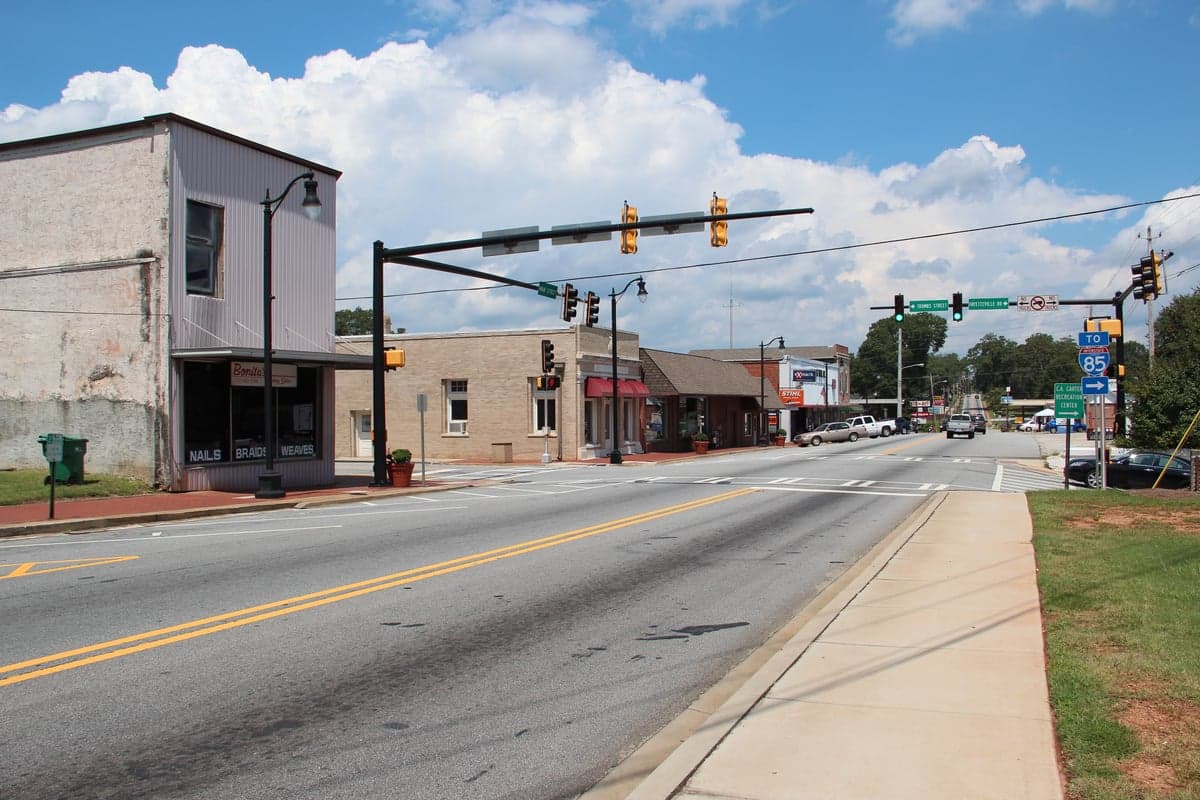
Palmetto was founded in the 1840s as a railroad stop along the Atlanta & West Point Railroad, which connected the growing inland cotton economy to the port of Savannah. The original settlers were white yeoman farmers and merchants from the Georgia Piedmont, drawn by cheap land and the promise of rail access for shipping cotton. The town was officially incorporated in 1854, and by the late 19th century, a small Black population had formed around the railroad depot and along Main Street, working as laborers, domestic servants, and sharecroppers on surrounding farms. The historic Palmetto Depot District — centered on the train station — became the commercial and social heart of the town, where both races interacted in commerce but lived separately. Through the early 1900s, the population remained overwhelmingly white and native-born, with cotton ginning and timber milling as the primary employers. The Great Depression hit hard, and the town’s population stagnated until the post-World War II era, when a modest wave of white families from rural Alabama and Georgia moved in, settling in the West Palmetto area along U.S. 29.
Modern era (post-1965)
After the 1965 Hart-Cellar Act and the broader Civil Rights movement, Palmetto’s demographic profile began to shift. The 1970s and 1980s saw a steady out-migration of white families to newer suburbs in Coweta and Fayette counties, while Black families from rural south Georgia and Atlanta’s inner-city neighborhoods moved into the East Palmetto and South Fulton Road corridors, drawn by lower housing costs and proximity to industrial jobs in Union City and Fairburn. By 1990, the city had become majority Black, a shift that accelerated through the 2000s. The Hispanic population began to grow noticeably after 2000, driven by construction and landscaping jobs in the booming Atlanta exurbs; these families concentrated in the Palmetto Station area near the railroad tracks and along Broad Street, where older rental housing was affordable. Today, the city’s racial composition — 51.1% Black, 23.3% white, 19.7% Hispanic, and negligible Asian (0.3%) and Indian (0.0%) shares — reflects a community shaped by domestic migration and limited international immigration. The low foreign-born rate (3.3%) underscores that Palmetto remains a predominantly native-born, Southern city, unlike the more globally diverse suburbs closer to Atlanta’s core.
The future
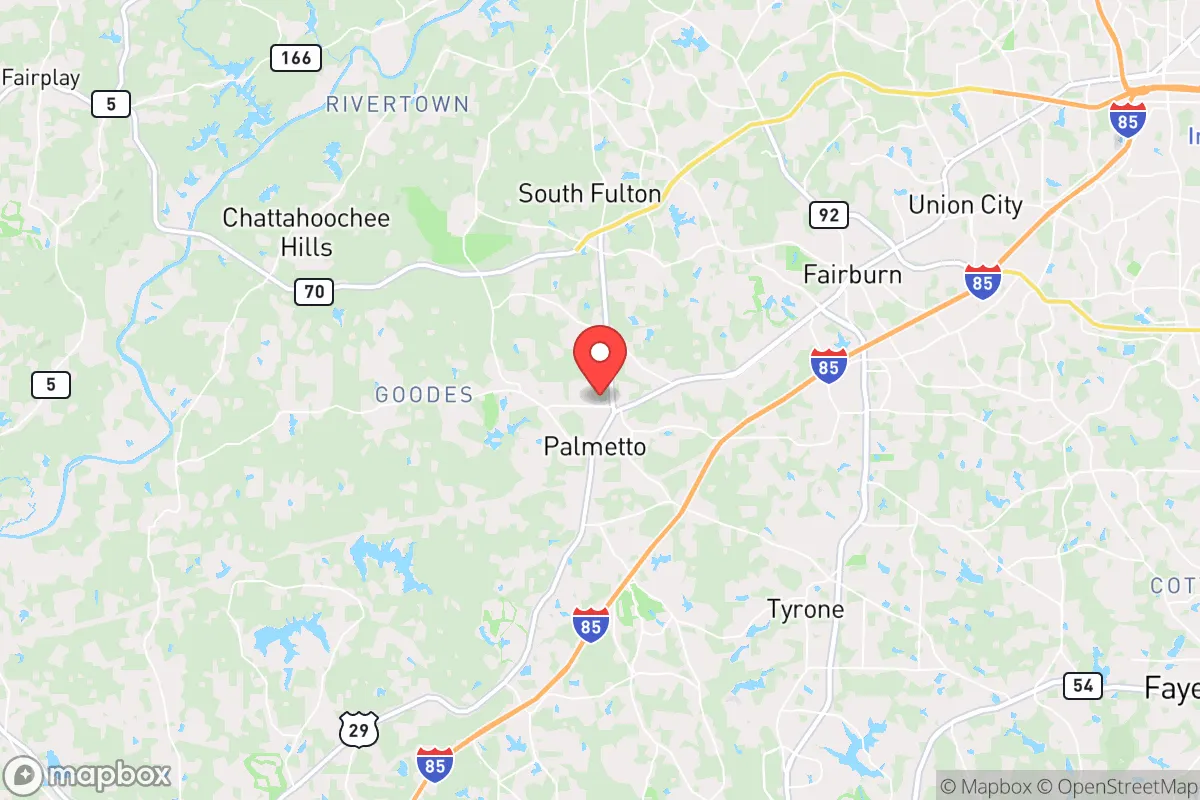
Palmetto’s population is likely to grow modestly over the next decade, driven by spillover from the rapidly developing areas of southern Fulton County and northern Coweta County, including the Chattahoochee Hills and Riverview districts. The Hispanic share is expected to continue rising as families seek affordable housing and service-sector jobs, while the Black majority may stabilize or grow slightly as Atlanta’s gentrification pushes lower-income residents further south. The white population, now a minority, is likely to remain stable or decline slowly, as few new white families are moving into the city limits. The city’s cultural identity is becoming more Hispanic-influenced, with Spanish-language signage and small tiendas appearing along Broad Street, but the overall character remains working-class and Southern. For a newcomer, Palmetto offers a low-cost entry point into the Atlanta region, but the trade-off is limited amenities, a small tax base, and a population that is less educated and less globally connected than the metro average.
Palmetto is becoming a more Hispanic and persistently Black, working-class suburb on the southern fringe of the Atlanta metro — a place where affordability and history matter more than rapid growth or cosmopolitan diversity. For a family or individual moving in now, the city provides a stable, rooted community with a clear sense of place, but one that will likely remain economically modest and demographically stable rather than transforming into a boomtown. The next 10-20 years will probably see gradual infill development along the U.S. 29 corridor and a slow increase in Hispanic residents, but no dramatic shift in the city’s fundamental character.

* Values derived from national, state, county, city and local statistics and may differ in a specific area. Last updated: 2026-10-14T23:20:11.000Z
Narrative content on this page is AI-generated and may contain mistakes. Verify any details that matter before acting on them.
ReloMaps may earn a commission from affiliate links at no extra cost to you.

