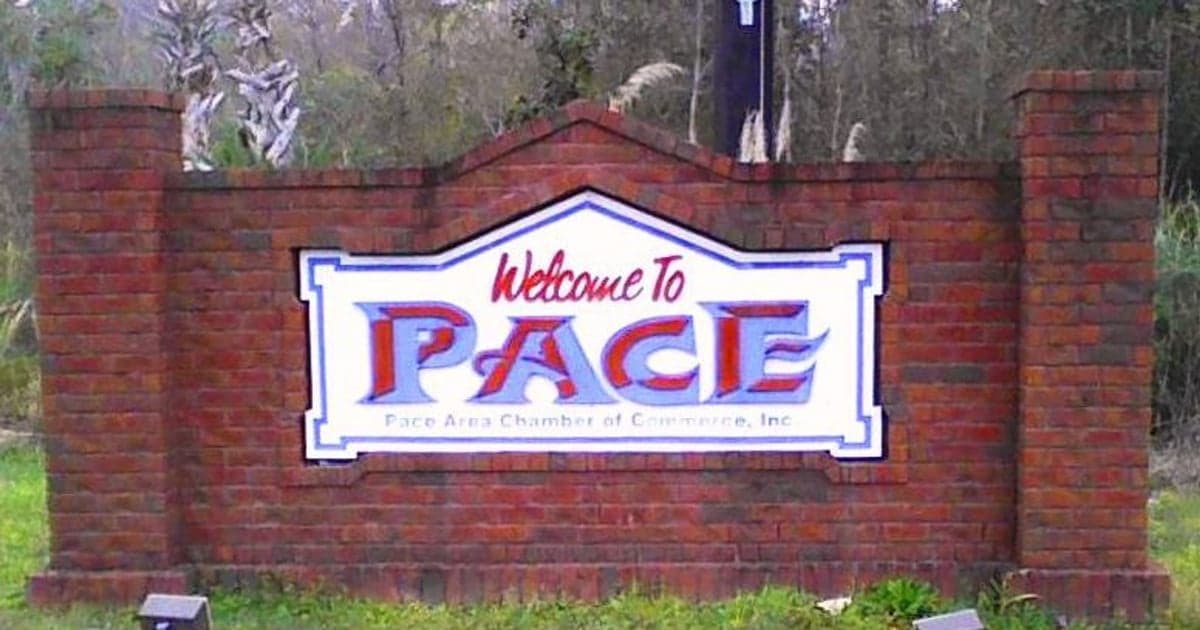
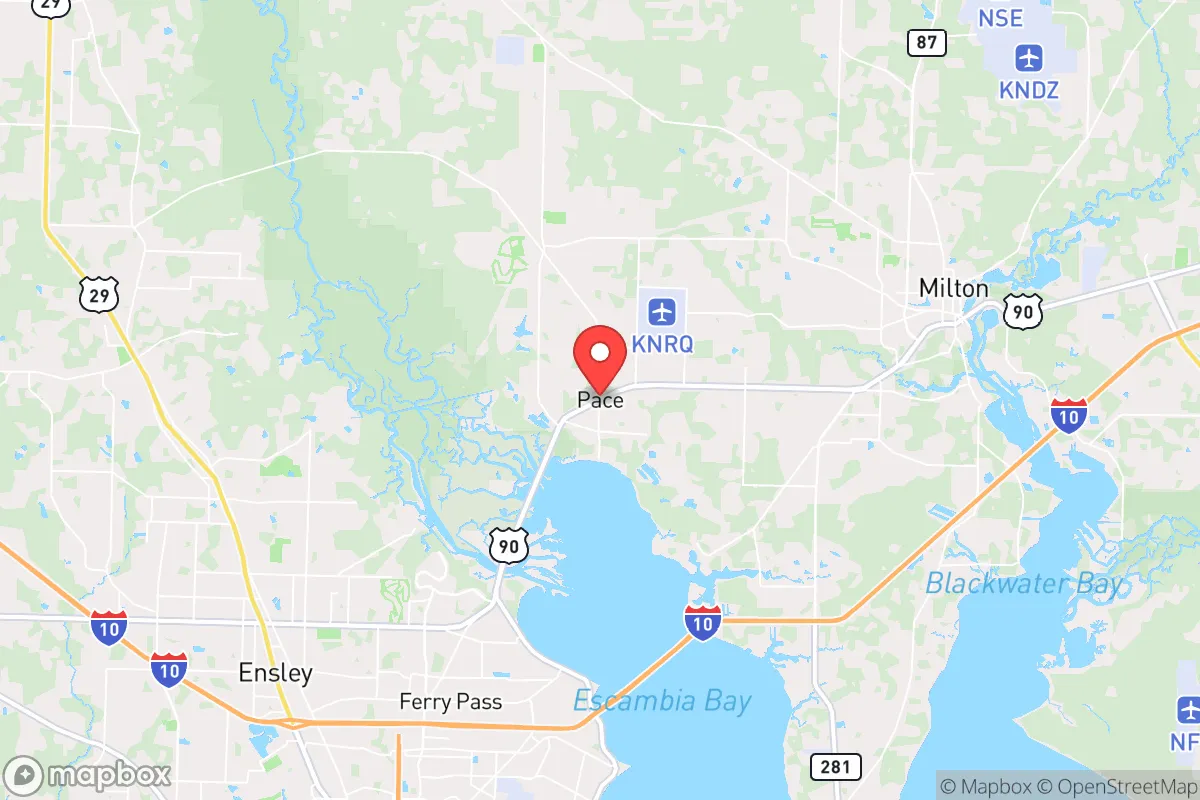
Photo: Wikipedia
Personal Sovereignty in Pace, FL
Viable for self-reliance. Generally workable, though some barriers may limit total independence.
What does Personal Sovereignty tell us?
Personal Sovereignty measures your capacity for self-reliance and independence with minimal government friction. Higher scores mean fewer barriers between you and the way you want to live... but it assumes you have the space you need and good neighbors.
What does this tell us?
Personal Sovereignty measures your capacity for self-reliance and independence with minimal government friction. Higher scores mean fewer barriers between you and the way you want to live... but it assumes you have the space you need and good neighbors.
State Policy
Energy independence: Importer (12% of energy produced in-state)
Personal Liberty
Homesteading

Personal Liberty Analysis
Pace, Florida, situated in Santa Rosa County within the Florida Panhandle, offers a personal sovereignty environment that is heavily shaped by the state's broad preemption laws and a local culture of self-reliance. Residents here operate under a framework where state-level protections for gun rights, property use, and medical autonomy are strong, while local government maintains a relatively light touch on day-to-day life. For individuals and families who prioritize independence, Pace provides a legal and cultural setting where the default answer to personal choices is often "yes," provided those choices do not infringe on neighbors' rights or violate state statutes.
Tax burden and regulatory posture in Santa Rosa County
Florida's lack of a state income tax is the cornerstone of Pace's low tax burden, meaning residents keep 100% of their earned wages. Santa Rosa County supplements this with a relatively modest property tax rate, typically around 0.8% to 1.0% of assessed home value, which is below the national average. The county's regulatory posture is generally permissive, especially compared to more urbanized areas like Miami-Dade or Broward. Business licensing is straightforward, and there are no county-level occupational licenses for most trades, though state-level professional licensing still applies. Zoning in Pace is primarily agricultural and low-density residential, which limits the scope of local ordinances that might restrict property use. The regulatory environment is best described as "light-touch" — the county focuses on basic safety and environmental compliance without imposing layers of bureaucratic hurdles. For a family or individual, this translates to fewer fees, less paperwork, and more freedom to use property as they see fit, within broad state guidelines.
Self-defense and gun law specifics in Pace, FL
Florida's firearm laws are among the most protective of individual rights in the nation, and Pace residents benefit directly from this framework. The state operates under a constitutional carry system as of July 2023, meaning no permit is required to openly carry a firearm or to carry a concealed weapon for anyone legally allowed to possess a gun. For those who still wish to obtain a concealed carry license (useful for reciprocity in other states), the process is shall-issue with no discretionary denial by local sheriffs. Florida also has a Stand Your Ground law with no duty to retreat in any place where a person has a legal right to be, including public spaces. Santa Rosa County Sheriff's Office is known for a pro-Second Amendment stance, and local gun ranges and training facilities are plentiful. There are no county-level firearm-specific restrictions beyond state law, and private firearm sales between individuals are not regulated by local ordinance. For a resident prioritizing self-defense sovereignty, Pace offers a legal environment where the right to keep and bear arms is treated as a fundamental, preempted right that local governments cannot infringe upon.
Self-reliance and homesteading viability: lot sizes, zoning, and off-grid feasibility
Pace's zoning and land-use patterns strongly support self-reliance and homesteading ambitions. The area is characterized by large residential lots — commonly one to five acres — with many properties zoned for agricultural use (AG) or rural residential (RR). This means raising chickens, goats, or even a small herd of cattle is typically permitted without special permits, as long as basic setback and animal welfare standards are met. Off-grid feasibility is moderate but improving. While Santa Rosa County does not mandate connection to municipal water or sewer on larger lots, well and septic systems are standard and permitted through straightforward county health department processes. Solar panel installation is allowed without restrictive homeowner association (HOA) interference on unincorporated land, though some subdivisions may have covenants. Rainwater collection is legal and encouraged for non-potable uses. The main constraint is that the county does require building permits for structures, and electrical work must meet state code if grid-tied. However, for a family willing to manage their own water, waste, and power, Pace offers a viable path to a high degree of self-sufficiency without running afoul of local regulations.
Personal liberties: parental rights, medical autonomy, speech, and property
Florida's legal climate under recent state legislation has strengthened several dimensions of personal liberty that directly affect Pace residents. Parental rights in education are explicitly protected by state law, giving parents broad authority over their children's curriculum, medical decisions, and records. Medical autonomy is supported by Florida's informed consent laws for medical procedures and a legal framework that generally defers to individual choice in treatment, though vaccine mandates have been prohibited at the state level for most public-facing contexts. Free speech is robustly protected under both the Florida and U.S. Constitutions, and Santa Rosa County has not enacted local ordinances that restrict expressive activity beyond standard time-place-manner rules. Property rights are strongly defended through Florida's Private Property Rights Protection Act, which requires government to compensate landowners if a regulation reduces property value by more than 50%. This creates a powerful disincentive against overreaching local zoning changes. For a resident who values the ability to make decisions about their family, health, and property without government interference, Pace's legal environment is among the most accommodating in the Southeast.
Overall, Pace, Florida, ranks as a high-sovereignty area within the United States, particularly for those who prioritize gun rights, low taxation, and the ability to live self-sufficiently. The combination of state-level preemption, a permissive county regulatory culture, and large-lot zoning creates a living environment where personal autonomy is the baseline expectation rather than an exception. Compared to areas in the Northeast or West Coast with extensive land-use controls and higher tax burdens, Pace offers a markedly lighter regulatory touch. For the single individual or family seeking a place where the government's role is limited and personal responsibility is the norm, Pace represents a strong option in the Florida Panhandle's freedom-friendly corridor.

* Values derived from national, state, county, city and local statistics and may differ in a specific area. Last updated: 2026-11-08T00:46:37.000Z
Narrative content on this page is AI-generated and may contain mistakes. Verify any details that matter before acting on them.
ReloMaps may earn a commission from affiliate links at no extra cost to you.

