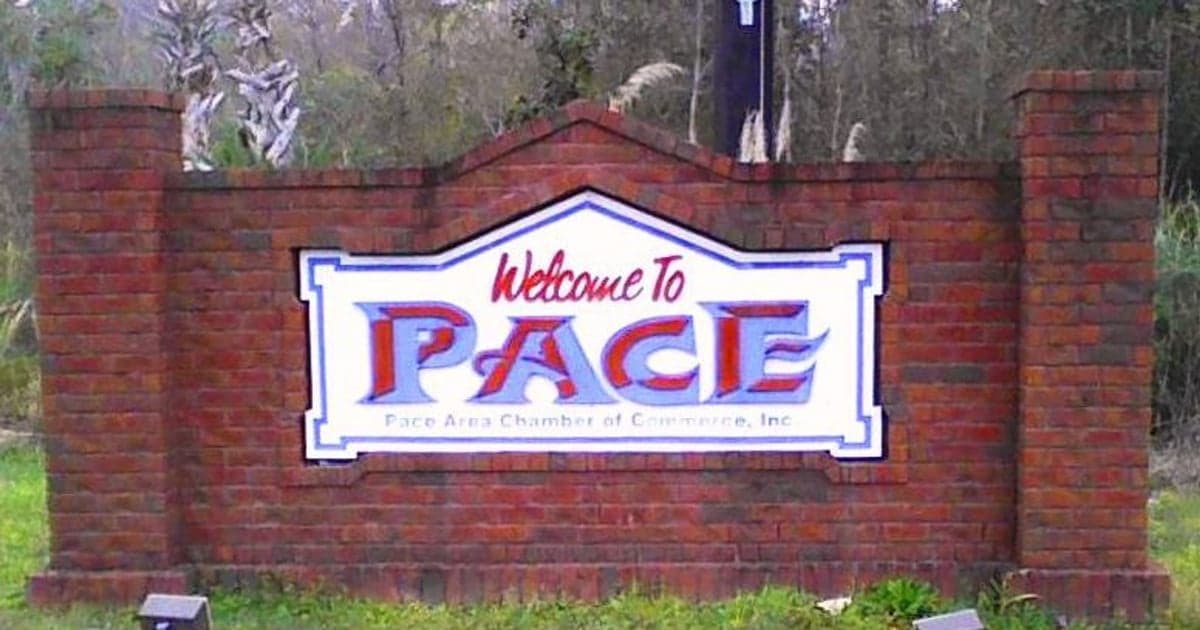
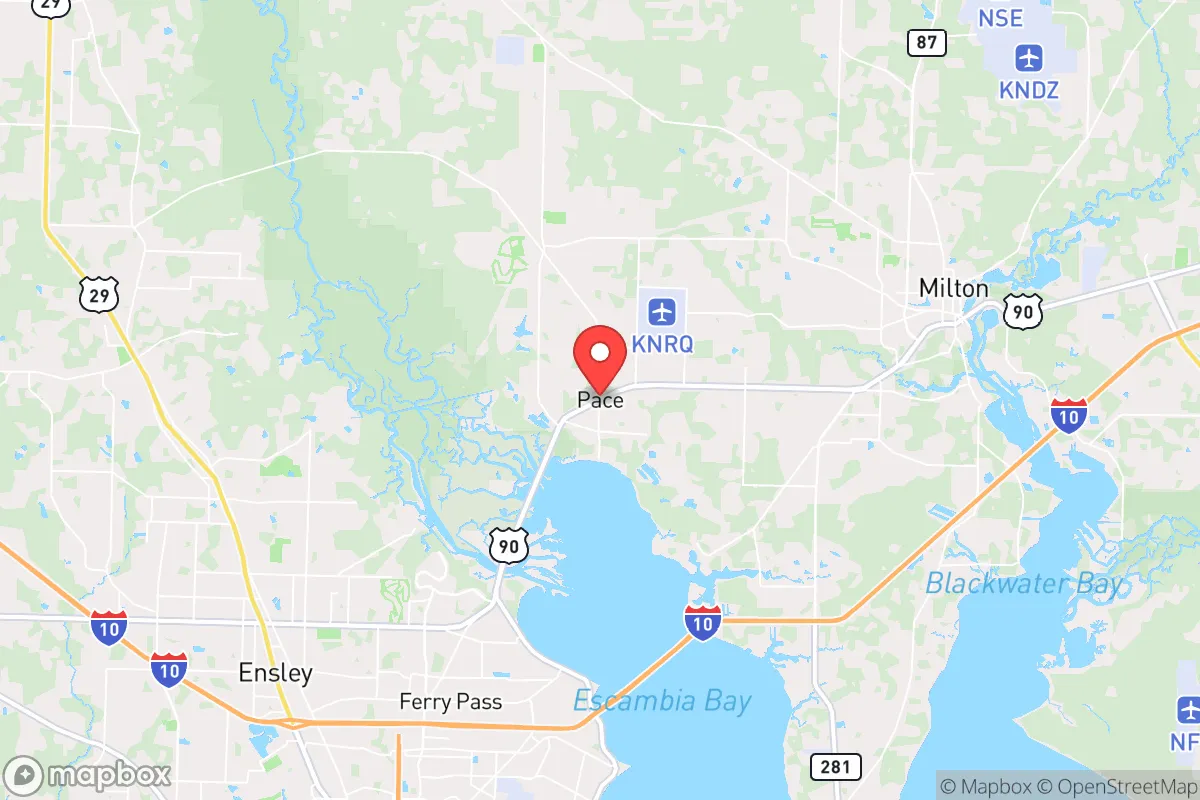
Photo: Wikipedia
Demographics of Pace, FL
Affluence Level in Pace, FL
A middle-class area roughly in line with national averages across income, home values, education, and employment.
People of Pace, FL
The people of Pace, Florida today form a predominantly white, family-oriented community of roughly 25,630 residents, characterized by a notably low foreign-born share of just 1.6% and a strong suburban identity. The city’s population is 84.9% white, with a Hispanic or Latino share of 5.8%, a Black population of 2.3%, and East/Southeast Asian communities at 1.8%. Distinctively, Pace feels more like an unincorporated bedroom community than a traditional city, with a high proportion of single-family homes, a median age around 38, and a culture deeply tied to nearby Pensacola and the Eglin Air Force Base economy.
How the city was settled and grew
Pace was not a colonial-era settlement but a product of the 20th-century timber and railroad economy. The area was originally part of a vast pine forest, and the first permanent residents were loggers and mill workers drawn to the region’s abundant longleaf pine. The community’s name comes from the Pace family, who established a sawmill and general store in the late 1800s near what is now the intersection of US-90 and Chumuckla Highway. The original settlement clustered around Pace Proper, the historic core near the old mill site, where a handful of farmsteads and worker cottages housed the first families—mostly of Scots-Irish and English descent from neighboring Alabama and Georgia. By the 1930s, the population remained sparse, with fewer than 500 residents, as the economy relied on small-scale agriculture and timber. The post-World War II era brought the first significant wave of newcomers: returning veterans and defense workers drawn to the expanding Naval Air Station Pensacola and Whiting Field. These families settled in the East Pace area, along Berryhill Road, where modest ranch homes were built on large lots, establishing the pattern of low-density suburban development that defines the city today.
Modern era (post-1965)
The 1965 Hart-Cellar Act had minimal direct impact on Pace’s demographics, as the city remained overwhelmingly white and native-born. Instead, the major population driver after 1965 was domestic in-migration from other parts of the South, particularly from Louisiana and Mississippi, as well as from military families transferring to nearby bases. The 1970s and 1980s saw the development of Woodbine, a large subdivision off Woodbine Road that absorbed many of these new arrivals—mostly young families seeking affordable housing and good schools. By the 1990s, Pace’s population had grown to over 10,000, and the city began to attract a small but growing Hispanic community, primarily of Mexican and Central American origin, who found work in construction, landscaping, and the service industry. These families concentrated in the Five Points area near the intersection of US-90 and Woodbine Road, where a handful of Hispanic-owned businesses and a Catholic mission church served as community anchors. The East/Southeast Asian population, largely Filipino and Vietnamese, grew modestly during this period, tied to military and medical professional networks, and settled in the North Pace neighborhoods near Highway 197. The Indian-subcontinent population remains very small at 0.6%, with no distinct neighborhood concentration. The Black population, at 2.3%, is dispersed rather than clustered, reflecting Pace’s history as a predominantly white suburb with limited historical Black settlement.
The future
Pace’s population is projected to grow moderately over the next decade, driven by continued spillover from Pensacola and the broader Santa Rosa County housing market. The city’s demographic profile is expected to remain predominantly white, but the Hispanic share is likely to increase gradually, potentially reaching 8–10% by 2035, as younger families move into newer subdivisions like Marsh Landing and Whispering Pines in the western part of the city. These new communities are attracting a mix of first-time homebuyers and retirees, with homes priced between $300,000 and $500,000. The East/Southeast Asian population may see modest growth as medical professionals continue to relocate to the area for jobs at Santa Rosa Medical Center and Pensacola’s hospitals. The foreign-born share is expected to remain low, likely below 3%, as Pace lacks the industrial or agricultural base that draws larger immigrant populations. The city’s cultural identity is evolving from a quiet rural crossroads to a more suburban, commuter-oriented community, with new retail and dining options along US-90 reflecting a broader Southern suburban norm. For someone moving in now, Pace offers a stable, low-diversity environment with strong schools and a family-focused lifestyle, but those seeking a more cosmopolitan or ethnically diverse setting may find the pace of change slower than in larger Florida metros.
In short, Pace is becoming a more polished, slightly more diverse version of its former self—still overwhelmingly white and native-born, but with a growing Hispanic presence and a steady influx of military-affiliated and professional families. The city’s future is one of managed growth, where new subdivisions fill in remaining farmland while the core neighborhoods retain their established character. For a relocating family or individual, Pace represents a safe, predictable choice in a region where demographic change is gradual and community values remain rooted in traditional Southern suburban life.

* Values derived from national, state, county, city and local statistics and may differ in a specific area. Last updated: 2026-11-08T00:46:37.000Z
Narrative content on this page is AI-generated and may contain mistakes. Verify any details that matter before acting on them.
ReloMaps may earn a commission from affiliate links at no extra cost to you.

