
Photo: Wikipedia
Political ClimatePolitical Climate in Otis, MA
District shown is the primary district for this city’s centroid. Cities may span multiple districts.
Local Political AnalysisPolitical Analysis of Otis, MA
Otis is a reliably Democratic town in a reliably Democratic state, but it’s not as deep blue as the rest of Massachusetts. The town’s Cook Partisan Voting Index (PVI) of D+8 is a solid seven points more moderate than the state’s D+15 rating. In practice, that means while a Democrat will almost always carry Otis in a presidential or statewide race, the margin is usually tighter here than in, say, Cambridge or Boston. You’ll see a noticeable number of Trump signs on lawns in the rural stretches, especially along Route 8 and near the Tolland state line, which you just don’t get in the western suburbs of Springfield. The trend over the last decade has been a slow drift leftward, mirroring the state, but the town’s small population—around 1,600 people—means local elections often hinge on personality and town services, not party labels.
How it compares
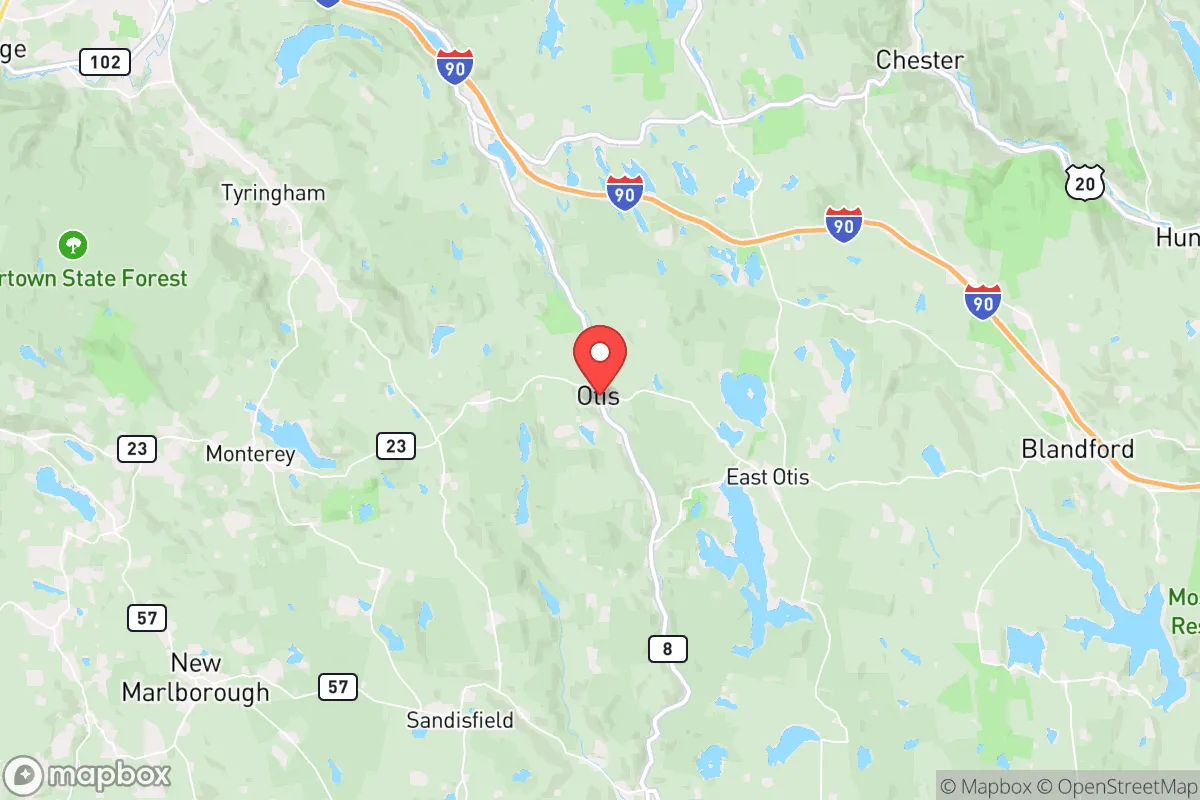
Otis sits in the far southwest corner of Berkshire County, an area that’s politically distinct from the rest of the state. The county as a whole is D+12, but Otis is the most conservative town in the southern part of the county. Head north to Lee or Lenox, and you’re in D+15 or D+18 territory, with a much more liberal, arts-and-tourism-driven electorate. Drive east into Hampden County, and towns like Blandford or Chester are actually Republican-leaning (R+5 or so), creating a sharp political border just a few miles away. Compared to the state average, Otis has a higher proportion of registered unenrolled voters—about 55%—and a lower share of active Democrats. The state’s D+15 PVI reflects the overwhelming Democratic majorities in Greater Boston, Worcester, and the Pioneer Valley; Otis’s D+8 is closer to what you’d see in a suburban town like Milton or Arlington, but with a much more rural, independent-minded character.
What this means for residents
For a liberal resident, Otis feels comfortable but not insulated. You’ll win every local election if you run as a Democrat, but you’ll have neighbors who disagree on taxes, gun rights, and development. The town’s small size means you’ll know those neighbors personally, so political arguments tend to stay civil. For a conservative resident, the reality is that you’re a clear minority in town and an even smaller one in the county. You won’t find a local GOP committee meeting in Otis—you’d have to drive to Great Barrington or Pittsfield for that. But you’re not isolated: the nearby towns in Hampden County and across the border in New York (Columbia County) offer more like-minded company. The practical effect of the D+8 lean is that town government is pragmatic, not ideological. The select board and school committee focus on road maintenance, snow plowing, and the volunteer fire department, not national wedge issues. Both sides can agree on keeping property taxes low—Otis has no town-wide sewer system and minimal municipal services—which is a rare point of unity.
The biggest cultural distinction in Otis is its fierce independence, which cuts across party lines. The town has a strong tradition of opposing large-scale development, whether it’s a proposed solar farm or a new subdivision. This NIMBY-ish streak is common in rural Massachusetts, but in Otis it’s amplified by the fact that many residents are second-home owners or retirees who moved here specifically to get away from the politics and pace of the city. You’ll hear as much grumbling about Boston’s influence on state policy from Democrats as from Republicans. The state’s recent push for MBTA Communities Act compliance (requiring multi-family zoning near transit) has been met with skepticism here, even though Otis has no train station. In the long term, the town’s political trajectory will likely follow the state’s, but at a slower pace—Otis will probably never be as blue as the rest of Massachusetts, and that’s exactly how most residents, regardless of party, want it.

State Political ClimatePolitical Climate in Massachusetts
State Political AnalysisPolitical Environment in the State
Massachusetts is one of the most reliably Democratic states in the country, with a Cook Partisan Voting Index of D+15, meaning it votes about 15 points more Democratic than the national average in presidential elections. Over the past 20 years, the state has shifted further left, driven by the consolidation of the Boston metro area and the emptying out of its once-competitive industrial towns. For a conservative relocator, this means you are moving into a state where Democrats hold every statewide office, a supermajority in the legislature, and all 11 U.S. House seats — but the political reality on the ground is more nuanced than the registration numbers suggest, with distinct pockets of red and purple that can make daily life feel very different depending on where you land.
Urban vs. rural divide
The political map of Massachusetts is a classic urban-rural split, but with a twist: the urban core is so dominant that it overwhelms the rest of the state. Boston and its immediate suburbs (Cambridge, Somerville, Brookline) are among the most liberal jurisdictions in the country, routinely voting 80-90% Democratic. The I-495 belt — places like Framingham, Lowell, and Worcester — has shifted blue over the last decade as professional-class commuters and immigrant populations have grown. Meanwhile, the western part of the state, including Berkshire County (Pittsfield, Great Barrington) and the Pioneer Valley (Northampton, Amherst), is also deeply blue, driven by college towns and a strong progressive activist base. The real red territory is in the central and southeastern rural areas: Plymouth County towns like Carver and Middleborough, Bristol County towns like Freetown and Berkley, and the Cape Cod interior (Barnstable, Yarmouth) often vote Republican by 10-20 points in local races. The most reliably Republican county in the state is Worcester County's northern tier (Winchendon, Templeton, Phillipston), where Trump won 60%+ in 2020. But these areas are small in population — the entire western half of the state has fewer people than Boston's inner suburbs.
Policy environment
Massachusetts has a high-tax, high-service policy environment that is a feature, not a bug, for its majority. The state income tax is a flat 5% (recently reduced from 5.15% via a 2022 ballot measure), and the sales tax is 6.25%. Property taxes are locally set and vary wildly — Boston's rate is about $10.50 per $1,000 of assessed value, while rural towns like Ashfield can hit $18. The state has a robust regulatory apparatus: strict environmental permitting, a strong building code, and a notoriously slow permitting process for new construction. Education policy is a point of pride — Massachusetts consistently ranks #1 in K-12 outcomes nationally, but that comes with high per-pupil spending (over $20,000) and a heavy emphasis on MCAS testing and charter school caps. Healthcare is near-universal, with the state's 2006 reform serving as the model for the ACA. Election laws are among the most accessible in the country: no-excuse mail-in voting, same-day registration, and early voting are all permanent fixtures. For a conservative, the practical effect is that you will pay more in taxes and fees, but you will get reliable services — good roads, excellent schools, and a safety net that works.
Recent policy direction
The last five years have seen a clear leftward acceleration on several fronts. On gun and self-defense law, Massachusetts already had some of the strictest laws in the nation (licensing, assault weapon ban, magazine capacity limits), and in 2024 the legislature passed a major expansion: a ban on "ghost guns," a requirement for serial numbers on all frames and receivers, and a new "red flag" law that allows family members or police to petition for temporary removal of firearms. On parental and education rights, the state has moved in the opposite direction from many red states: in 2023, it passed a law requiring all public schools to adopt policies supporting transgender students' use of names, pronouns, and facilities consistent with their gender identity, overriding local school board discretion. On speech and privacy, Massachusetts has a strong public records law and a shield law for journalists, but it also has a broad anti-SLAPP statute that can make it hard to sue critics. On medical and bodily autonomy, the state is a fortress for abortion rights — the 2020 ROE Act removed parental consent requirements for minors and allowed abortion after 24 weeks for fatal fetal anomalies — and in 2024 it passed a shield law protecting providers who prescribe abortion pills via telehealth to patients in states with bans. On property rights, the state's "Chapter 40B" law allows developers to bypass local zoning if they include affordable housing, which has been a flashpoint in suburban towns. On taxation, the 2022 "millionaire's tax" (a 4% surcharge on income over $1 million) passed with 52% support, and the revenue is earmarked for education and transportation. On voting and ballot access, the state has moved to automatic voter registration via the RMV and has no voter ID requirement at the polls (though you need ID to register).
Civil unrest & political movements
Massachusetts has a long tradition of organized activism, but it's overwhelmingly left-of-center. The 2020 George Floyd protests in Boston were large and sustained, with several nights of clashes between police and demonstrators, and led to the creation of a police reform law in 2021 that banned chokeholds and created a statewide certification system. The immigration politics are a major flashpoint: Massachusetts is a "sanctuary state" under a 2017 law that limits local police cooperation with ICE, and in 2023-2024, the state's emergency shelter system (the only "right to shelter" law in the country) was overwhelmed by an influx of migrants, leading to a political crisis. Governor Maura Healey, a Democrat, declared a state of emergency and began capping shelter stays. On the right, the Massachusetts Fiscal Alliance and the MassGOP are active but marginalized — the party has not won a statewide race since 2014. There is a small but vocal Second Amendment sanctuary movement in towns like Palmer and Spencer, where local boards have passed resolutions opposing new gun laws, but these have no legal force. Election integrity controversies are minimal — the state's mail-in voting system was widely used in 2020 and 2022 with no major fraud allegations, and the Republican secretary of state (a rare GOP officeholder until 2022) certified all results without controversy.
Projection
Over the next 5-10 years, Massachusetts will likely become even more Democratic, but the nature of that dominance may shift. In-migration is heavily from New York and Connecticut, and these newcomers tend to be younger, more diverse, and more liberal, settling in the Boston metro and the I-495 corridor. The rural red towns are aging and shrinking — places like Adams and North Adams in the Berkshires have lost 10-15% of their population since 2000. The state's high cost of housing (median home price over $600,000) is pushing some middle-class families out, but those who leave tend to be more moderate or conservative, while the arrivals are more progressive. The Republican Party is in a structural crisis — it has not held a legislative seat in Boston or Cambridge in decades, and its base is increasingly confined to the exurbs and the Cape. Expect continued leftward movement on climate policy (the state has a net-zero by 2050 law), housing regulation (more state preemption of local zoning), and social issues (possibly a "right to housing" constitutional amendment). For a conservative moving in now, the political environment will feel more constrained in a decade, not less.
The bottom line for a conservative relocator: If you choose Massachusetts, you are accepting that your vote for president or Senate will be a protest vote, not a deciding one. But your daily life will be shaped more by your town than by the state — a move to a red town like Carver, Middleborough, or Winchendon will give you a local government that reflects your values, even as the state government does not. You will pay high taxes and navigate a thicket of regulations, but you will also get excellent schools, reliable infrastructure, and a social safety net that works. The trade-off is real, and it's worth understanding before you sign the lease.
* Values derived from national, state, county, city and local statistics and may differ in a specific area. Last updated: 2026-09-29T17:16:35.000Z
Narrative content on this page is AI-generated and may contain mistakes. Verify any details that matter before acting on them.
ReloMaps may earn a commission from affiliate links at no extra cost to you.

