
Photo: Wikipedia
Personal Sovereignty in Otis, MA
Moderate friction. Expect trade-offs in some aspect of personal liberty and independence.
What does Personal Sovereignty tell us?
Personal Sovereignty measures your capacity for self-reliance and independence with minimal government friction. Higher scores mean fewer barriers between you and the way you want to live... but it assumes you have the space you need and good neighbors.
What does this tell us?
Personal Sovereignty measures your capacity for self-reliance and independence with minimal government friction. Higher scores mean fewer barriers between you and the way you want to live... but it assumes you have the space you need and good neighbors.
State Policy
Energy independence: Importer (5% of energy produced in-state)
Personal Liberty
Homesteading

Personal Liberty Analysis
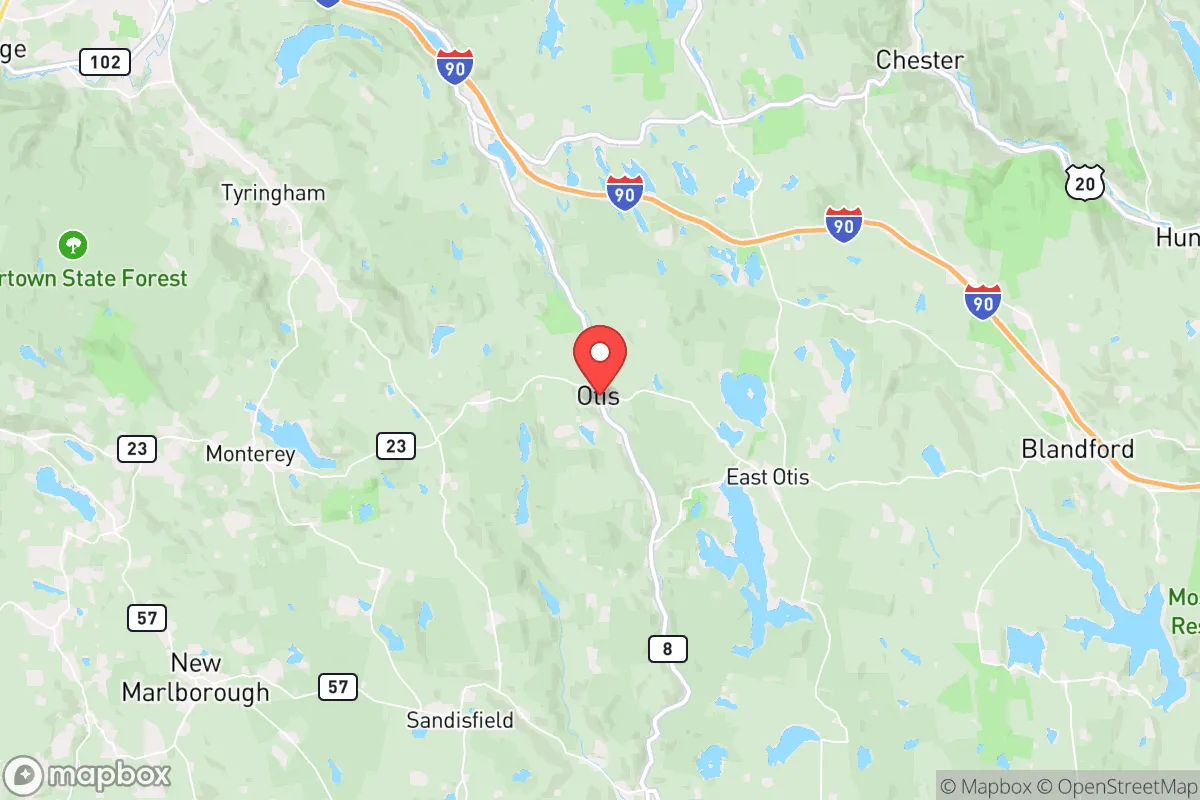
Otis, Massachusetts, offers a notably high degree of personal sovereignty within the broader context of a state known for its regulatory density, making it a strategic choice for those prioritizing autonomy. While Massachusetts imposes a significant state-level tax burden and a comprehensive regulatory framework, the rural character of Otis—a town of roughly 1,600 residents in the Berkshires—creates a practical environment where self-reliance is not just possible but often necessary. The key for a freedom-minded individual or family is understanding that Otis provides a buffer of physical distance and local governance culture from the more interventionist tendencies of Boston, resulting in a unique balance of state-level constraints and local-level liberty.
Tax burden and regulatory posture in a rural Massachusetts context
Massachusetts carries a relatively high tax burden, ranking among the top ten states nationally. The state income tax is a flat 5.0% on most income, and the state sales tax is 6.25%. Property taxes in Otis, however, are a more nuanced story. The town's effective property tax rate is approximately $12.50 per $1,000 of assessed value, which is below the state average but still higher than many low-tax states. For a home valued at $350,000, this translates to roughly $4,375 annually. The regulatory posture in Otis is light-touch relative to urban Massachusetts. The town has no local zoning overlay for most residential parcels, and building permits are handled with a practical, rural efficiency. The state's building code (the 10th Edition of the Massachusetts State Building Code) applies, but enforcement in Otis is less aggressive than in suburban communities. The biggest regulatory hurdle for newcomers is the state's Title 5 septic system regulations, which can require costly upgrades when selling a property. Overall, the tax and regulatory environment is a trade-off: you pay a premium for state services (roads, schools, emergency services) but enjoy minimal local interference in how you use your land.
Self-defense and gun law specifics in Berkshire County
Massachusetts has some of the most restrictive gun laws in the nation, and Otis residents must comply fully. The state requires a License to Carry (LTC) for both open and concealed carry, which is issued by the local police chief (in Otis, the Berkshire County Sheriff's Office handles this). The process includes a background check, fingerprinting, a firearms safety course, and a fee of $100. The "may-issue" standard was effectively replaced by a "shall-issue" standard after the Bruen decision, but local chiefs still retain discretion on restrictions. In practice, Otis's chief is known to be reasonable, and most applicants with clean records receive an unrestricted LTC. The state bans "assault weapons" as defined by Massachusetts law, limits magazine capacity to 10 rounds, and requires all firearm transfers to go through a licensed dealer. There is no "stand your ground" law; Massachusetts imposes a duty to retreat if safely possible before using deadly force in self-defense. Castle Doctrine applies to one's home, but with a narrower scope than in many states. For a gun owner, Otis is a place where you can legally own and carry firearms, but the process is more burdensome and the legal landscape more restrictive than in neighboring New York or Vermont. The practical reality is that many residents own firearms for hunting and home defense, and the local culture is supportive of responsible gun ownership.
Self-reliance and homesteading viability: lot sizes, zoning, and off-grid feasibility
Otis is a strong candidate for homesteading and self-reliant living. The town's minimum lot size is 2 acres in most residential districts, with many parcels being 5 to 20 acres. Zoning is minimal: there are no restrictions on keeping chickens, goats, or even small livestock on residential lots, provided they are not a nuisance. The town allows accessory dwelling units (ADUs) without special permits, which is useful for multi-generational living or rental income. Off-grid feasibility is high but requires careful planning. The state's building code requires a connection to the electrical grid if available within 300 feet, but many rural lots are beyond that distance, making solar with battery storage a practical option. Well water and septic systems are standard, and the town does not require municipal water or sewer hookups. Wood stoves are common for supplemental heat, and the town's fire department is volunteer-based, keeping costs low. The biggest constraint is the state's wetlands protection act, which can limit clearing and building near streams or ponds. For a family wanting to grow food, raise animals, and reduce reliance on external systems, Otis offers a permissive local environment within a state that still requires compliance with health and safety codes.
Personal liberties: parental rights, medical autonomy, speech, and property
Parental rights in Massachusetts are generally strong, but the state has a progressive framework. Parents have the right to homeschool under state law, but they must submit an annual education plan to the local school district for approval. In Otis, the school district (Farmington River Regional School District) is accommodating, and most plans are approved without issue. Medical autonomy is a mixed bag. Massachusetts has a mandatory vaccine schedule for school attendance, with medical and religious exemptions available but increasingly scrutinized. The state's health insurance mandate requires residents to carry coverage or face a tax penalty. However, Otis residents have access to a range of alternative healthcare providers in the Berkshires, and the rural setting allows for more personal choice in daily health decisions. Free speech is fully protected under the First Amendment, and the town's small, tight-knit community means that controversial opinions are generally tolerated rather than policed. Property rights are strong in practice: the town has no rent control, no short-term rental bans, and no inclusionary zoning. The state's Chapter 40B law can force towns to allow affordable housing developments, but Otis's rural character and low population density make such projects rare. The biggest property rights concern is the state's conservation restrictions and the Massachusetts Endangered Species Act, which can limit development on certain parcels. For a property owner, the rule is: buy a lot that is already cleared and buildable, and you will have few surprises.
Overall, Otis offers a high degree of personal sovereignty relative to most of Massachusetts, but it is not a libertarian enclave. The state's tax burden, gun laws, and health mandates are real constraints that a freedom-minded individual must accept. However, the town's rural character, minimal local zoning, and permissive homesteading environment create a practical space for self-reliance that is increasingly rare in the Northeast. For a family or individual who values autonomy and is willing to navigate state-level regulations, Otis provides a solid foundation for a life built on personal responsibility and independence, with the trade-off being a higher tax and regulatory baseline than in states like New Hampshire or Vermont.

* Values derived from national, state, county, city and local statistics and may differ in a specific area. Last updated: 2026-09-29T17:16:35.000Z
Narrative content on this page is AI-generated and may contain mistakes. Verify any details that matter before acting on them.
ReloMaps may earn a commission from affiliate links at no extra cost to you.

