
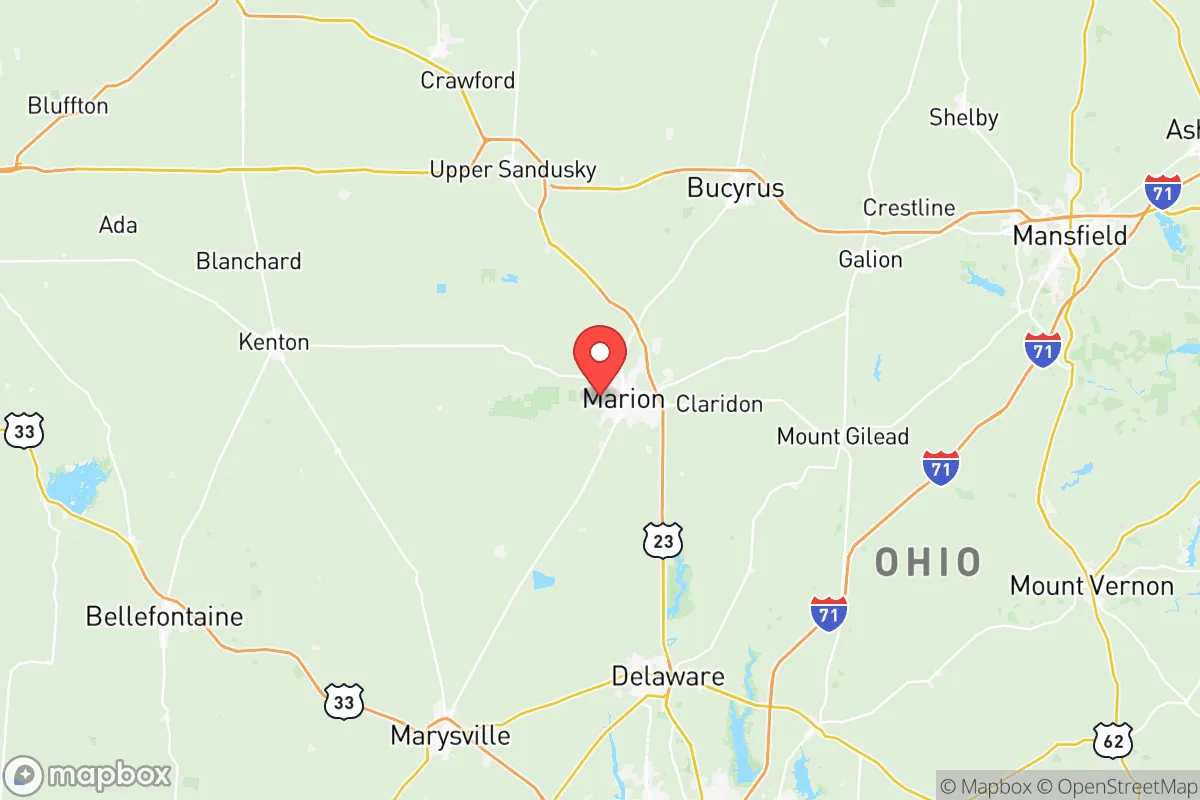
Photo: Wikipedia
Personal Sovereignty in Marion County
Viable for self-reliance. Generally workable, though some barriers may limit total independence.
What does Personal Sovereignty tell us?
Personal Sovereignty measures your capacity for self-reliance and independence with minimal government friction. Higher scores mean fewer barriers between you and the way you want to live... but it assumes you have the space you need and good neighbors.
What does this tell us?
Personal Sovereignty measures your capacity for self-reliance and independence with minimal government friction. Higher scores mean fewer barriers between you and the way you want to live... but it assumes you have the space you need and good neighbors.
State Policy
Energy independence: Importer (40% of energy produced in-state)
Personal Liberty
Homesteading

Personal Liberty Analysis
Marion County, Ohio, offers a notably higher degree of personal sovereignty than much of the urbanized eastern half of the state, particularly for those concerned with government overreach and preserving autonomy. The county’s small-town and rural character, combined with Ohio’s generally permissive state-level framework on firearms, property rights, and taxation, creates an environment where individuals and families can exercise significant control over their lives. While no location is a libertarian utopia, Marion County’s blend of low regulatory density, a self-reliant cultural ethos, and proximity to larger markets makes it a serious consideration for those prioritizing personal freedom.
Tax burden and regulatory posture: How Marion County compares to Ohio’s urban centers
Ohio’s state-level tax structure is moderate, with a flat income tax rate of 3.5% as of 2026 and a sales tax of 5.75%, but local jurisdictions add their own layers. Marion County’s combined sales tax rate is 7.25%, which is lower than the 8%+ rates found in Columbus (Franklin County) or Cincinnati (Hamilton County). Property taxes in Marion County are a significant advantage: the effective rate averages around 1.3% of assessed home value, compared to 1.8% or higher in many suburban Columbus districts. This difference can save a homeowner $500–$1,000 annually on a $200,000 property. The regulatory posture is equally favorable. Marion County does not impose the kind of zoning overlays, tree preservation ordinances, or stormwater management fees that plague homeowners in places like Delaware or Powell. Building permits are straightforward, and there are no county-level rental registration schemes or short-term rental bans, unlike in Marengo or Cardington where some townships have adopted minimal restrictions. For a prepper or homesteader, this means fewer bureaucratic hurdles when constructing a workshop, installing a fence, or adding a livestock shelter.
Self-defense and gun law specifics: What Ohio’s permitless carry means for Marion County residents
Ohio became a permitless carry state in 2022, meaning any law-abiding adult 21 or older can carry a concealed handgun without a license. This is a foundational liberty for those prioritizing self-defense. Marion County’s sheriff’s office is known for a pro-Second Amendment stance, and the county has no local ordinances that restrict magazine capacity, firearm types, or storage requirements—unlike the patchwork of bans in cities like Columbus or Toledo. The county’s rural and small-town character means that open carry is common and socially accepted, particularly in towns like LaRue and New Bloomington. Stand-your-ground laws apply statewide, with no duty to retreat in any place where a person is lawfully present. For parents, this legal environment means that teaching firearm safety and responsible ownership is not undermined by local government overreach. The only practical limitation is that Ohio prohibits carrying into certain posted locations (schools, government buildings, airports), but these restrictions are uniform and predictable. For those who want to build a defensive capability, Marion County’s gun culture is robust, with multiple local ranges and gun shops in Marion and Prospect.
Self-reliance and homesteading viability: Lot sizes, zoning, and off-grid feasibility across Marion County
Marion County is a strong candidate for homesteading and off-grid living, but viability varies by location. The county’s zoning is minimal: most townships (like Grand Prairie and Claridon) have no zoning at all, allowing for livestock, gardens, and workshops without permits. Minimum lot sizes in unincorporated areas are typically 1–2 acres, but many parcels of 5–10 acres are available for $5,000–$10,000 per acre, far cheaper than the $30,000+/acre in Delaware County. Off-grid feasibility is high: Ohio’s net metering policy allows solar panel owners to sell excess power back to the grid, and there are no county-level bans on rainwater collection or composting toilets. However, the county does enforce state building codes for new construction, so a completely off-grid cabin must meet basic structural and septic standards. In towns like Morral and Caledonia, residents routinely keep chickens, goats, and even small cattle herds on 2–5 acre lots without neighbor complaints. The biggest constraint is water: well drilling is common and costs $5,000–$10,000, but some areas near the Scioto River have high iron content requiring filtration. For a prepper, the ability to raise food, store supplies, and generate power without government interference is a major draw.
Personal liberties: Parental rights, medical autonomy, speech, and property protections
Ohio’s state-level legal framework provides strong protections for parental rights, medical freedom, and property ownership, and Marion County’s local culture reinforces these. Parental rights in education are robust: Ohio’s “Parents’ Bill of Rights” (enacted 2023) requires schools to notify parents of any changes in a child’s health or well-being and prohibits instruction on sexual orientation or gender identity in K-3. Marion County’s school districts—including Marion City, Pleasant, and Ridgedale—have largely complied without controversy. Medical autonomy is protected by Ohio’s ban on vaccine passports and its prohibition of mandatory COVID-19 vaccines for employment or school attendance. The county has no local health orders that restrict private medical choices, unlike the mandates seen in Cuyahoga County or Franklin County during the pandemic. Free speech is protected by the First Amendment, and Marion County has no local ordinances restricting political signage, leafleting, or public assembly. Property rights are strong: Ohio’s “takings” laws require just compensation for any regulatory taking, and the county has no rent control or inclusionary zoning mandates. For a conservative individual or parent, this means the government stays out of your home, your child’s education, and your medical decisions.
Overall, Marion County offers a level of personal sovereignty that is rare in Ohio’s urban corridor. While it lacks the extreme low-tax environment of a state like Texas or Florida, its combination of permitless carry, minimal zoning, strong parental rights, and a self-reliant culture makes it a standout in the Midwest. For those fleeing the regulatory creep of Columbus or the high costs of Delaware County, Marion County provides a practical, affordable, and legally permissive base for building an autonomous life. The key trade-off is lower economic opportunity and fewer services, but for those who prioritize freedom over convenience, it is a compelling choice.

* Values derived from national, state, county, city and local statistics and may differ in a specific area. Last updated: 2026-05-14T18:15:14.000Z
Narrative content on this page is AI-generated and may contain mistakes. Verify any details that matter before acting on them.
ReloMaps may earn a commission from affiliate links at no extra cost to you.

