Photo: Wikipedia
Demographics of Marion County
Affluence Level in Marion County
A below-average socioeconomic profile. Incomes, home values, and educational attainment trail the U.S., with higher poverty and unemployment.
People of Marion County
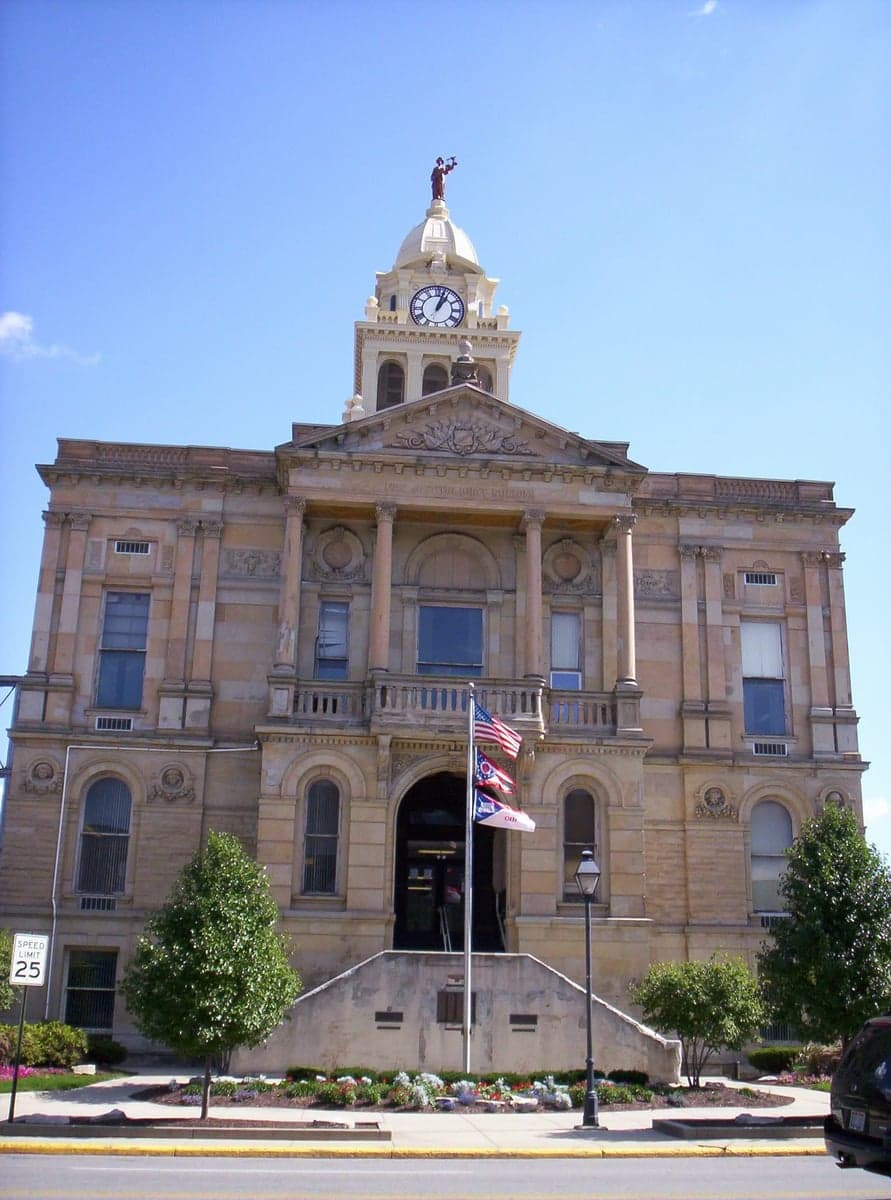
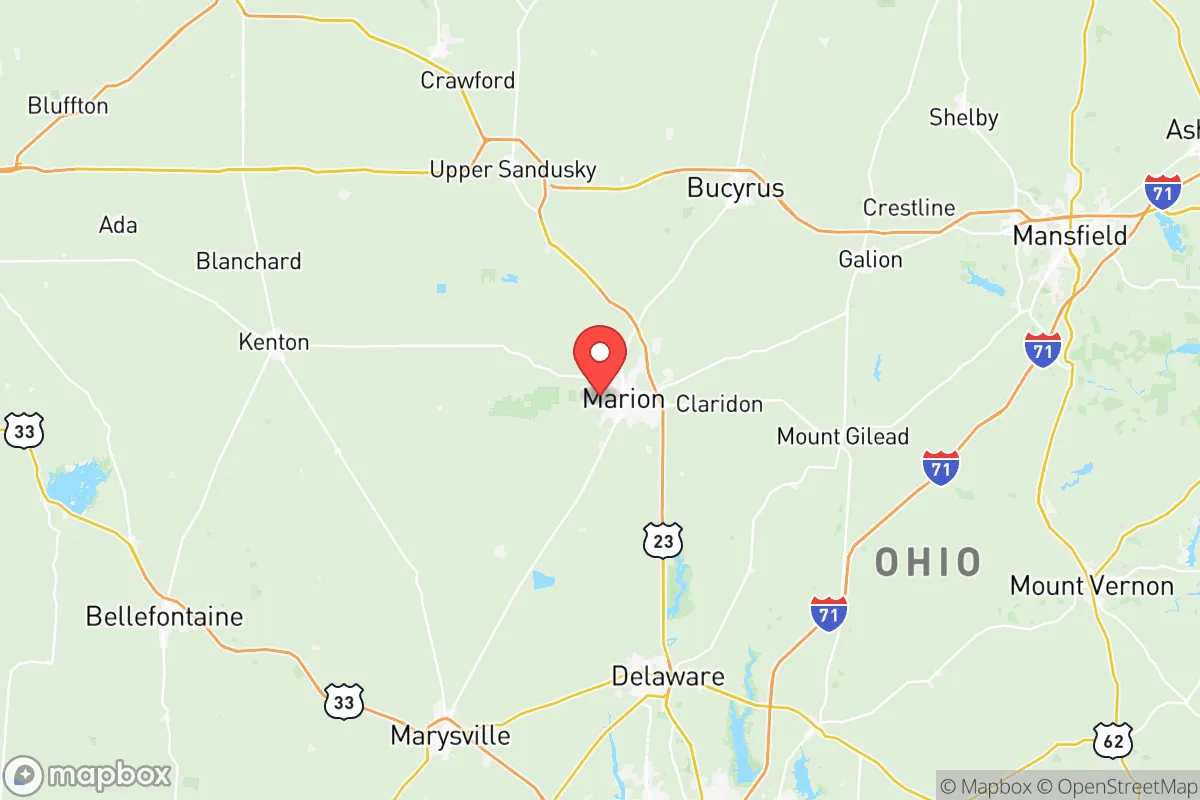
Marion County, Ohio, is a predominantly white, working-class community of 65,145 residents, characterized by a strong manufacturing and agricultural heritage and a population density of roughly 140 people per square mile. The county's identity is rooted in its history as a railroad and industrial hub, with a population that is 86.6% white, 4.9% Black, and 3.1% Hispanic, and a notably low foreign-born share of just 0.6%. The county seat, Marion, anchors the region, while smaller towns like Caledonia, Prospect, and Waldo retain a rural, small-town character. With only 13.7% of adults holding a bachelor's degree or higher, the population skews toward blue-collar employment and traditional Midwestern values, making it a culturally conservative area with limited ethnic diversity.
Settlement & growth (pre-1960)
Before American settlement, the area now known as Marion County was part of the hunting grounds of the Wyandot and Shawnee nations, who used the region's river valleys for seasonal camps. The first permanent American settlers arrived in the early 1800s, primarily of Scots-Irish and German stock, drawn by the fertile soils of the Scioto River basin and the promise of cheap land under the Land Act of 1800. The county was formally organized in 1824, and the town of Marion was platted in 1822, quickly becoming the county seat due to its central location.
The arrival of the railroad in the 1850s transformed Marion County from a quiet agricultural outpost into a transportation and manufacturing hub. The Atlantic and Great Western Railroad (later part of the Erie Railroad) established a major junction in Marion, bringing a wave of Irish and German immigrants who built the tracks and later settled in the city's near-east side, an area still known locally as "the Flats." By the 1880s, the discovery of natural gas and the rise of the Marion Steam Shovel Company (later Marion Power Shovel) created a boom in heavy industry, attracting a second wave of European immigrants—primarily Poles, Slovaks, and Italians—who found work in the foundries and factories. These groups concentrated in Marion's south end, around the industrial corridor along the railroad tracks, and in the village of Green Camp, which housed many quarry and shovel workers.
The early 20th century saw the arrival of Black Americans during the Great Migration, moving from the rural South to fill industrial jobs in Marion's factories, particularly at the Marion Power Shovel and the Huber Manufacturing Company. By 1930, the Black population had grown to roughly 3% of the county total, with most families settling in Marion's near-north side, along Church Street and around the historic St. Paul African Methodist Episcopal Church. The post-World War II era brought a modest suburbanization wave, as returning veterans used GI Bill benefits to build homes in the villages of Prospect and Caledonia, but the county's population remained overwhelmingly white and native-born, with the foreign-born share peaking at just 4% in 1910 and declining steadily thereafter.
Modern era (post-1965)
The 1965 Hart-Cellar Act had minimal impact on Marion County, as the region lacked the economic pull or established ethnic networks to attract significant post-1965 immigration. The foreign-born population today stands at just 0.6%, one of the lowest rates in Ohio, and the county's demographic story since 1965 has been one of domestic out-migration and aging rather than new arrivals. The decline of heavy manufacturing in the 1970s and 1980s—Marion Power Shovel laid off thousands before closing in the 1990s—triggered a steady exodus of working-age residents to Sun Belt states and larger Ohio cities like Columbus and Cincinnati. The county's population peaked at 66,217 in 1970 and has since fluctuated around 65,000, with a slight decline of about 1.6% since 2020.
The Hispanic population, now 3.1%, grew modestly after 2000, driven by Mexican and Central American migrants who found work in Marion County's remaining agricultural sector—particularly in the cucumber and tomato fields around the village of Morral and the township of Grand Prairie. This community remains small and dispersed, with no formal ethnic enclave, though a handful of Hispanic-owned businesses have opened along Marion's Marion-Williamsport Road corridor. The Black population, at 4.9%, has remained stable since the 1970s, concentrated in the same near-north side neighborhoods of Marion city, with little suburban spread into the surrounding townships. The East/Southeast Asian population (0.3%) and Indian subcontinent population (0.3%) are tiny, consisting mostly of professionals employed at Marion General Hospital or at the Whirlpool Corporation plant in the city's industrial park, and they are scattered across the county without any visible ethnic clustering.
Suburbanization within the county has been limited. Unlike the explosive growth of outer-ring Columbus suburbs, Marion County's villages—Waldo, LaRue, and New Bloomington—have seen only modest new housing construction, and the county's rural townships (Big Island, Claridon, and Tully) remain dominated by farmland and woodlots. The county's population is aging, with a median age of 42.3, and the 65+ cohort now makes up 19% of residents, reflecting the out-migration of younger adults and the return of some retirees to family homesteads.
The future
Marion County's population is projected to remain flat or decline slightly over the next decade, with no major demographic shifts on the horizon. The foreign-born share is unlikely to rise significantly, as the county lacks the job growth, ethnic infrastructure, or housing stock to attract new immigrants. The Hispanic population may grow incrementally through natural increase and continued agricultural labor migration, but it will likely remain below 5% of the total. The Black and Asian populations are expected to remain stable, with no signs of in-migration from larger cities.
The county is not tribalizing into distinct ethnic enclaves; rather, it is homogenizing into an older, whiter, and more culturally uniform population. The small immigrant communities that do exist are assimilating rapidly, with second-generation Hispanic and Asian residents typically leaving the county for college or jobs in Columbus or elsewhere. The cultural identity of Marion County is being shaped less by new arrivals and more by the departure of younger, more educated residents, leaving behind a population that is increasingly conservative, religious, and rooted in local traditions like the Marion County Fair and the annual Popcorn Festival (celebrating the county's status as a major popcorn producer).
For someone moving in now, Marion County offers a stable, low-cost, and safe environment with a strong sense of community, but it is not a place of demographic dynamism or cultural change. The population is what it is: overwhelmingly white, native-born, and working-class, with a quiet, slow-paced rhythm that appeals to those seeking a traditional Midwestern lifestyle away from the pressures of urban growth. The county's future is one of continuity, not transformation, and newcomers should expect to find a community that values stability, self-reliance, and neighborly familiarity over diversity or rapid change.

* Values derived from national, state, county, city and local statistics and may differ in a specific area. Last updated: 2026-05-14T18:15:14.000Z
Narrative content on this page is AI-generated and may contain mistakes. Verify any details that matter before acting on them.
ReloMaps may earn a commission from affiliate links at no extra cost to you.

