Photo: Wikipedia
Political ClimatePolitical Climate in Ocean Isle Beach, NC
District shown is the primary district for this city’s centroid. Cities may span multiple districts.
Local Political AnalysisPolitical Analysis of Ocean Isle Beach, NC
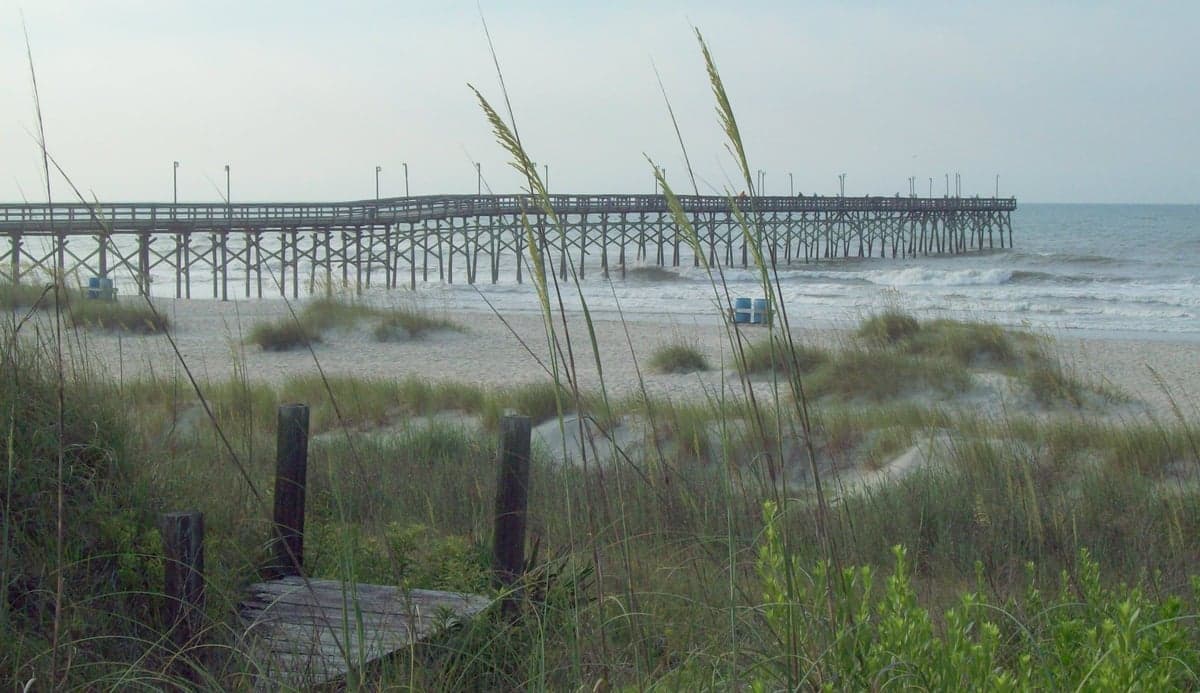
Ocean Isle Beach leans solidly Republican, with a Cook Partisan Voting Index of R+7, making it significantly more conservative than North Carolina as a whole, which sits at R+1. This isn't a new development—the area has been a reliable red stronghold for decades, driven by a mix of retirees, second-home owners, and long-time locals who prioritize low taxes and limited government. The political trajectory here is stable, with no signs of a major shift, though the influx of out-of-state buyers from blue states has introduced a small but growing contingent of moderate Democrats, particularly among seasonal residents.
How it compares
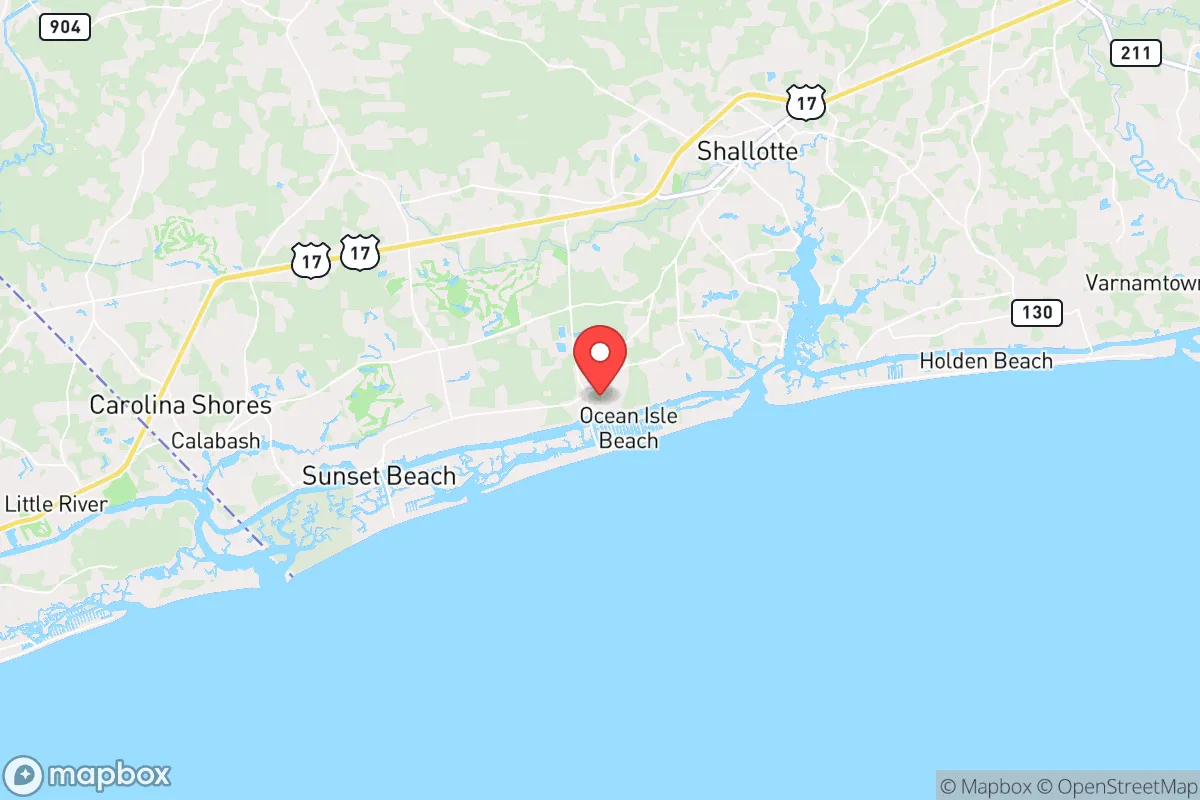
Compared to the rest of North Carolina, Ocean Isle Beach is a political outlier. The state as a whole is a classic purple battleground, with urban centers like Charlotte and Raleigh pulling it left and rural areas pushing it right. In Brunswick County, where Ocean Isle Beach sits, the Republican advantage is amplified. Nearby towns like Shallotte and Sunset Beach lean similarly conservative, while Wilmington, about 30 miles north, is more competitive—its New Hanover County voted for Biden in 2020 by a slim margin. This contrast means that a resident of Ocean Isle Beach experiences a much more uniformly conservative environment than someone in, say, Asheville or Durham. The local school board, county commission, and even the chamber of commerce are dominated by Republicans, and political discussions at the grocery store or beach bar tend to assume a conservative baseline.
What this means for residents
For conservative residents, this political climate is a comfortable fit. They see their values reflected in local governance—lower property taxes, fewer regulations on short-term rentals, and a strong emphasis on law enforcement. The county’s Republican leadership has kept development relatively unchecked, which appeals to those who want to maximize property values and business freedom. For liberal residents, life here is more about adaptation. They’re a clear minority, but not an invisible one—there’s a quiet network of progressive-leaning folks, especially among the younger workforce in hospitality and real estate. They’ll find that local elections are rarely competitive, and their votes often feel symbolic. However, the town’s small size means that personal relationships can transcend politics; a neighbor’s party affiliation matters less than whether they help with hurricane prep. The biggest practical impact is on policy: Ocean Isle Beach has no local income tax, and the county’s approach to environmental regulation is more permissive than in liberal-leaning coastal areas like the Outer Banks.
What really sets Ocean Isle Beach apart culturally is its quiet, almost apolitical vibe. Unlike the loud partisan battles in Raleigh or Charlotte, politics here is more of a background hum. People come here to escape, not to argue. The local paper, the Brunswick Beacon, covers county commission meetings and school board decisions with a neutral tone, and you’re more likely to hear complaints about beach erosion or traffic on the causeway than about national politics. That said, the area’s deep red lean does shape daily life: gun rights are widely supported, with open carry common, and the local churches—mostly Baptist and Methodist—are influential in community events. For a liberal resident, the lack of a visible progressive infrastructure (no local Democratic party office, few LGBTQ+ events) can feel isolating, but the trade-off is a low-stress, neighborly atmosphere where most people just want to enjoy the beach. Looking ahead, the political balance is unlikely to change dramatically, but the steady trickle of remote workers and retirees from blue states could nudge the county from R+7 to R+5 over the next decade—a shift that would still leave it comfortably conservative, but slightly less monolithic.

State Political ClimatePolitical Climate in North Carolina
State Political AnalysisPolitical Environment in the State
North Carolina is a classic battleground state, with a Cook PVI of R+1 that barely hints at the political knife-fight happening beneath the surface. Over the last 20 years, the state has shifted from a reliably conservative Southern stronghold to a true purple state, driven by massive in-migration into the Research Triangle (Raleigh-Durham-Chapel Hill) and the Charlotte metro, while rural eastern and western counties have hardened their Republican lean. The result is a state that votes for Republican presidential candidates by narrow margins (Trump won it by just 1.3 points in 2024) but also elects Democratic governors (Josh Stein in 2024) and a split legislature, making it one of the most politically competitive and consequential states in the country.
Urban vs. rural divide
The political geography of North Carolina is a textbook case of the urban-rural split. The major metros—Charlotte (Mecklenburg County), Raleigh and Durham (Wake and Durham Counties), and Greensboro and Winston-Salem (Guilford and Forsyth Counties)—are solidly Democratic, driven by educated professionals, tech and finance workers, and a growing diverse population. Mecklenburg County alone delivered a 30-point margin for Biden in 2020, and Wake County was similarly lopsided. Meanwhile, the rural east—places like Fayetteville (Cumberland County) and Greenville (Pitt County)—are more mixed, with military and university populations creating pockets of blue, but the surrounding counties are deep red. The western mountains, including Asheville (Buncombe County), are an island of blue in a sea of red, with Asheville itself being one of the most liberal cities in the South. The real battlegrounds are the exurban and suburban counties that have been trending blue: Union County (southeast of Charlotte) is still red but narrowing, while Cabarrus and Johnston counties are becoming competitive. The rural-to-suburban shift is the single biggest factor driving the state's purple trajectory.
Policy environment
North Carolina's policy environment is a patchwork of conservative state-level control and moderate-to-liberal local governance. The state has a flat income tax rate of 4.5% (down from 7% in 2013, with a scheduled drop to 3.99% by 2027), a 6.75% corporate income tax, and a 4.75% state sales tax (local add-ons push it to 7% or higher in many areas). Property taxes are low by national standards, averaging about 0.78% of assessed value. The state is a right-to-work state with no state-level minimum wage above the federal $7.25. Education is a major flashpoint: the state has a robust charter school system and a voucher program (Opportunity Scholarship Program) that now covers all income levels, but public school funding has been a perennial legal battle, with the state Supreme Court ordering billions in additional funding for low-wealth districts. Healthcare is mixed—the state expanded Medicaid in 2023 under a bipartisan deal, covering roughly 600,000 new enrollees, but the state did not set up its own exchange and relies on the federal marketplace. Election laws are moderately restrictive: voter ID is required (with some exceptions), early voting is generous (17 days), and same-day registration is available during early voting. The state has a Republican-controlled legislature that has enacted conservative policies on abortion (12-week ban, with exceptions), gun rights (permitless carry passed in 2023), and transgender issues (bathroom bill restrictions on youth).
Recent policy direction
The last five years have seen North Carolina lurch rightward on several fronts, even as the state's electorate has become more competitive. The most significant recent law is the 12-week abortion ban (SB 20, 2023), which replaced a previous 20-week limit and includes exceptions for rape, incest, and fetal anomalies, but imposes a 72-hour waiting period and mandatory counseling. On guns, the state passed permitless concealed carry (HB 189, 2023), allowing any adult who can legally possess a firearm to carry it concealed without a permit. On education, the Parents' Bill of Rights (HB 755, 2023) requires schools to notify parents about curriculum changes and medical services, and prohibits instruction on gender identity and sexuality in K-4. On voting, the state enacted SB 747 (2023), which shortens the absentee ballot return window and eliminates a same-day registration option for voters who move between counties. On property rights, the state has not passed a broad "takings" law, but it did enact a land-use preemption bill (HB 401, 2023) that limits local governments' ability to regulate short-term rentals and accessory dwelling units. On privacy and surveillance, the state has no comprehensive data privacy law, but it did pass a biometric privacy law (SB 452, 2023) requiring consent for collection of biometric data. The overall direction is a conservative tilt on social and cultural issues, combined with a moderate-to-liberal approach on economic development and infrastructure spending.
Civil unrest & political movements
North Carolina has a long history of political activism on both sides. The Moral Monday protests (2013-2015) were a major left-wing movement against the legislature's conservative agenda, drawing thousands to the state capitol. More recently, the 2020 protests in Charlotte, Raleigh, and Durham over police brutality were large but largely peaceful, with some property damage in downtown Raleigh. On the right, the state has seen a surge in county-level "constitutional sheriff" movements, particularly in rural western counties like Macon and Cherokee, where sheriffs have declared they will not enforce certain state or federal gun laws. Immigration politics are relatively muted compared to border states, but Alamance County (Burlington) has been a flashpoint, with the sheriff's office facing a federal lawsuit over racial profiling. There is no sanctuary city policy in any major North Carolina city, though Durham and Orange County have "welcoming" ordinances that limit cooperation with ICE. Election integrity has been a hot topic since 2020, with the state's 9th Congressional District fraud scandal (2018) still a reference point for both sides. The state has not seen the kind of secession or nullification rhetoric found in Texas or California, but there is a persistent state sovereignty movement in the legislature, with bills asserting the state's right to ignore federal mandates on gun control and environmental regulation.
Projection
Over the next 5-10 years, North Carolina is likely to become even more competitive, with a real chance of flipping to a Democratic lean at the presidential level. The key driver is in-migration: the state is adding about 100,000 new residents per year, with the vast majority settling in the Charlotte and Research Triangle metros. These newcomers are disproportionately young, college-educated, and moderate-to-liberal, which will continue to shift the suburbs. The rural counties, meanwhile, are losing population and aging, which will slowly erode the Republican base. However, the state's legislative maps are heavily gerrymandered, so even if the state becomes more Democratic, the legislature may remain Republican for another decade. The wild card is Asheville and the western counties, which are seeing their own in-migration of retirees and remote workers, many of whom are conservative but not as culturally conservative as the native population. A new resident moving in now should expect a state that is politically divided but functionally conservative on most policy issues, with the possibility of a Democratic governor and a Republican legislature for the foreseeable future. The state's economic growth will continue to outpace the national average, but the political fights over education funding, abortion, and voting access will only intensify.
For a new resident, the bottom line is that North Carolina offers a low-tax, business-friendly environment with a high quality of life, but you will be living in a state that is constantly fighting over its identity. If you are conservative, you will find a state government that largely reflects your values on taxes, guns, and education, but you will also see your political influence slowly eroding in the suburbs. If you are liberal, you will find vibrant blue cities and a governor who can veto the worst of the legislature's agenda, but you will be frustrated by the state's resistance to expanding voting access and public school funding. The practical takeaway: choose your county carefully. If you want a conservative environment, look at Union or Johnston counties; if you want a liberal bubble, Durham or Orange counties; if you want a true purple mix, Wake or Mecklenburg counties are your best bet. The state is not going to flip overnight, but the trend lines are clear, and the next decade will be the most politically interesting in North Carolina's modern history.
* Values derived from national, state, county, city and local statistics and may differ in a specific area. Last updated: 2026-09-20T21:58:55.000Z
Narrative content on this page is AI-generated and may contain mistakes. Verify any details that matter before acting on them.
ReloMaps may earn a commission from affiliate links at no extra cost to you.

