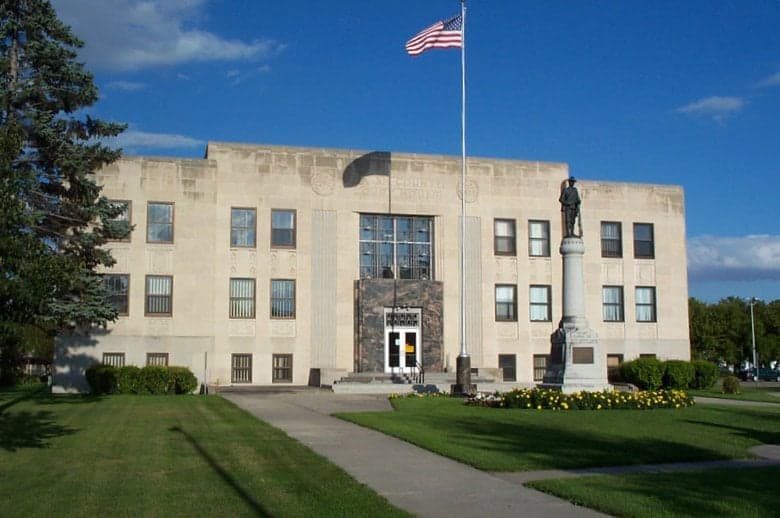
Photo: Wikipedia
Political ClimatePolitical Climate in Walsh County
Showing state-level results — no local-only data available.
Local Political AnalysisPolitical Analysis of Walsh County
Walsh County is a solidly Republican stronghold in northeastern North Dakota, with a Cook Partisan Voting Index of R+18, meaning it votes about 18 points more Republican than the national average. The county has been reliably red for decades, and that trend has only deepened in recent cycles — Trump won the county with over 70% of the vote in both 2016 and 2020, and the GOP's grip on local offices is essentially unchallenged. The county seat, Grafton, tends to be the most moderate part of the county, with a few precincts occasionally breaking 60-40 Republican instead of 75-25, while smaller towns like Park River, Minto, and Edinburg are deep red. The only real variation comes from the small Native American precincts near the Turtle Mountain Reservation border in the far north, which can lean Democratic by narrow margins, but they represent a tiny fraction of the county's total vote.
How it compares
Walsh County is significantly more Republican than North Dakota as a whole, which itself is a reliably red state. While the state's Cook PVI isn't officially published, North Dakota has voted Republican in every presidential election since 1968, and its state legislature has been under GOP supermajority control for years. Walsh County's R+18 puts it roughly in line with the state's most conservative rural counties — think McKenzie or Emmons — but notably redder than the state's population centers like Fargo (Cass County, roughly R+12) or Bismarck (Burleigh County, roughly R+14). The county's agricultural base and small-town culture drive this conservatism: farming communities tend to prioritize low taxes, gun rights, and traditional values, and Walsh County is no exception. The only real counterweight is Grafton, which has a slightly more diverse economy (including a state prison and a sugar beet processing plant) and a small but visible Democratic-leaning contingent, but even there, Republicans win every local race by comfortable margins.
What this means for residents
For conservative residents, Walsh County is a comfortable place to live politically. Local government is dominated by Republicans, so there's little friction over things like property taxes, school funding, or land-use regulations — the county commission and city councils generally align with conservative priorities. For liberal residents, the reality is more isolating. There's no organized Democratic Party presence in the county, and progressive candidates rarely bother to campaign here. Socially, it means that openly liberal views on issues like abortion or gun control are a minority position, and residents who hold them often keep quiet in public settings. That said, the county is not hostile — people are neighborly and pragmatic, and political disagreements rarely escalate into personal conflicts. The bigger practical impact is on policy: the county's strong Republican lean means it consistently votes for state legislators who support agricultural subsidies, oppose carbon regulations, and favor local control over education, which aligns with the economic interests of most residents regardless of party.
Culturally, Walsh County is distinct from the state's growing urban centers. There's a palpable sense that Fargo and Grand Forks are becoming more diverse and liberal, while Walsh County remains a bastion of traditional rural life. Church attendance is high, hunting and fishing are central to community life, and the local newspaper's letters to the editor still debate school board decisions and county road funding rather than national culture wars. The county's political trajectory seems locked in: as long as agriculture remains the economic backbone and the population continues to slowly decline (down about 10% since 2010), the Republican lean will only intensify. New residents moving in tend to be retirees or remote workers seeking lower costs, not young progressives, so don't expect Walsh County to shift purple anytime soon.

State Political ClimatePolitical Climate in North Dakota
State Political AnalysisPolitical Environment in the State
North Dakota has been a reliably Republican stronghold for decades, with the GOP holding every statewide office and a supermajority in the legislature. The state hasn't voted for a Democratic presidential candidate since Lyndon B. Johnson in 1964, and in 2024, Donald Trump carried it by over 20 points. But the political climate here isn't a monolith—it's shaped by a deep urban-rural divide, a strong libertarian streak, and a recent shift toward more aggressive conservative policymaking that has accelerated since the early 2010s. For a relocator, understanding this means knowing that while the state is deeply red, the flavor of that red varies from the oil fields of the northwest to the college towns of the east.
Urban vs. rural divide
The political map of North Dakota is a classic study in contrast. The state's two largest cities, Fargo and Bismarck, are the primary population centers and tend to be more moderate, though still reliably Republican. Fargo, home to North Dakota State University and a growing tech and healthcare sector, has a noticeable Democratic-leaning minority, especially in the downtown core and near the university. Cass County, which contains Fargo, voted for Trump by a narrower 12-point margin in 2024, compared to the statewide 20-point spread. Bismarck, the state capital, is more conservative but still hosts a mix of state workers and energy industry professionals. The real engine of the state's deep red lean comes from the rural expanses and the oil-rich Bakken region in the northwest. Counties like McKenzie, Williams, and Divide routinely deliver 80-90% of their votes to Republican candidates. The small city of Williston, at the heart of the oil boom, is a conservative bastion where energy policy and property rights dominate local politics. Meanwhile, Grand Forks, home to the University of North Dakota, is a bit of a purple outlier—its county, Grand Forks, has been known to flip to Democratic candidates in state-level races, though it still leans red in presidential years. The Native American reservations, particularly the Turtle Mountain Band of Chippewa and the Standing Rock Sioux Tribe, are overwhelmingly Democratic and provide the only consistent blue votes in otherwise deep red rural areas. This urban-rural split means that a resident in Fargo experiences a different political culture than someone in Watford City, but both are operating within a state government that is firmly controlled by the GOP.
Policy environment
North Dakota's policy environment is defined by low taxes, limited regulation, and a strong emphasis on energy and agriculture. There is no state income tax on individuals, a major draw for relocators, though the state does have a corporate income tax and a 5% sales tax that can be supplemented by local jurisdictions. Property taxes are relatively high compared to some other low-tax states, but the state offers a homestead tax credit for homeowners. The regulatory posture is business-friendly, particularly for the oil and gas industry, which operates under a framework that prioritizes extraction with minimal bureaucratic hurdles. Education policy is locally controlled, with school districts having significant autonomy, though the state has been a national leader in school choice, including a robust private school tuition tax credit program. Healthcare is a mixed bag: the state expanded Medicaid under the Affordable Care Act in 2013, a decision that was controversial among conservatives but has since been largely accepted. Election laws are straightforward—voter ID is required, but the state offers no-excuse absentee voting and has early voting in some counties. The state's political culture is heavily influenced by the Nonpartisan League's historical legacy of populism, which still manifests in a pragmatic, "get things done" attitude among many lawmakers, even as the party has become more uniformly conservative.
Recent policy direction
Over the past five years, North Dakota's legislature has moved decisively to the right on a range of issues. In 2023, the state passed one of the most restrictive abortion bans in the country, with exceptions only for rape, incest, and to save the mother's life, effectively ending most access. On gun rights, North Dakota is a constitutional carry state, meaning no permit is required to carry a concealed firearm, and the legislature has repeatedly rejected any form of red flag law. In 2021, the state passed a law prohibiting transgender girls from participating in K-12 sports, and in 2023, it banned gender-affirming care for minors. On education, the state has embraced school choice, with a 2023 law creating a tax credit for donations to private school scholarship funds. Property rights are strongly protected, with the state having a robust "right to farm" law that limits nuisance lawsuits against agricultural operations. On voting, the state has tightened voter ID requirements and passed a law requiring a photo ID to vote, which was upheld by the state supreme court. The state has also been a leader in pushing back against federal overreach, with a 2021 law asserting the state's right to nullify federal laws it deems unconstitutional, though this has not been tested in court. For a relocator, this means a state that is actively shaping its laws to reflect a conservative social and economic agenda, with a particular focus on parental rights, gun rights, and limiting government intervention in private life.
Civil unrest & political movements
North Dakota has seen its share of political flashpoints, most notably the Standing Rock protests in 2016-2017, where thousands of activists, including many from Native American communities, gathered to oppose the Dakota Access Pipeline. The protests were a major national story and highlighted deep tensions between energy development and tribal sovereignty. The state's response, which included a heavy law enforcement presence and the use of National Guard troops, was controversial and remains a sore point for many. More recently, the state has seen smaller but persistent protests over abortion rights, with activists on both sides holding rallies at the state capitol. The oil boom in the Bakken region has also brought a transient workforce that has shifted local politics, with some communities experiencing a more libertarian, pro-energy sentiment that can clash with the state's more traditional conservative base. There is no significant secession or nullification movement, though the state's "nullification" law mentioned earlier reflects a broader distrust of federal authority. Election integrity has been a topic of debate, with the state's voter ID law being challenged in court, but there have been no major controversies or widespread allegations of fraud. For a new resident, the most visible political movement is likely the active and well-organized conservative grassroots, particularly around gun rights and anti-abortion activism, while liberal activism is more concentrated in Fargo and on the reservations.
Projection
Looking ahead, North Dakota's political trajectory is likely to remain deeply conservative, but with some interesting shifts on the horizon. The state's population is aging and slowly declining in rural areas, while the Fargo metro area continues to grow, attracting younger, more diverse residents. This could gradually moderate the state's politics, particularly on social issues, but the effect will be slow. The oil and gas industry will continue to be a dominant force, ensuring that energy policy remains a top priority and that the state's economy stays tied to fossil fuels, even as national trends push toward renewables. The influx of out-of-state workers in the energy sector could also bring new political perspectives, though these tend to be conservative as well. The state's Republican Party is likely to remain unified, but internal tensions between the more pragmatic, business-friendly wing and the social conservative wing could emerge, especially on issues like Medicaid expansion and education funding. For a relocator moving in now, the state will likely be just as conservative in a decade, but with a slightly more urbanized and diverse population that may push for incremental changes on issues like marijuana legalization (which is currently illegal) and criminal justice reform. The bottom line is that North Dakota is not going to become a swing state anytime soon, but the flavor of its conservatism may evolve.
For a new resident, the practical takeaway is straightforward: if you align with conservative values on taxes, guns, and social issues, you will find a welcoming and supportive environment. If you lean liberal, you will be in a distinct minority, but you will find like-minded communities in Fargo, Grand Forks, and on the reservations. The state's political climate is stable and predictable, with a government that is responsive to its conservative base. The key is to understand that while the state is deeply red, it is not a monolith—the urban-rural divide, the influence of the energy industry, and the legacy of the Nonpartisan League all create a political culture that is distinct from other deep red states. You'll find that most political conversations here are pragmatic and focused on local issues, from road funding to school levies, rather than the national culture wars, though those are never far from the surface.
* Values derived from national, state, county, city and local statistics and may differ in a specific area. Last updated: 2026-07-18T17:31:06.000Z
Narrative content on this page is AI-generated and may contain mistakes. Verify any details that matter before acting on them.
ReloMaps may earn a commission from affiliate links at no extra cost to you.

