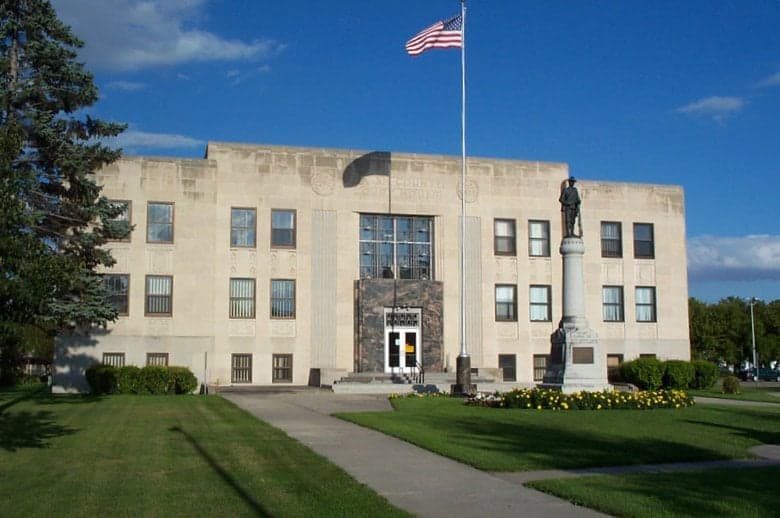
Photo: Wikipedia
Demographics of Walsh County
Affluence Level in Walsh County
A middle-class area roughly in line with national averages across income, home values, education, and employment.
People of Walsh County
Settlement & growth (pre-1960)
Before European settlement, the area that is now Walsh County was the domain of the Ojibwe (Chippewa) and Dakota Sioux nations, who used the Red River Valley as a travel corridor and hunting ground. The region was part of the vast territory claimed by France and later sold to the United States in the Louisiana Purchase of 1803. Permanent American settlement did not begin until after the 1870s, when the Northern Pacific Railroad pushed westward and the federal government opened the land to homesteaders under the Homestead Act of 1862.
The first major wave of settlers were Norwegian immigrants, who began arriving in the 1880s and established farms and communities along the Forest River and Park River valleys. Towns like Park River (founded 1881) and Edinburg (1887) became centers of Norwegian-American culture, with Lutheran churches, Norwegian-language newspapers, and fraternal organizations. The Norwegians were followed closely by German immigrants from Russia, often called Volga Germans, who settled in the southern part of the county around Minto and Grafton in the 1890s and early 1900s. These German-Russian families brought with them a tradition of wheat farming and a strong Catholic faith that still marks communities like Minto today.
A smaller but significant wave of Polish and Czech immigrants arrived in the first decade of the 1900s, settling in and around Walshville and the western townships. The town of Grafton, platted in 1881 and named for a railroad official, grew as the county's commercial center, drawing a mix of ethnic groups including Irish railroad workers and Scandinavian tradesmen. By 1910, Walsh County's population had peaked at over 15,000, with nearly every quarter-section of land under cultivation. The county's economy was almost entirely agricultural, based on wheat, barley, and potatoes, with Grafton serving as a grain-shipping and milling hub.
The decades from 1920 to 1960 saw a slow but steady population decline as farm consolidation reduced the number of families needed to work the land. The Great Depression and the Dust Bowl of the 1930s hit the region hard, though Walsh County fared better than areas further west due to its proximity to the Red River. Many young people left for factory jobs in Minneapolis and the Pacific Northwest during and after World War II. By 1960, the county's population had fallen to roughly 12,000, and the ethnic character remained overwhelmingly Northern European — Norwegian, German, and a smaller number of Polish and Irish families — with virtually no non-white population.
Modern era (post-1965)
The 1965 Hart-Cellar Act had little immediate effect on Walsh County, as the region attracted almost no international immigration for the next two decades. The county's population continued its gradual decline, falling to 10,600 by 1990. The most significant demographic change of the modern era began in the mid-1990s, when Hispanic workers, primarily of Mexican origin, started arriving to work in the region's potato-processing plants and sugar beet fields. The town of Grafton became the primary destination, with a smaller concentration in Minto near the sugar beet cooperatives. Today, 12.7% of the county's population is Hispanic, up from less than 1% in 1990, making this the fastest-growing ethnic group in the county.
Domestic migration has been a net negative for Walsh County since the 1960s, with young adults leaving for college and not returning, and retirees moving to warmer climates. The county's white population, which stood at 81.8% in the most recent data, is aging rapidly, with a median age well above the national average. The Black population remains tiny at 0.9%, and East/Southeast Asian communities account for just 0.6% of residents, with a small Indian-subcontinent population of 0.1%. These non-white, non-Hispanic groups are concentrated almost entirely in Grafton, where a handful of professionals work in healthcare and education.
Suburbanization has not occurred in Walsh County in the traditional sense; instead, the pattern has been one of rural depopulation as small towns like Edinburg, Park River, and Walshville have lost residents to Grafton or to larger cities like Grand Forks. Grafton itself has held relatively steady, buoyed by the food-processing industry and its role as a regional service center. The Hispanic community in Grafton has established a small but visible presence, with Spanish-language church services and a Mexican grocery store, though integration into the broader community has been gradual and not without tension.
The future
Walsh County's population is projected to continue its slow decline over the next 10-20 years, driven by an aging white population and outmigration of young adults. The Hispanic share of the population is likely to grow, potentially reaching 18-20% by 2040, as Hispanic families have higher birth rates and younger median ages than the white population. However, the county is unlikely to become a destination for new immigrant groups from Asia, Africa, or the Middle East, given the limited economic opportunities outside of agriculture and food processing.
The cultural identity of Walsh County is evolving from a purely Scandinavian-German enclave to a more binational community, with Grafton emerging as a small but genuine multicultural hub in an otherwise homogeneous region. The rural townships and villages like Minto, Park River, and Edinburg will likely continue to shrink, while Grafton may stabilize or even grow slightly if the processing plants remain viable. The county's political character, historically conservative and Republican, may shift slightly as the Hispanic population grows, though Hispanic voters in rural North Dakota have not yet formed a cohesive voting bloc.
For someone moving to Walsh County today, the reality is that this is a place of deep roots and slow change, where community ties are strong but economic opportunity is limited. The county offers a safe, affordable, and family-oriented lifestyle for those who value rural living, but it is not a place of demographic dynamism or rapid growth. The people of Walsh County are increasingly a mix of aging Norwegian-German families and younger Hispanic workers, and the county's future will depend on whether these two groups can build a shared community identity in the decades ahead.

* Values derived from national, state, county, city and local statistics and may differ in a specific area. Last updated: 2026-07-18T17:31:06.000Z
Narrative content on this page is AI-generated and may contain mistakes. Verify any details that matter before acting on them.
ReloMaps may earn a commission from affiliate links at no extra cost to you.

