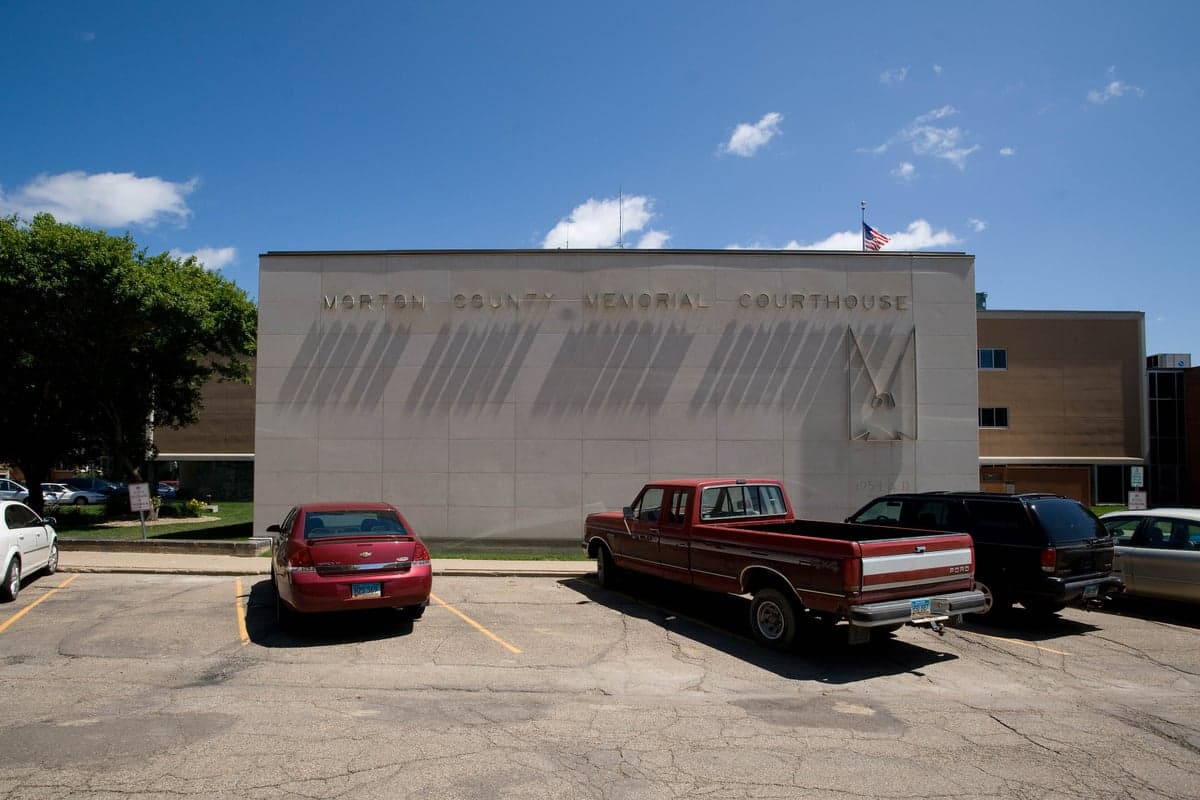
Photo: Wikipedia
Political ClimatePolitical Climate in Morton County
Showing state-level results — no local-only data available.
Local Political AnalysisPolitical Analysis of Morton County
Morton County, North Dakota, is a deeply red stronghold with a Cook Partisan Voting Index (PVI) of R+18, making it one of the most reliably Republican counties in the state. The county's political trajectory has remained consistently conservative over the past two decades, with Republican presidential candidates routinely winning here by margins of 40 points or more—though the 2020 and 2024 cycles showed slight erosion in the margins as national polarization tightened. Surrounding North Dakota as a whole is also solidly red, though the exact PVI is not publicly available; clinically, Morton County is roughly 5-7 points more Republican than the state average, which leans heavy red itself.
How it compares
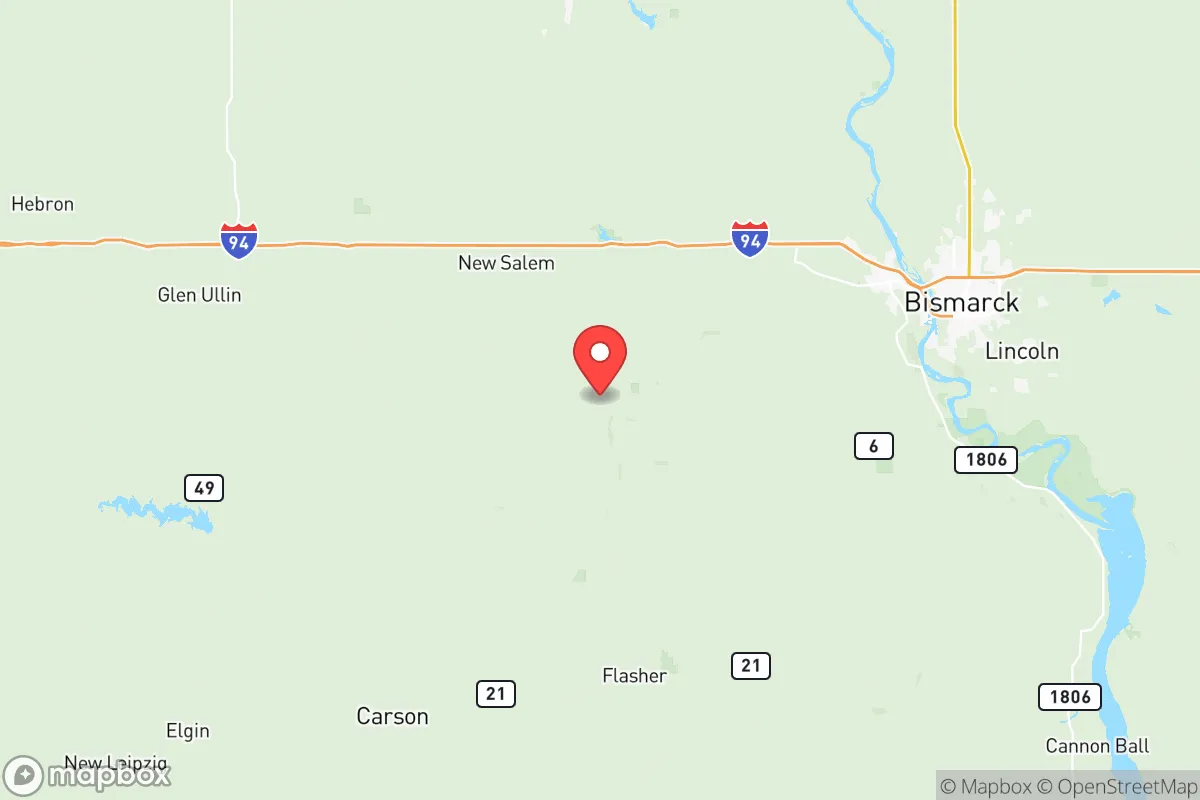
Morton County's R+18 PVI is markedly more conservative than the state's overall lean, which remains Republican but with pockets of moderation in the oil-rich west and the college-heavy east. Within the county, Mandan, the county seat, is the political anchor—its precincts near the state capitol complex and the historic downtown are the most moderate, occasionally tipping within 10 points of a statewide blue candidate, though still solidly red in presidential elections. New Salem and Flasher are hyper-Republican, often delivering 75-80% of the vote to the GOP nominee, while Hebron and Glen Ullin track similarly, driven by agricultural ties and strong anti-tax sentiment. The only precincts that show even a faint blue tint are near the University of Mary campus in Mandan, where younger faculty and students occasionally vote Democratic—but this is a tiny blip, not a trend. For comparison, neighboring Burleigh County (Bismarck) is somewhat less conservative (roughly R+15), while Oliver County to the north is pure deep red (R+25). Simply put, Morton County is the conservative backbone of central North Dakota—reliable, steady, and resistant to seismic shifts.
What this means for residents
For conservative residents in Morton County, life is politically comfortable: local offices, school boards, and county commission seats are dominated by Republicans, and policy debates—from property taxes to energy development—are framed in familiar, small-government terms. For the few liberal or moderate residents, the reality is quieter: you learn to pick your battles. Most social issues are settled at the state level in favor of conservative legislation, but Morton County is also pragmatic—there is a strong live-and-let-live ethos, especially regarding business and private property. The practical upshot is that political activism here focuses on local zoning, school funding, and agricultural policy, not the culture war flashpoints that dominate coastal news. The county’s political unity also means fewer partisan gridlocks on infrastructure; new highway projects near Mandan, like the Highway 1806 bridge improvements, typically move forward with bipartisan local support.
Culturally, Morton County wears its conservatism with a measured, Western North Dakota style—practical rather than performative. The biggest policy distinctions from the rest of North Dakota aren't huge, but they lean toward even greater resistance to federal land management: there is a strong, vocal support for local control over energy development, particularly in the Tesla plains (the rolling grasslands south of I-94) where wind farm approvals often stir debate between agricultural landowners and rural conservationists. On social issues like abortion or gun rights, Morton County aligns with state law but tends to be slightly more permissive on hunting regulations (e.g., easier access to public land drawing tags) than the squeaky-clean Bismarck crowd. Longtime residents will tell you that the area's political culture hasn't changed much since the 1980s—just a little more polarized and a little more orderly. The trajectory ahead looks stable: Morton County will remain a Republican stronghold for the foreseeable future, though younger families moving in from the oil patch are subtly nudging it toward a more libertarian, less socially hawkish brand of conservatism. For anyone moving here, understanding this political landscape means knowing you'll find your tribe, even if the majority is clearly on one side of the fence.

State Political ClimatePolitical Climate in North Dakota
State Political AnalysisPolitical Environment in the State
North Dakota has been a reliably Republican state for decades, but the flavor of that conservatism has shifted noticeably since the 2010s. The state voted for Donald Trump by 34 points in 2024, a margin that has widened from 27 points in 2016, driven by a rural population that feels increasingly distant from coastal cultural norms. The dominant coalition is a mix of energy-sector workers in the Bakken region, agricultural producers in the Red River Valley, and a growing number of out-of-state transplants from places like California and Colorado who are drawn by low taxes and a slower pace of life. The Democratic-NPL (Nonpartisan League) party, once a prairie populist force, has collapsed outside of a few tribal areas and university towns, losing every statewide race since 2010.
Urban vs. rural divide
The political map is starkly divided between a handful of small cities and the vast rural expanse. Fargo and Grand Forks are the most competitive areas: Cass County (Fargo) voted for Trump by only 12 points in 2024, while Grand Forks County was closer to 18 points. These metros are home to North Dakota State University and the University of North Dakota, which pull in younger, more moderate voters and a small but visible progressive community. In contrast, Williston and Dickinson in the oil patch routinely vote 70-80% Republican, driven by a workforce that prizes energy development and distrusts federal regulation. Bismarck and Mandan are reliably conservative but more establishment-oriented, with state government employees and insurance companies shaping a quieter brand of Republicanism. The rural counties along the Missouri River and the Turtle Mountain region are the only places where Democrats still win local races, thanks to Native American voter turnout. The divide isn't just about party—it's about lifestyle: urban residents in Fargo care about downtown development and bike lanes, while rural voters in Hettinger or Bowman are focused on land use, water rights, and school consolidation.
Policy environment
North Dakota's policy environment is built around low taxation and minimal regulation. There is no state income tax on individuals (eliminated in phases starting in 2015), and the corporate income tax rate is a flat 4.31%. Property taxes are relatively high compared to other low-tax states, but a homestead credit and a "billion-dollar" property tax relief fund passed in 2023 have softened the blow for homeowners. The regulatory posture is business-friendly: the state has a "right-to-work" law, no state-level minimum wage above the federal $7.25, and a streamlined permitting process for energy and agriculture. Education policy is decentralized, with strong local control over school boards and a robust school choice movement that has expanded charter schools and a tax-credit scholarship program for private schools. Healthcare is a mixed bag: the state expanded Medicaid under the Affordable Care Act in 2013, but the legislature has resisted further expansion of government-run programs, and rural hospital closures remain a persistent issue. Election laws are among the most restrictive in the nation: voters must present a qualifying ID (including a concealed carry permit), and the state has no same-day registration, no automatic voter registration, and a strict absentee ballot application deadline. The state also has a "voter ID" law that was upheld by the Supreme Court in 2018, requiring a residential street address—a hurdle for Native Americans living on reservations without standard street addresses.
Recent policy direction
The last five years have seen a sharp turn toward cultural conservatism, even as the state's economic policies remain steady. In 2023, the legislature passed a near-total abortion ban (HB 1250) with exceptions only for rape, incest, and life of the mother, which took effect after the Dobbs decision. Gun laws have been loosened: permitless carry was enacted in 2017, and in 2023 the state passed a "Second Amendment Protection Act" that prohibits state enforcement of any future federal gun bans. Parental rights have been a major focus: the 2023 session saw a "Parents' Bill of Rights" (SB 2231) that requires schools to notify parents about curriculum changes and prohibits instruction on gender identity and sexual orientation in K-3 classrooms. On education, the state passed a school voucher-style program (HB 1532) in 2023 that gives families up to $3,000 per child for private school expenses, funded by a new state trust. Property rights remain strong: the state has a "takings" law that requires compensation for any regulation that reduces property value by more than 50%, and it has resisted federal land-use planning mandates. Privacy and surveillance are less protected: the state has no comprehensive data privacy law, and law enforcement can access cell-site location data without a warrant under a 2018 state Supreme Court ruling. Voting access has tightened further: in 2021, the legislature passed a law requiring absentee ballots to be returned by Election Day (eliminating the postmark deadline) and limiting ballot drop boxes to one per county.
Civil unrest & political movements
North Dakota has seen its share of political flashpoints, most famously the Standing Rock protests in 2016-2017, where thousands of activists from across the country gathered to oppose the Dakota Access Pipeline. The protests were a defining moment for the state: law enforcement from multiple agencies used water cannons, rubber bullets, and tear gas, and the state legislature responded by passing a law (SB 2344) that criminalizes trespassing on energy infrastructure and increases penalties for riot-related offenses. The movement has since faded, but it left a lasting divide between the state's conservative majority and its Native American communities, who continue to push for voting access and land rights. On the right, the "Bakken Patriots" and local Tea Party groups remain active, organizing around election integrity and opposition to federal land management. The state has seen a small but vocal secessionist movement in the oil patch, with some residents calling for a "Liberty State" separate from the rest of North Dakota, though it has no real political traction. Immigration politics are muted: the state has a small but growing immigrant population (mostly from Somalia and Southeast Asia) in Fargo, which has led to occasional tensions over housing and school resources, but no sanctuary policies or major enforcement actions. Election integrity controversies have been limited to isolated disputes over voter ID requirements on reservations, with the Turtle Mountain Band of Chippewa successfully suing the state in 2020 to allow tribal IDs without street addresses.
Projection
Over the next 5-10 years, North Dakota's political trajectory points toward continued Republican dominance, but with a growing tension between the old-school, chamber-of-commerce conservatism of Bismarck and the more populist, culturally aggressive conservatism of the oil patch. Demographic shifts are modest: the state's population is aging and slowly declining outside of Fargo and the Bakken, and in-migration from blue states is small but noticeable—mostly remote workers and retirees looking for cheap land and low taxes. These newcomers tend to be conservative but not necessarily aligned with the state's existing political culture; they often push for less regulation on housing and more school choice, which aligns with the current direction. The biggest wildcard is the energy transition: if federal policies shift toward decarbonization, the Bakken's oil-dependent economy could contract, potentially weakening the populist right and strengthening the more moderate, agriculture-driven wing of the party. The Democratic-NPL is unlikely to recover statewide, but it could gain ground in Fargo and Grand Forks if younger voters continue to move in and if the national party moderates on cultural issues. Expect the state to remain a laboratory for conservative policy—more school choice, tighter voting laws, and continued resistance to federal environmental rules—but with occasional flashpoints over tribal sovereignty and energy development.
For a new resident, the practical takeaway is straightforward: if you're conservative, you'll find a state that largely aligns with your values on taxes, guns, and education, but you should be prepared for a political culture that can be insular and suspicious of outsiders. If you're liberal, you'll be in a clear minority, but you'll find small, resilient communities in Fargo, Grand Forks, and on the reservations where your views are welcome—just don't expect them to shape state policy anytime soon. The state's politics are stable, predictable, and increasingly polarized along urban-rural lines, but the low cost of living and strong economy mean most residents can afford to focus on their daily lives rather than the political drama.
* Values derived from national, state, county, city and local statistics and may differ in a specific area. Last updated: 2026-07-01T01:54:54.000Z
Narrative content on this page is AI-generated and may contain mistakes. Verify any details that matter before acting on them.
ReloMaps may earn a commission from affiliate links at no extra cost to you.

