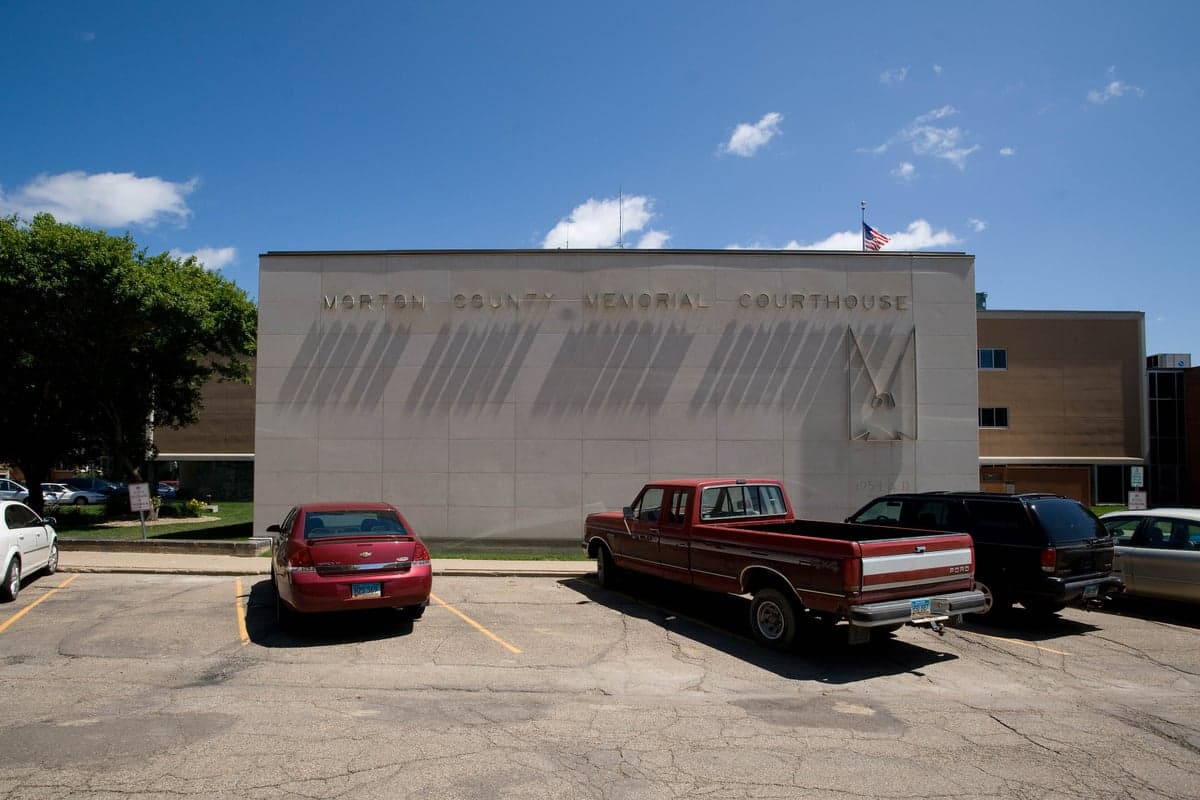
Photo: Wikipedia
Demographics of Morton County
Affluence Level in Morton County
A middle-class area roughly in line with national averages across income, home values, education, and employment.
People of Morton County
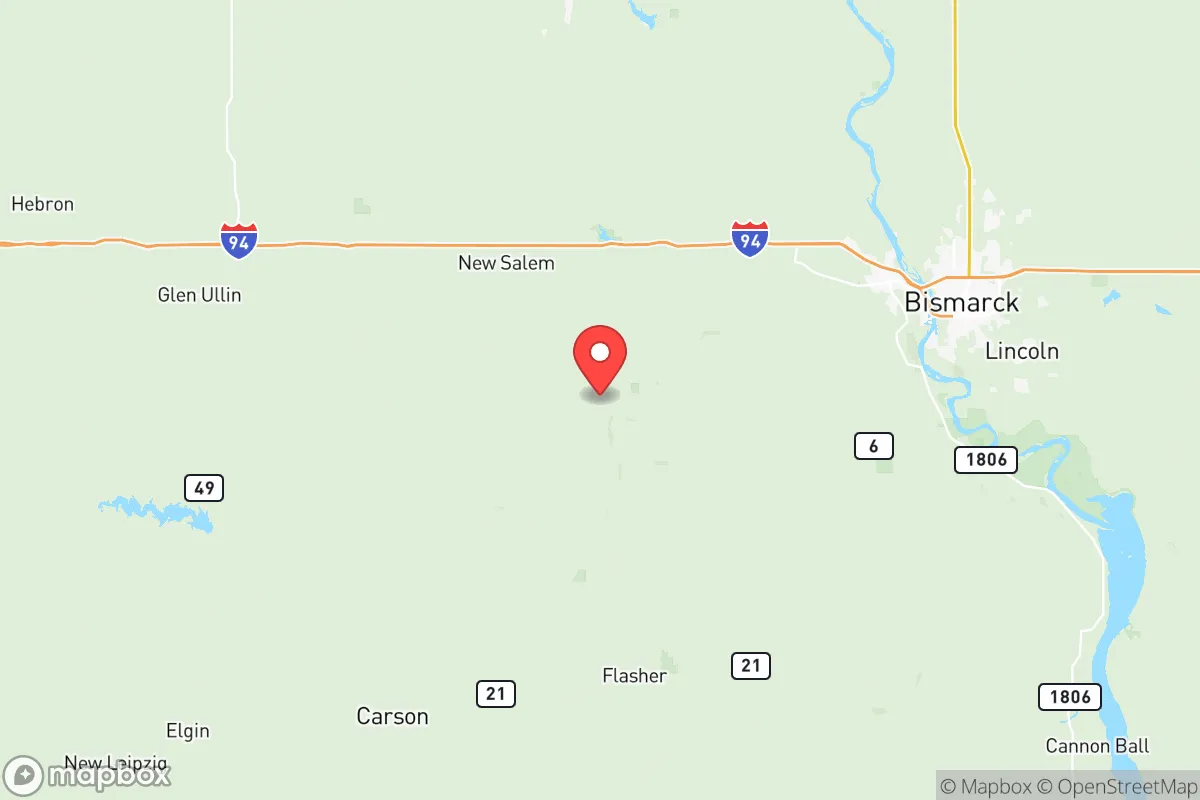
The people of Morton County, North Dakota, today are overwhelmingly white and native-born, with a population of 33,479 that reflects deep German-Russian and Scandinavian roots from the late 19th and early 20th centuries. The county’s identity is a blend of agricultural tradition, energy-sector pragmatism, and small-town resilience, centered on the county seat of Mandan and extending to rural hubs like Glen Ullin and Hebron. Its foreign-born population stands at just 0.4%, and its racial profile—87.4% white, 4.2% Hispanic, 1.7% Black, and 0.2% East/Southeast Asian—makes it one of the least diverse counties in the United States, a byproduct of its particular settlement history and limited immigration draw. The area retains a distinct character: heavily Lutheran and Catholic, politically conservative, and tied to the Missouri River rail and agricultural economy, with a quiet self-sufficiency that newcomers find either deeply appealing or isolating.
Settlement & growth (pre-1960)
The land that became Morton County was originally home to the Mandan, Hidatsa, and Arikara nations, who lived in earthlodge villages along the Missouri River for centuries before European contact. The Lewis and Clark Expedition wintered near present-day Fort Abraham Lincoln State Park, just south of Mandan, in 1804-1805, and the area became a focal point for the fur trade. The 1851 Fort Laramie Treaty ceded most of the region to the United States, and by the 1870s, the U.S. Army established Fort Abraham Lincoln to protect railroad construction and settlers—Custer’s 7th Cavalry departed from there for the Little Bighorn in 1876.
The first major wave of non-Native settlement came in the 1870s and 1880s with the arrival of the Northern Pacific Railway. Mandan, founded in 1879 as a rail terminus and named for the Mandan people, became the county’s anchor—a rough-and-tumble railroad town of graders, surveyors, and merchants. German-Russian immigrants, many from the Black Sea colonies, arrived in large numbers between 1885 and 1910, drawn by the promise of cheap land and the Homestead Act. They clustered in farming communities like Glen Ullin (founded 1883) and Hebron (founded 1885), where they built Catholic and Lutheran churches and established dryland wheat farming. Norwegian and Scandinavian settlers also came during this period, founding New Salem (founded 1883) and Almont (1886), bringing Lutheran traditions that still shape the county’s religious culture.
By 1910, Morton County’s population had swelled to 25,289, nearly all of it rural and agricultural. The Dust Bowl and Great Depression of the 1930s hit hard—wheat prices collapsed, and drought drove out some homesteaders, though the county’s Missouri River access offered more resilience than drier counties to the west. A second infrastructure boom came during World War II and the post-war years. The Garrison Dam project (1947-1953) on the Missouri River, about 50 miles north, created Lake Sakakawea and brought federal construction jobs and a wave of laborers to the region. Mandan grew modestly, from about 5,000 in 1940 to 11,000 by 1960, as the nearby Fort Lincoln state military reservation and the expanding railroad yards diversified the economy away from pure agriculture. The population hit a post-war high of 23,000 in 1950 but then plateaued, as younger residents began migrating to larger cities like Bismarck—directly across the river—for white-collar opportunities.
Modern era (post-1965)
The 1965 Hart-Cellar Act, which opened immigration to non-European countries, had almost no effect on Morton County. The county’s foreign-born share today is 0.4%, the lowest in the Bismarck-Mandan metro and one of the lowest in North Dakota. The few immigrants who arrived after 1965 were almost entirely tied to the energy sector: a small number of Hispanic workers came during the Bakken boom (2008-2015), settling in Mandan and St. Anthony (a tiny unincorporated community near the oil fields), drawn by pipeline construction and trucking jobs. The county’s Hispanic population grew from about 0.5% in 2000 to 4.2% by 2022, but the absolute numbers are small—roughly 1,400 people. The Black population, at 1.7%, increased slightly from near zero in 2000, largely due to oil-field migration from other U.S. states rather than foreign immigration. The East/Southeast Asian population (0.2%) is minimal, concentrated in Mandan as medical professionals at CHI St. Alexius Health or as technical workers at the nearby Great Plains Energy plant.
Domestic migration has been more consequential. The 1980s farm crisis emptied many rural towns: Glen Ullin shrank from 946 in 1980 to 738 in 2022, and Hebron fell from 803 to 688. The county seat, Mandan, bucked that trend by absorbing rural depopulation and attracting workers from Bismarck’s spillover housing market. Since 2010, Mandan has grown 15% to about 25,000, as families priced out of Bismarck’s western suburbs moved across the Missouri River. Suburbanization has been focused on Mandan’s north side and west side, where new subdivisions like Prairie Heights offer affordable starter homes. The county’s population has aged—the median age rose from 38 in 2000 to 43 in 2022—as younger adults continue to leave for college or jobs in larger metros. The college-educated rate, at 29.3%, is below the national average of 34% but above many other rural North Dakota counties, reflecting the presence of a regional hospital and the Bismarck State College branch campus in Mandan.
The future
Morton County’s population is trending slowly upward, projected to reach 35,000-36,000 by 2040, but the growth will be concentrated almost entirely in Mandan and its immediate environs. The outlying communities—Glen Ullin, Hebron, New Salem, Almont—are expected to continue slow declines as agriculture consolidates and young adults leave. The county is becoming slightly more diverse, with the Hispanic share likely to rise to 6-7% by 2040, driven by energy-sector and construction workers. However, the overall racial makeup will remain heavily white because foreign immigration is negligible and domestic migration is drawing from equally white neighboring counties. The energy industry’s automation is a long-term threat—pipelines require fewer workers than drilling—so the county is hedging with tourism (Lewis and Clark history, the North Dakota State Fair) and remote work, which has brought a small number of out-of-state telecommuters to Mandan since 2020.
The cultural identity of Morton County is evolving slowly from “German-Russian farming” toward “Bismarck-Mandan commuter suburb.” The county’s conservatism remains deeply ingrained—voter registration is 70% Republican—but the economy is diversifying beyond agriculture and energy into healthcare, education, and light manufacturing. For someone moving in now, Morton County offers a very low crime rate, strong public schools (Mandan High School consistently ranks in the top 20 in the state), and a tight-knit social fabric where nearly everyone knows their neighbors. The trade-offs are limited ethnic diversity, a long commute to any major urban amenity (the nearest Target is in Bismarck, 5 minutes from Mandan), and a climate with harsh winters that discourages newcomers without family or job ties. It is a place for people who value stability, community, and land over excitement, change, or diversity—and it is likely to remain so for the foreseeable future.

* Values derived from national, state, county, city and local statistics and may differ in a specific area. Last updated: 2026-07-01T01:54:54.000Z
Narrative content on this page is AI-generated and may contain mistakes. Verify any details that matter before acting on them.
ReloMaps may earn a commission from affiliate links at no extra cost to you.

