Political ClimatePolitical Climate in Mckenzie County
Showing state-level results — no local-only data available.
Local Political AnalysisPolitical Analysis of Mckenzie County
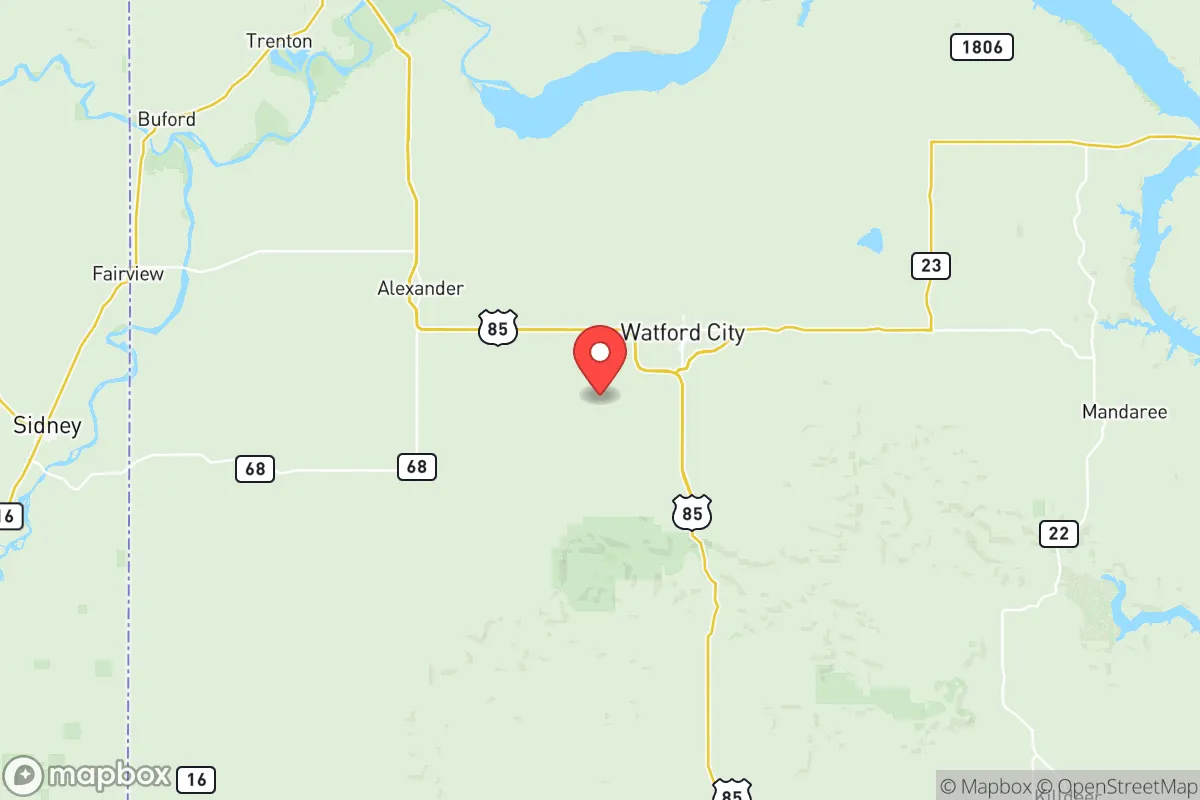
McKenzie County, North Dakota, is one of the most reliably Republican jurisdictions in the nation, anchored by a Cook Partisan Voting Index (PVI) of R+18, meaning it votes roughly 18 points more Republican than the national average. This deep-red lean is driven by the oil and gas economy of the Bakken shale formation, which has transformed the county from a sleepy agricultural outpost into a booming energy hub. The county has trended even redder in recent cycles, with Donald Trump winning over 80% of the vote in 2020 and 2024, a shift from the more moderate, split-ticket voting patterns of the pre-boom era. While the county is overwhelmingly conservative, there are subtle political variations between its communities, with the county seat of Watford City and the smaller town of Alexander showing slightly more moderate tendencies than the deeply conservative rural precincts around Arnegard and Keene.
How it compares
McKenzie County is significantly more Republican than North Dakota as a whole, which itself is a reliably red state. While North Dakota has a PVI of R+20, McKenzie County's R+18 is actually slightly less Republican than the state average, a surprising fact given the county's reputation as an oil-patch stronghold. This is because the state's rural, agricultural counties—like Hettinger and Adams—are even more conservative, while McKenzie County's energy boom has brought in a more diverse, transient workforce from across the country, including some moderates and even a small number of liberals. In practice, this means that while a Republican candidate can expect to win McKenzie County by a landslide, the margin is often a few points narrower than in the state's most rural, non-oil counties. The county's political trajectory also differs from the state's: as North Dakota's population slowly ages and rural areas depopulate, McKenzie County's younger, more economically active population keeps its politics slightly more dynamic and less entrenched than the state's most static precincts.
What this means for residents
For conservative residents, McKenzie County offers a deeply affirming political environment where their views on energy, regulation, and gun rights are the mainstream. Local government is overwhelmingly Republican, and policies favor minimal business regulation and strong support for the oil and gas industry. For liberal residents, the reality is more isolating: they are a distinct minority, and progressive candidates rarely appear on local ballots. However, the county's transient workforce means that political conversations are often more pragmatic than ideological, with many residents focused on economic opportunity rather than partisan battles. The county's rapid growth has also created some tension between long-time ranchers and newcomers, though this is more about land use and infrastructure than party politics. In Watford City, the largest town, you'll find a slightly more diverse political mix, with some professionals and service workers leaning moderate, but even there, a Democrat would struggle to break 30% in a countywide race.
Culturally, McKenzie County is defined by its boomtown ethos: hard work, self-reliance, and a suspicion of government overreach. This manifests in strong support for the Second Amendment, with most residents owning firearms, and a general resistance to zoning and land-use regulations that might slow development. The county's politics are also shaped by the oil industry's influence, with local officials often coming from energy backgrounds and prioritizing infrastructure like roads and housing over social services. For newcomers, especially those from blue states, the adjustment can be jarring: political signs are overwhelmingly Republican, and local news outlets rarely cover state or national politics from a liberal perspective. Yet, the county's economic dynamism means that most residents are too busy working to engage in heated political debates, creating a practical, if not always welcoming, environment for those who don't share the majority's views.

State Political ClimatePolitical Climate in North Dakota
State Political AnalysisPolitical Environment in the State
North Dakota is a deeply Republican state, but its politics are more nuanced than the raw numbers suggest. The state hasn't voted for a Democratic presidential candidate since Lyndon B. Johnson in 1964, and in 2024, Donald Trump carried it by over 20 points. However, the political landscape is shaped by a unique blend of prairie populism, a strong libertarian streak, and a rural-urban divide that makes places like Fargo and Grand Forks more competitive than the rest of the state. Over the last 20 years, the GOP has consolidated power, but the state's small population and strong sense of community mean that individual relationships and local issues still matter more than party labels in many areas.
Urban vs. rural divide
The political map of North Dakota is a study in contrasts. The eastern corridor, anchored by Fargo and Grand Forks, is the most politically competitive region. Fargo, home to North Dakota State University and a growing tech and healthcare sector, has a significant Democratic-leaning population, particularly in the downtown core and near the university. Cass County, which includes Fargo, has been a battleground, occasionally flipping to Democratic candidates for state-level offices. Grand Forks, home to the University of North Dakota, follows a similar pattern, though it leans slightly more conservative than Fargo. In contrast, the western half of the state, driven by the oil boom in the Bakken shale, is deeply Republican. Williston, Dickinson, and Minot are conservative strongholds, where energy policy and property rights dominate the conversation. The rural counties in between, like those in the Red River Valley and the Drift Prairie, are reliably Republican, but with a populist bent that sometimes supports progressive agricultural policies. The Native American reservations, such as the Standing Rock Sioux Reservation near Fort Yates, are Democratic strongholds, though their small populations limit their statewide impact.
Policy environment
North Dakota's policy environment is defined by low taxes, limited regulation, and a hands-off approach to social issues. The state has no state income tax, a policy that was phased in over the last decade and is a major draw for relocators. Property taxes are relatively low, though they vary by county, and the state has a robust oil tax fund that helps keep the budget balanced. The regulatory posture is business-friendly, particularly for energy and agriculture, with streamlined permitting for oil and gas extraction. On education, the state has a strong tradition of local control, with school boards wielding significant authority. There is a growing school choice movement, but it remains limited compared to other states. Healthcare policy is a mixed bag; the state expanded Medicaid under the Affordable Care Act, a decision that was controversial among conservatives but has proven popular in rural areas. Election laws are straightforward: voter ID is required, but the state offers same-day registration and no-excuse absentee voting, making it relatively accessible. The state's small population means that politics is still highly personal, with many voters knowing their legislators personally.
Recent policy direction
In the last five years, North Dakota has moved decisively to the right on a range of issues, but with a pragmatic, rather than ideological, edge. On gun rights, the state passed constitutional carry in 2021, allowing residents to carry concealed firearms without a permit. It also passed a "Stand Your Ground" law in 2023, removing the duty to retreat in self-defense situations. On education and parental rights, the legislature passed a bill in 2023 requiring schools to notify parents of any curriculum related to sexual orientation or gender identity, and it banned transgender girls from participating in K-12 sports. On abortion, the state has one of the most restrictive laws in the country, banning the procedure at six weeks with no exceptions for rape or incest, though a court challenge is ongoing. On property rights, the state has been aggressive in defending landowners against federal overreach, particularly in the context of the Dakota Access Pipeline protests. On voting and ballot access, the state has maintained its relatively open system, though it did pass a voter ID law in 2021 that was criticized by Democrats as restrictive. The overall direction is toward greater individual liberty in the economic and self-defense spheres, combined with significant government intervention in social and medical matters.
Civil unrest & political movements
The most significant political flashpoint in recent memory was the Dakota Access Pipeline protests at the Standing Rock Sioux Reservation near Fort Yates in 2016-2017. The protests drew thousands of activists from across the country, including environmentalists, Native American rights groups, and left-wing organizers. The state government, led by then-Governor Jack Dalrymple, responded with a heavy law enforcement presence, including the National Guard, leading to accusations of overreach. The protests were a defining moment for the state, deepening the divide between the conservative, energy-focused western counties and the more liberal, activist-influenced eastern cities. Since then, the state has seen smaller protests, including those related to abortion rights and LGBTQ+ issues, particularly in Fargo and Grand Forks. There is also a growing libertarian movement, particularly in the oil patch, that advocates for even less government intervention. Immigration politics are less prominent here than in border states, but there is a small but vocal group advocating for stricter enforcement. The state has no sanctuary cities, and local law enforcement generally cooperates with federal immigration authorities. Election integrity has not been a major controversy, though some Republican legislators have pushed for stricter voter ID laws.
Projection
Over the next 5-10 years, North Dakota is likely to remain a deeply Republican state, but the demographic shifts underway could make it slightly more competitive. The oil boom in the west has brought in a wave of new residents, many of whom are young, male, and conservative, reinforcing the GOP's dominance in that region. At the same time, Fargo and Grand Forks are growing, driven by the tech and healthcare sectors, which tend to attract a more diverse and moderate population. The state's population is aging, and the out-migration of young people to other states could accelerate, particularly if the oil economy slows. The Native American population is growing, but its political influence remains limited by low voter turnout and geographic isolation. The most likely scenario is that North Dakota becomes even more Republican at the state level, but with a more competitive eastern corridor that could occasionally elect Democrats to local and state offices. The state's libertarian streak will continue to shape policy, particularly on taxes and property rights, but social issues will remain a flashpoint. For a new resident, the political climate will feel stable and predictable, but with a growing undercurrent of tension between the rural, energy-driven west and the urban, service-driven east.
For a new resident, the bottom line is that North Dakota offers a political environment that is deeply conservative but with a practical, live-and-let-live attitude that can be appealing to both conservatives and libertarians. If you are a conservative, you will find a state that aligns with your values on taxes, guns, and energy. If you are a liberal, you will find a small but active community in Fargo and Grand Forks, but you will need to be comfortable being in the minority. The state's small population means that politics is personal, and you can have a real impact if you get involved. The key is to understand the local dynamics: the west is about energy and property rights, the east is about education and healthcare, and the rural areas are about agriculture and community. If you can navigate those differences, North Dakota is a place where you can live your life with a minimum of government interference, regardless of your political leanings.
* Values derived from national, state, county, city and local statistics and may differ in a specific area. Last updated: 2026-07-19T14:37:20.000Z
Narrative content on this page is AI-generated and may contain mistakes. Verify any details that matter before acting on them.
ReloMaps may earn a commission from affiliate links at no extra cost to you.

