Demographics of Mckenzie County
Affluence Level in Mckenzie County
An upper-middle-class area. Household wealth, education levels, and homeownership run ahead of national benchmarks.
People of Mckenzie County
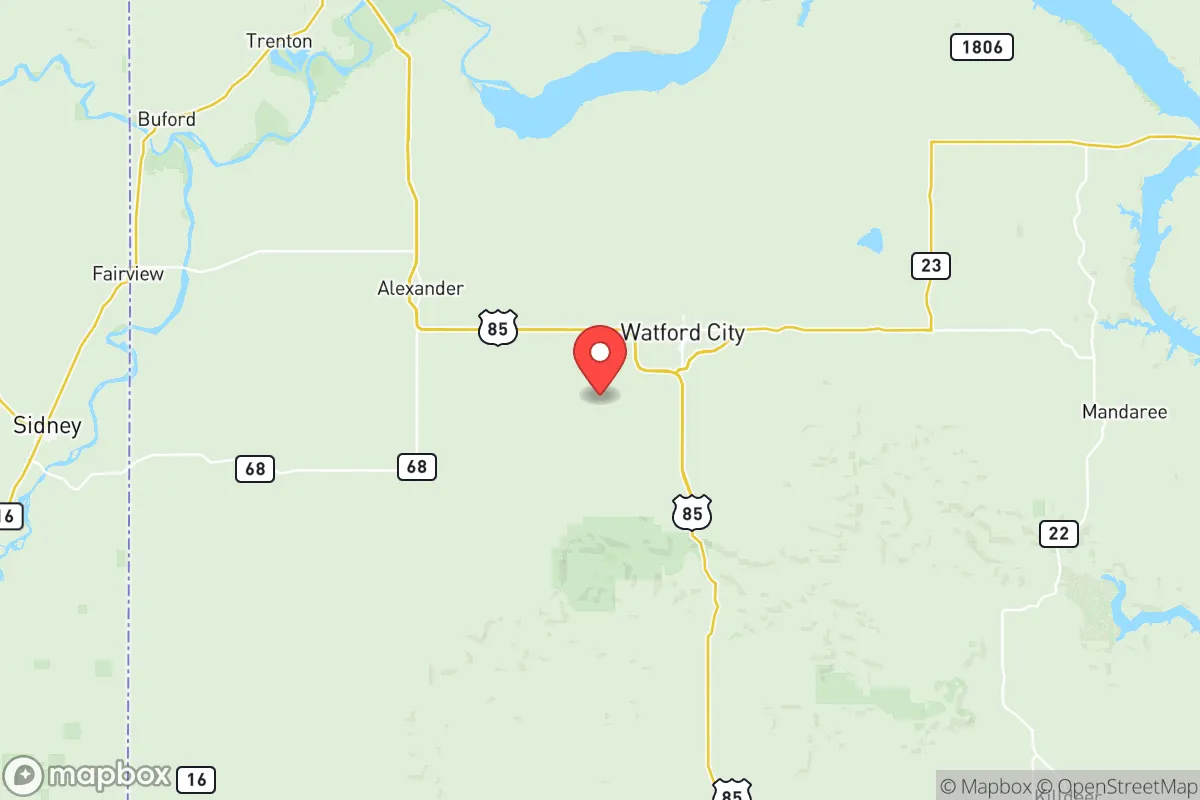
Today, McKenzie County, North Dakota is home to roughly 14,280 residents, a population that remains predominantly white (74.5%) but has been reshaped by the 21st-century oil boom. The county’s character is defined by a mix of long-established ranching families, a significant and growing Hispanic community (11.2%), and a transient workforce drawn to the Bakken shale fields. This is a place where the legacy of homesteaders and Scandinavian settlers meets the modern reality of energy-driven migration, creating a community that is both deeply rooted and rapidly evolving.
Settlement & growth (pre-1960)
The original inhabitants of the region were the Mandan, Hidatsa, and Arikara (Three Affiliated Tribes), whose presence along the Missouri River and its tributaries predates European contact by centuries. Their villages, including those near what is now the Fort Berthold Reservation, were centers of trade and agriculture long before the first white settlers arrived. The area that became McKenzie County was formally organized in 1905, carved out of the vast Dakota Territory, but significant American settlement did not begin in earnest until the early 20th century.
The first major wave of non-Native settlers were homesteaders, primarily of Norwegian, German, and Russian-German descent, who arrived between 1900 and 1920. They were drawn by the promise of cheap land under the Homestead Act and the extension of the railroad. These families established the county's foundational towns, including Watford City (the county seat), Alexander, and Arnegard. The landscape was harsh, and these early settlers relied on dryland farming and cattle ranching to survive. A smaller but notable wave of Scandinavian immigrants, particularly from Sweden and Norway, also settled in the area, leaving a lasting cultural imprint on place names and local Lutheran churches.
The Dust Bowl and the Great Depression of the 1930s hit the region hard, causing a significant population decline as many homesteaders abandoned their claims. The discovery of oil in the Williston Basin in 1951 brought a modest boom, but the county remained sparsely populated and economically tied to agriculture for decades. By 1960, the population had actually fallen to around 9,000, as younger generations left for urban centers.
Modern era (post-1965)
The 1965 Hart-Cellar Act had a minimal direct impact on McKenzie County, as the region did not attract the large-scale international immigration seen in coastal cities. The county’s modern demographic transformation is almost entirely a story of domestic migration, driven by the Bakken oil boom that began around 2008. This energy boom brought a massive influx of workers, primarily from other parts of the United States, including Texas, Oklahoma, and the Rust Belt states.
The most visible demographic shift has been the growth of the Hispanic population, which now stands at 11.2%. This community is largely composed of workers and their families who came from Texas, California, and Mexico to work in the oil fields and supporting industries. They have concentrated in Watford City and the smaller communities of Keene and Grassy Butte, where they have established businesses, churches, and community organizations. The Black population (2.1%) and East/Southeast Asian population (0.9%) are smaller but growing, also tied to the energy sector and its ancillary services. The Indian subcontinent population remains negligible at 0.1%.
Suburbanization in the traditional sense is limited, but the oil boom has created a new pattern of "man camps" and temporary housing developments around Watford City and along Highway 85. The county has struggled with housing shortages, leading to the construction of new apartment complexes and subdivisions to accommodate the influx. The foreign-born population remains very low at 2.0%, reflecting that this is a domestic migration story, not an international one.
The future
The population of McKenzie County is likely to remain volatile, tied directly to the price of oil and the pace of drilling in the Bakken. If energy prices remain stable or rise, the county will continue to attract domestic migrants, and the Hispanic community will likely grow further, potentially becoming a larger share of the population. The white, non-Hispanic population, while still the majority, is aging, and younger families are often the ones arriving for work.
The county is becoming more diverse, but this diversity is primarily driven by Hispanic and, to a lesser extent, Black and Asian workers, rather than a broad international mix. The cultural identity is evolving from a purely Scandinavian-American ranching culture to a more multi-ethnic, working-class energy hub. The next 10-20 years will likely see continued growth in Watford City as the primary service center, with smaller towns like Alexander and Arnegard either stabilizing or declining as residents move to larger communities for amenities.
For someone moving in now, McKenzie County is a place of economic opportunity but also of rapid change and high costs of living. It is a community where the old ranching families still hold significant influence, but where the new energy workforce is reshaping daily life, schools, and local politics. The future is one of continued boom-and-bust cycles, with a population that is younger, more diverse, and more transient than at any point in its history.

* Values derived from national, state, county, city and local statistics and may differ in a specific area. Last updated: 2026-07-19T14:37:20.000Z
Narrative content on this page is AI-generated and may contain mistakes. Verify any details that matter before acting on them.
ReloMaps may earn a commission from affiliate links at no extra cost to you.

