Photo: Wikipedia
Political ClimatePolitical Climate in Grand Forks County
Showing state-level results — no local-only data available.
Local Political AnalysisPolitical Analysis of Grand Forks County
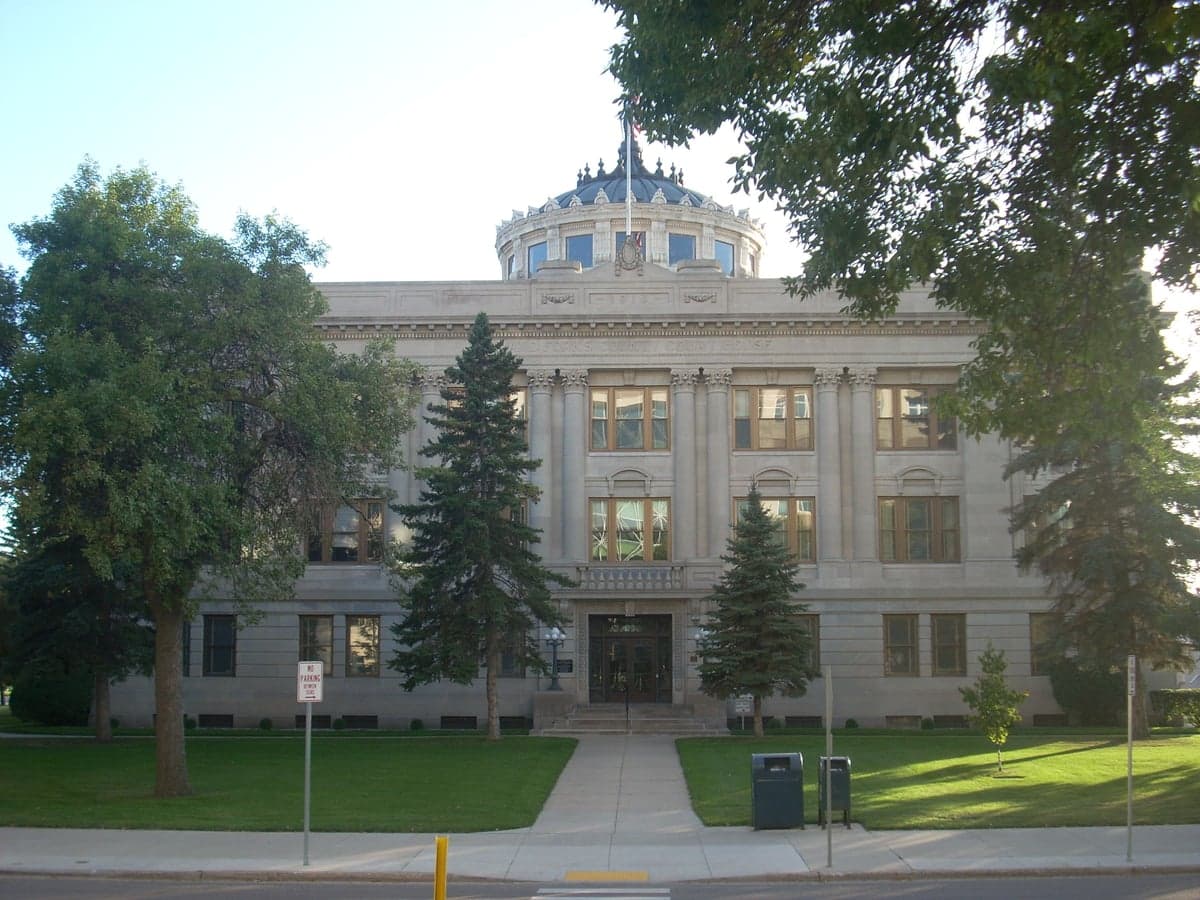
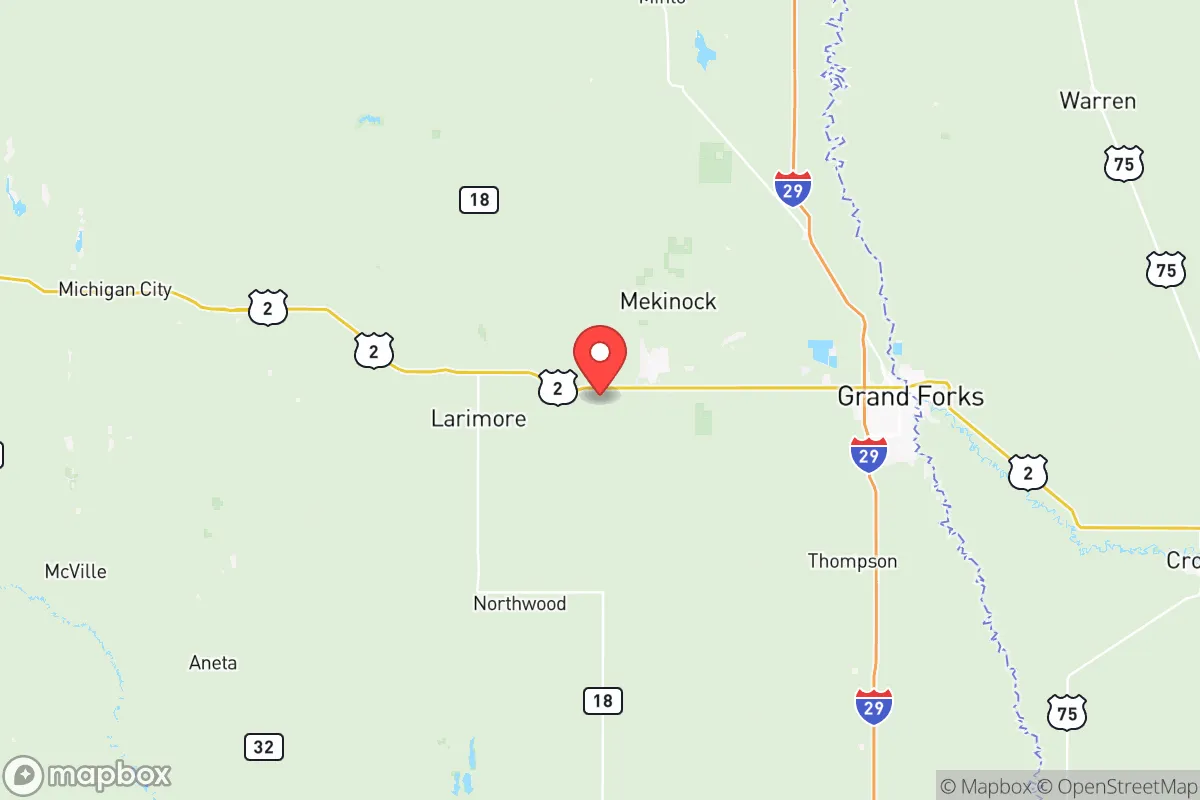
Grand Forks County leans solidly Republican, with a Cook Partisan Voting Index (PVI) of R+18, making it one of the more conservative counties in eastern North Dakota. The county has voted for the GOP presidential candidate in every election since 2000, though the margin has tightened slightly in recent cycles—Donald Trump won the county by about 18 points in 2020, down from a 24-point margin in 2016. The real political story here isn't a uniform red wall, but a sharp urban-rural split: the city of Grand Forks itself, home to the University of North Dakota (UND), provides a reliable Democratic-leaning base, while the surrounding small towns and farm country—places like Thompson, Larimore, and Manvel—vote overwhelmingly Republican. This divide means the county's overall R+18 rating masks a more nuanced local reality where precinct-level results can swing from D+10 in central Grand Forks to R+40 in rural townships.
How it compares
Compared to the rest of North Dakota, Grand Forks County is actually slightly less conservative than the state average. While North Dakota as a whole has trended hard right—Trump won the state by 33 points in 2020—Grand Forks County's R+18 PVI reflects the moderating influence of its university population and the city's more diverse economy. For context, neighboring Walsh County to the west is closer to R+25, while Cass County (Fargo) sits around R+15, making Grand Forks County roughly in the middle of the state's political spectrum. The key difference is that Grand Forks County has a genuine two-party dynamic in local races: Democratic candidates for state legislature and county commission can win seats in Grand Forks city precincts, whereas in most other North Dakota counties, Republicans face little to no organized opposition. The state's Cook PVI is not publicly calculated by the Cook Political Report, but based on presidential margins, it's estimated at R+25 to R+30, meaning Grand Forks County is about 7-12 points more competitive than the state as a whole.
What this means for residents
For conservative residents, the R+18 lean means their values are broadly reflected in county policy—low taxes, limited regulation, and a strong agricultural and energy focus. The county commission and most city councils outside Grand Forks are reliably Republican, so issues like gun rights, property tax caps, and opposition to state-level carbon initiatives get a sympathetic hearing. For liberal residents, the picture is more mixed: they can reliably win city council seats in Grand Forks' Ward 1 and Ward 2 (near UND), and the county's Democratic-NPL Party remains active enough to field candidates for state legislative seats in District 42 and 43. However, statewide policies—like North Dakota's near-total abortion ban, permitless carry law, and lack of anti-discrimination protections for LGBTQ+ residents—can feel out of step with the more progressive views common in the university community. The practical effect is that Grand Forks County residents experience a kind of political dualism: the city allows for a liberal social bubble, but the county and state governments lean heavily conservative.
Culturally, this split shows up in everyday life. Grand Forks has a vibrant arts scene, a growing craft brewery culture, and a visible LGBTQ+ community centered around the UND campus, while the rural towns like Thompson and Manvel are more likely to host church suppers, 4-H events, and NRA-certified shooting ranges. The county's political trajectory is toward slow, incremental moderation—driven by UND's enrollment growth and an influx of younger professionals in healthcare and tech—but the surrounding rural areas are aging and becoming more conservative, which keeps the overall R+18 rating stable. For anyone moving here, the key takeaway is that Grand Forks County offers a genuine choice: you can find a community that matches your politics, whether you're a conservative farmer in Larimore or a liberal professor in the university district, but the county as a whole will remain reliably red for the foreseeable future.

State Political ClimatePolitical Climate in North Dakota
State Political AnalysisPolitical Environment in the State
North Dakota is about as reliably Republican as a state gets. The GOP holds supermajorities in both legislative chambers, and the state has voted for the Republican presidential candidate by at least 20 points in every election since 2000 — hitting a +34 spread in 2024. That red dominance is driven by a rural, resource-extraction economy and a culture of self-reliance, but the political picture is not a monolith. Fargo has become a blue-dot urban hub, while oil country like Williston and Dickinson is a bastion of libertarian-leaning conservatism, and the eastern Red River Valley holds a mix of moderate and agrarian left traditions. Over the last two decades, the state has moved steadily rightward on social and cultural issues while remaining fiercely independent on fiscal policy.
Urban vs. rural divide
If you draw a line down the middle of the map, western North Dakota votes a solid 80-85% Republican in most races, while the eastern metro areas — especially Fargo, West Fargo, and Grand Forks — are more competitive. Fargo is the state’s largest city and the only reliably blue-leaning district in state legislative races; Cass County as a whole voted +12 for Trump in 2024, but the city itself often elects Democrats to local office and sends a few to the state house. Grand Forks, home to UND, is more balanced but still leans Republican overall. Bismarck and its sister city Mandan, the state capital, are conservative but moderate on fiscal issues thanks to a large state government workforce. Out west, Williston, Dickinson, and Minot are deeply red, fueled by oil wealth and a transient blue-collar workforce that wants low taxes and minimal regulations. The rural counties — places like Hettinger, Slope, and Grant — are the most Republican in the nation; some gave Trump more than 90% of the vote. This geographic split means that statewide candidates sometimes tack left on messaging to keep the eastern metros competitive, but governing is a Republican affair.
Policy environment
North Dakota has no state personal income tax and a low property tax burden, though local mill levies vary. The state relies heavily on oil and gas extraction taxes and federal agricultural subsidies. Its regulatory posture is business-friendly: it’s a right-to-work state, and environmental regulations are light compared to coastal states — a key draw for the energy industry. On education, the state funds its public schools above the national average per student and has a strong statewide K-12 system, but school choice options are limited: there’s a small tax-credit scholarship program but no vouchers or charter schools. Higher education is anchored by NDSU in Fargo and UND in Grand Forks. Healthcare policy is mixed; the state did expand Medicaid under the Affordable Care Act in 2013, a rare Republican-led expansion, but it has kept a tight grip on abortion regulations and telehealth licensing. Election laws require a non-expired photo ID, though a student ID from a North Dakota university is accepted. No-excuse absentee voting is allowed, but mail-in balloting is not universal. The voter ID law has been challenged but upheld, often prompting complaints about Native American turnout issues.
Recent policy direction
Over the last five years, North Dakota has enacted some of the most conservative state laws in the country, especially on social issues. In 2023, the legislature passed a near-total abortion ban after a six-week heartbeat bill; it’s currently tied up in court, but the state Supreme Court has upheld a trigger ban in effect. Gun laws are among the most permissive: permitless carry was signed into law in 2017, and a "stand your ground" self-defense statute was passed in 2021. On parental and education rights, Governor Doug Burgum signed a "Parents Bill of Rights" in 2021 that requires schools to notify parents about curriculum changes and health services. In 2023, the state became one of the first to pass a law banning transgender female athletes from participating in K-12 and college sports, and it also restricted gender-affirming care for minors. Property rights are strong: the state retains control over subsurface mineral rights, which has been a flashpoint during oil booms, but surface owners have little recourse against drillers. In 2021, the legislature passed a bill making it harder for local governments to restrict oil and gas operations. On voting, the state has preserved its photo ID requirement, and in 2023 it rejected efforts to implement ranked-choice voting. On taxation, a 2023 law cut individual income tax rates (though the state has none, so it applied to corporate and bank taxes) and lowered the top rate on pass-through entities. The overall direction is toward limited government, cultural conservatism, and economic deregulation.
Civil unrest & political movements
North Dakota is not known for frequent street protests, but the state has been the scene of one of the most significant modern activist movements: the Dakota Access Pipeline protests at Standing Rock in 2016-2017. While technically on tribal land near the South Dakota border, the protests drew national attention and involved thousands of activists; state and local law enforcement in Morton County and Mandan were heavily criticized for their response. Since then, pipeline opposition has faded, but Native rights advocacy remains active. In 2020, Black Lives Matter rallies took place in downtown Fargo and Grand Forks, drawing a few hundred people each but no major unrest. On the right, the state’s strong gun culture and libertarian streak have fueled a small but vocal “constitutional sheriff” movement and some county-level nullification resolutions against vaccine mandates and federal firearms restrictions — though none have passed binding law. Immigration politics are relatively quiet; North Dakota is one of the few states that actively recruits refugees to bolster its labor force, with resettlement agencies in Fargo and Bismarck. There are no sanctuary cities. Election integrity controversies are minimal: the 2020 election results were certified without major challenge, though some rural counties considered hand-count audits. Overall, the state is politically stable — the kind of place where you rarely see campaign yard signs until October and people tend to keep their politics civil at the grocery store.
Projection
Over the next five to ten years, North Dakota’s political geography will shift slowly but measurably. Fargo’s population is growing as a hub for tech and healthcare (Microsoft, Sanford Health), drawing younger workers from blue states. That will likely make Cass County more competitive — it could flip to a swing county or even blue within a decade if national trends continue. Meanwhile, western oil extraction will remain volatile but structurally Republican. The rural exodus continues; many small counties are losing population, consolidating even more political power in Fargo and Bismarck. In-migration from out-of-state is mostly conservative — people moving for jobs in energy, ag, and remote work — but is unlikely to tilt the state much more right than it already is. Expect continued GOP dominance at the state level, but a possible narrowing in statewide races if a moderate Democrat emerges from the Fargo area. The legislature will likely remain supermajority Republican, but internal factions (Main Street vs. libertarian right) may grow louder. Social policy will not moderate, but fiscal policy may see more debate over property tax reform and school funding as the state’s revenue from oil declines in the long term. A new resident moving in now should expect a stable, deeply conservative policy environment that values low taxes and individual liberties, with a small but functioning blue enclave in Fargo.
For someone considering a move to North Dakota, the bottom line is straightforward: if you want a state where government stays out of your wallet and your gun safe, and where cultural issues tilt right, you’ll feel at home almost anywhere outside the university neighborhoods of Fargo and Grand Forks. If you lean left, you’ll find a vibrant community in Fargo and pockets in Grand Forks, but you’ll be in the minority — and that’s okay, because politics here is more about live-and-let-live than constant conflict. The cost of living is low, the landscape is wide open, and the people are generally neighborly. Just know that on a national electoral map, this state is a deep, unshakable red — and that’s exactly how most North Dakotans like it.
* Values derived from national, state, county, city and local statistics and may differ in a specific area. Last updated: 2026-07-10T08:12:10.000Z
Narrative content on this page is AI-generated and may contain mistakes. Verify any details that matter before acting on them.
ReloMaps may earn a commission from affiliate links at no extra cost to you.

