Photo: Wikipedia
Political ClimatePolitical Climate in Burleigh County
Showing state-level results — no local-only data available.
Local Political AnalysisPolitical Analysis of Burleigh County
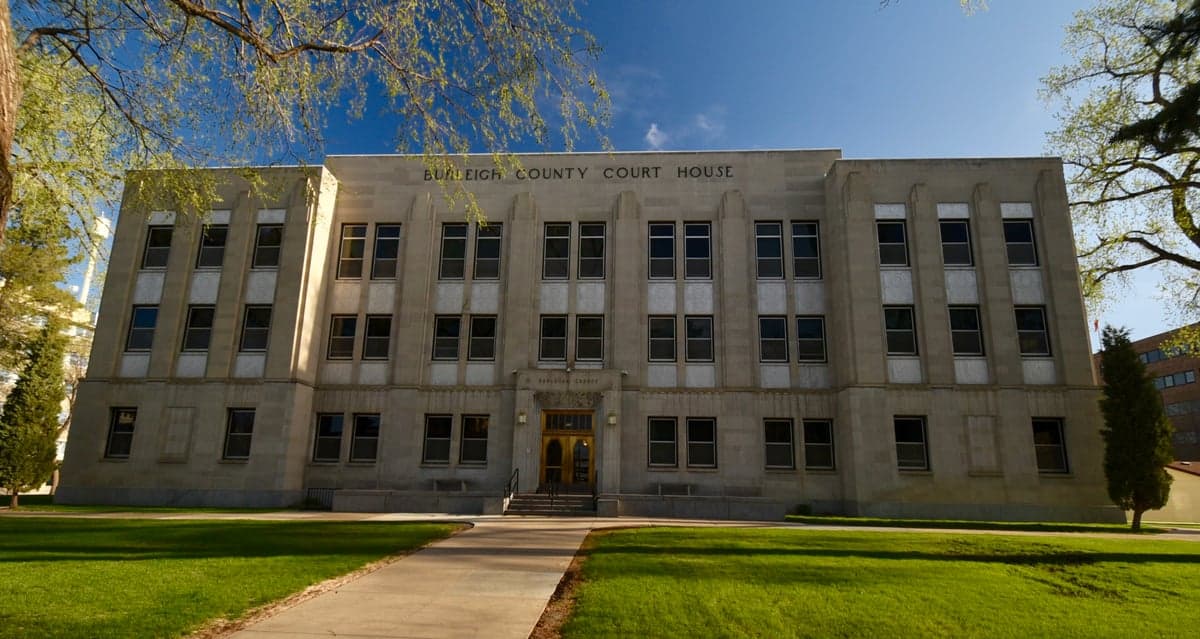
Burleigh County, anchored by Bismarck, is one of the most reliably Republican counties in North Dakota, with a Cook Partisan Voting Index of R+18. That means the county votes about 18 points more Republican than the national average in presidential elections. In 2024, Donald Trump carried Burleigh County by roughly 35 points, a margin that has held steady since 2016. The county's political trajectory is stable red, with no signs of a shift toward the center — if anything, the rural precincts outside Bismarck have become more conservative over the past decade, while the city itself has remained a solid Republican stronghold with a small but persistent Democratic minority.
How it compares to North Dakota as a whole
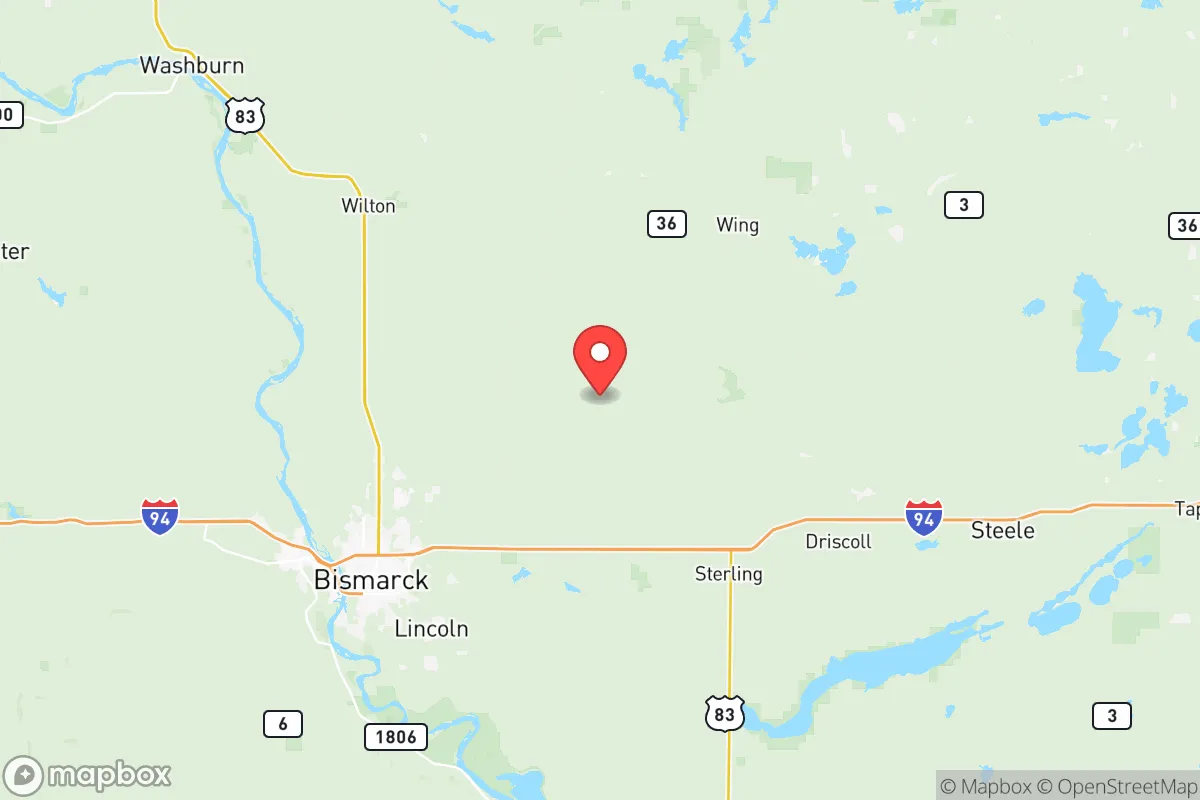
North Dakota as a state is also deeply Republican, but Burleigh County is actually a bit more conservative than the state average. The state's Cook PVI is not publicly calculated, but statewide presidential margins have hovered around R+20 to R+25 in recent cycles. Burleigh County's R+18 PVI puts it slightly to the left of the state's most conservative counties (like Hettinger or Adams, which often vote 40+ points Republican) but well to the right of the state's few blue-leaning areas, such as the college town of Grand Forks or the Native American-majority precincts in Rolette County. Within Burleigh County itself, the political geography is fairly uniform: Bismarck's core neighborhoods and the suburbs of Lincoln and Mandan (which is actually in Morton County but functionally part of the metro) all vote Republican by comfortable margins. The only precincts that occasionally vote Democratic are a handful of precincts near the state capitol complex and the University of Mary campus, where younger and more educated voters sometimes split tickets. The rural townships around Wing and Driscoll are among the most conservative in the county, often voting 80%+ Republican.
What this means for residents
For conservative residents, Burleigh County's political climate means their values are reflected in local governance. The county commission, the Bismarck city council, and the school board are all dominated by Republicans, and policy decisions — from tax rates to land use to education funding — tend to align with conservative priorities. For liberal residents, the reality is that they are a clear minority. There is no organized progressive caucus on the city council, and Democratic candidates rarely win countywide office. However, the political climate is not hostile in a personal sense. Bismarck is a civil, Midwestern community where political disagreements rarely spill into daily life. Liberal residents can find community through the Burleigh County Democratic Party or through issue-specific groups like the local chapter of the League of Women Voters. The practical effect of the county's lean is that property taxes are relatively low, zoning is permissive, and the local economy is heavily tied to state government and energy — both sectors that benefit from Republican policy priorities.
Culturally, Burleigh County is distinct from the state's more rural areas in that it is the seat of state government. This gives Bismarck a slightly more professional, policy-oriented atmosphere than, say, the oil patch towns of Williston or the agricultural communities of the Red River Valley. The presence of the state capitol, the North Dakota Heritage Center, and numerous state agencies means that politics is a common topic of conversation, but it's usually discussed in a pragmatic, policy-focused way rather than a partisan one. The county's strong Republican lean is unlikely to change in the near future, as the population is growing slowly and the new residents tend to be retirees or state employees who are already aligned with the dominant political culture. For anyone moving to Burleigh County, the political climate is straightforward: it's a conservative place where conservative policies are the norm, and where liberal residents can live comfortably as long as they are comfortable being in the minority.

State Political ClimatePolitical Climate in North Dakota
State Political AnalysisPolitical Environment in the State
North Dakota is a deeply red state, with a Republican lean that has only intensified over the past two decades. In 2024, Donald Trump won the state by a margin of roughly 20 points, a slight dip from his 33-point win in 2020, but still reflecting a solidly conservative electorate. The dominant coalition is a mix of rural agricultural interests, energy sector workers from the Bakken oil fields, and a growing number of conservative-leaning transplants from blue states. The state’s political trajectory has been a steady march rightward since the 1990s, when it was still a competitive two-party state with a strong populist streak. Today, the Democratic-NPL (Nonpartisan League) party holds no statewide elected offices and only a handful of legislative seats, concentrated in a few urban pockets.
Urban vs. rural divide
The political map of North Dakota is a textbook study in the urban-rural split, but with a twist: even the "urban" areas are relatively small and conservative. The largest city, Fargo, is the state’s most liberal-leaning metro, but it still votes Republican in most statewide races. In 2024, Cass County (Fargo) went for Trump by about 10 points, a far cry from the 30+ point margins in rural counties. Grand Forks, home to the University of North Dakota, is a swing area that leans slightly red, while Bismarck and Mandan are reliably conservative, driven by state government and energy workers. The real engine of the state’s red lean is the vast rural expanse—counties like McKenzie (the heart of the Bakken) and Williams County (Williston) vote Republican by 50-60 points. The only reliably blue counties are Rolette and Sioux, both home to Native American reservations (Turtle Mountain and Standing Rock, respectively), which vote heavily Democratic due to tribal solidarity and federal funding concerns. The divide isn’t just about geography; it’s about economic base. Oil and agriculture drive the red vote, while the service and education sectors in Fargo and Grand Forks provide the few Democratic footholds.
Policy environment
North Dakota’s policy environment is a conservative’s dream, with low taxes, minimal regulation, and a strong emphasis on individual liberty. There is no state income tax on wages (only a corporate income tax and a modest property tax), and the state has a constitutional spending limit that keeps budgets lean. The regulatory posture is business-friendly, especially for energy and agriculture—permitting for oil drilling is streamlined, and there are no state-level environmental regulations stricter than federal minimums. Education policy is dominated by school choice: the state has a robust open enrollment system, and in 2023, it passed a school voucher-like program (HB 1532) that provides tax credits for private school tuition. Healthcare is a mixed bag: the state expanded Medicaid under the Affordable Care Act in 2013, but it also has some of the most restrictive abortion laws in the nation (a near-total ban with exceptions only for rape, incest, and life of the mother, passed as HB 1465 in 2023). Election laws are among the most secure in the country—voter ID is required, same-day registration is not allowed, and mail-in voting is restricted to those with a valid excuse. The state also has a strong tradition of direct democracy through ballot initiatives, though the legislature has made it harder to amend the constitution via initiative in recent years.
Recent policy direction
The last five years have seen North Dakota accelerate its conservative policy agenda, with a focus on cultural and educational issues. In 2023, the legislature passed a sweeping parental rights bill (SB 2231) that requires schools to notify parents of any curriculum involving sexuality or gender identity, and it bans instruction on these topics in K-3. Gun laws are among the most permissive in the nation: permitless carry has been legal since 2017, and there is no state-level red flag law. The state also passed a "Second Amendment Preservation Act" (HB 1469) in 2021 that purports to nullify federal gun laws, though it’s largely symbolic. On privacy and surveillance, North Dakota has a weak record—it was one of the first states to require warrants for drone surveillance (2015), but it also has a robust data-sharing agreement with federal law enforcement. Medical and bodily autonomy is sharply restricted: abortion is banned after six weeks (with no exceptions for fetal anomalies), and the state has a "trigger law" that would ban all abortions if Roe v. Wade were overturned (which it was, in 2022). Property rights are strong, with no state-level eminent domain abuse for private development. Taxation is trending downward: in 2023, the legislature cut the corporate income tax rate from 4.31% to 3.5%, and there are ongoing efforts to eliminate it entirely. Voting access has been tightened: in 2021, the state passed a law (HB 1253) that requires absentee ballots to be notarized or witnessed, a move critics say suppresses the Native American vote.
Civil unrest & political movements
North Dakota has a history of civil unrest that is both recent and deeply rooted. The most famous flashpoint was the Standing Rock protests (2016-2017), where thousands of activists from the Standing Rock Sioux Tribe and allies from across the country camped near the reservation to oppose the Dakota Access Pipeline. The protests were met with a heavy law enforcement response, including the use of water cannons in freezing temperatures, and they became a national symbol of the conflict between energy development and tribal sovereignty. Today, the movement has largely dissipated, but the scars remain—tensions between the state government and tribal nations are still raw, especially over voting access and law enforcement jurisdiction. On the right, the state has a small but vocal libertarian and "constitutional sheriff" movement, particularly in rural counties like McLean and Mercer, where sheriffs have publicly refused to enforce certain state or federal gun laws. There is also a growing "election integrity" movement, fueled by baseless claims of fraud in the 2020 election, which has led to increased scrutiny of mail-in voting and ballot drop boxes. Immigration politics are relatively quiet—North Dakota has a tiny foreign-born population (about 4%), and the state has no sanctuary policies. There is no serious secession or nullification rhetoric, though the "Second Amendment Preservation Act" is a form of symbolic nullification. A new resident would notice that political activism is low-key compared to coastal states; most people keep their politics private, and the culture is one of "live and let live" as long as you don’t rock the boat.
Projection
Over the next 5-10 years, North Dakota’s political trajectory is likely to remain solidly red, but with some interesting shifts. The biggest demographic change is the continued growth of the Fargo metro, which is attracting younger, more educated workers from out of state, many of whom are moderate or even liberal. This could slowly make the state more competitive in the long run, but for now, Fargo’s growth is offset by rural depopulation, which keeps the overall lean red. The energy sector is volatile—if oil prices stay high, the Bakken counties will continue to drive the conservative vote; if they crash, the state could see a temporary shift toward populist Democrats who promise economic diversification. The Native American population is growing faster than the state average, and if voting access is expanded (which is unlikely under the current legislature), it could create a more competitive dynamic in a few legislative districts. In-migration from blue states is real but small—most newcomers are drawn by jobs in energy, agriculture, or healthcare, and they tend to be conservative or libertarian. What a new resident should expect in a decade is a state that is still deeply red, but with a more urbanized, slightly more moderate Fargo metro that occasionally elects a Democrat to a local office. The cultural wars will likely intensify, especially around education and LGBTQ+ rights, as the state’s rural base pushes back against national trends. The tax environment will remain favorable, and the regulatory climate will stay business-friendly, but the state’s reliance on oil revenue means that any downturn could force tough budget choices.
For a new resident, the bottom line is this: North Dakota is a place where conservative values are the default, and you’ll feel that in everything from the low taxes to the permissive gun laws to the limited government services. If you’re a conservative, you’ll find a welcoming environment where your views are mainstream and your lifestyle is respected. If you’re a liberal, you’ll find a small but resilient community in Fargo and Grand Forks, but you’ll need to be comfortable being in the minority. The state’s politics are stable, predictable, and unlikely to surprise you—what you see is what you get. The key practical takeaway is that your vote will matter less in statewide races, but your voice can still have a real impact at the local level, especially in school board and city council elections, where the real decisions about your daily life are made.
* Values derived from national, state, county, city and local statistics and may differ in a specific area. Last updated: 2026-07-14T08:36:20.000Z
Narrative content on this page is AI-generated and may contain mistakes. Verify any details that matter before acting on them.
ReloMaps may earn a commission from affiliate links at no extra cost to you.

