
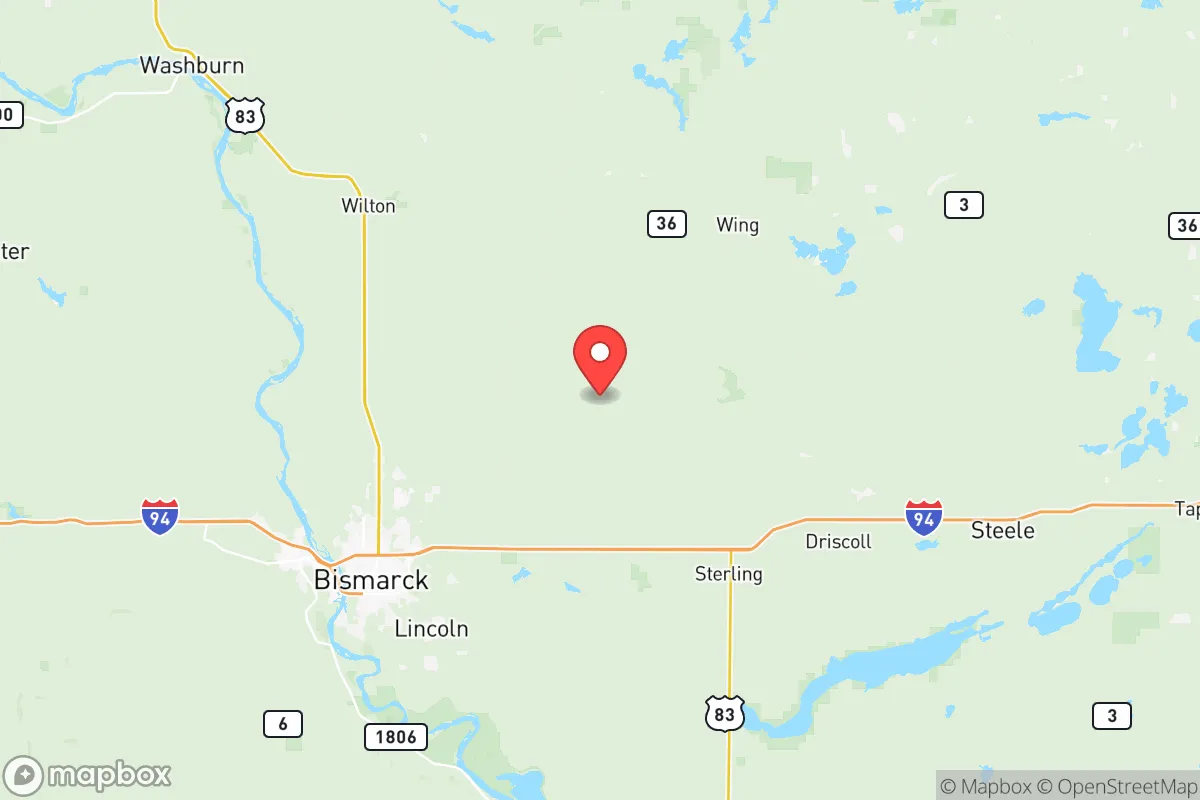
Photo: Wikipedia
Strategic Assessment of Burleigh County
Workable tactical position. Some exposure to population density or targets, but generally defensible in a crisis.
What does the Strategic Assessment tell us?
Our Strategic Assessment grades tactical survivability of an area. Major population centers, military targets, fallout zones, natural disasters, and border exposure all drive risk — lower exposure means a more defensible position in a crisis.
This is heavily inspired by Joel Skousen's Strategic Relocation book. Highly recommended you checkout the book ($)What does this tell us?
Our Strategic Assessment grades tactical survivability of an area. Major population centers, military targets, fallout zones, natural disasters, and border exposure all drive risk — lower exposure means a more defensible position in a crisis.
This is heavily inspired by Joel Skousen's Strategic Relocation book. Highly recommended you checkout the book ($)Strategic Pillars

Key Distances
Strategic Assessment Analysis
Burleigh County, anchored by the state capital of Bismarck, offers a compelling strategic profile for relocators prioritizing resilience, self-sufficiency, and distance from major metropolitan vulnerabilities. Its position in south-central North Dakota places it far from coastal hurricane zones, seismic fault lines, and the dense population corridors of the East and West Coasts, while its status as a state government and energy hub provides a stable economic and infrastructural backbone. For a conservative-leaning individual or family weighing disaster readiness and long-term security, Burleigh County presents a low-risk, high-stability option with tangible advantages in food, water, and energy independence.
Geographic position and natural advantages for long-term security
Burleigh County’s geography is its first line of defense. Situated on the Missouri River, the county benefits from a reliable freshwater source that is less prone to drought than many western states. The surrounding landscape is a mix of rolling plains, river breaks, and agricultural land, offering natural defensibility through open sightlines and limited choke points. The county is roughly 200 miles from the nearest major metropolitan area—Minneapolis-St. Paul—placing it well outside the immediate fallout or chaos zone of a major urban disaster. The nearest city of comparable size, Fargo, is about 190 miles east, while the Canadian border lies 150 miles north. This isolation from large population centers is a net positive for a relocator seeking to avoid the cascading failures—supply chain collapse, civil unrest, disease spread—that often follow a catastrophic event. The county’s low population density (roughly 95,000 residents across 1,668 square miles) means fewer people competing for resources in a crisis, and the cold winters naturally reduce the viability of many biological threats.
Risks, exposures, and proximity to fallout-relevant landmarks
No location is risk-free, and Burleigh County has specific exposures a strategic relocator must weigh. The most significant man-made risk is the presence of the Tharaldson Ethanol Plant near Casselton (about 100 miles east) and the Bismarck-Mandan rail corridor, which carries Bakken crude oil and ethanol through the county. A derailment or explosion at a rail crossing near Mandan or Lincoln could create a localized hazard, though the county’s flat terrain and prevailing winds typically disperse such events quickly. The Garrison Dam on the Missouri River, about 50 miles north of Bismarck, is a critical infrastructure point: while it provides flood control and hydroelectric power, a catastrophic failure would inundate low-lying areas along the river, including parts of Bismarck’s south side and the town of Fort Rice. However, the dam is well-maintained by the U.S. Army Corps of Engineers and is not considered a high-risk structure. The county is also within 200 miles of Minot Air Force Base, home to nuclear-capable B-52 bombers and missile silos—a potential target in a conflict scenario. That said, the base’s remote location and hardened facilities make a direct strike unlikely, and the county’s distance from the base (about 150 miles) provides a buffer from any immediate blast or fallout. Natural risks are minimal: tornadoes occur but are less frequent and intense than in the Plains states to the south, and the county is not in a floodplain for the Missouri River above the dam. Winter storms are the primary natural hazard, but they are predictable and manageable with proper preparation.
Practical resilience for a relocator: food, water, energy, and defensibility
For a relocator serious about self-sufficiency, Burleigh County scores well on the four pillars of practical resilience. Water is abundant: the Missouri River provides a year-round surface water source, and the county’s aquifer system (the Dakota Sandstone) offers deep groundwater access for wells. Bismarck’s municipal water treatment plant is modern and redundant, but a rural property with a well and a hand pump would provide true independence. Food production is a major strength. The county is surrounded by some of the most productive farmland in the nation—wheat, corn, soybeans, and sunflowers dominate—and local ranchers raise cattle, bison, and sheep. The Bismarck Farmers Market and numerous CSAs (community-supported agriculture operations) provide direct access to fresh produce, and the county’s agricultural extension office offers resources for home gardening and livestock. For long-term storage, the North Dakota State University Extension in Bismarck provides workshops on canning, dehydrating, and root cellaring. Energy is another strong point. North Dakota is the nation’s second-largest oil producer (Bakken shale), and Burleigh County sits near the Bismarck-Mandan oil refinery (a small refinery processing about 20,000 barrels per day) and multiple natural gas processing plants. The county also has significant wind energy potential, with several commercial wind farms operating in the region. A relocator could feasibly install solar panels or a small wind turbine, with net metering available through Montana-Dakota Utilities. Defensibility is aided by the county’s low population density and open terrain. Rural properties with long driveways, good sightlines, and a defensible perimeter (e.g., a creek or treeline) are common. The county’s sheriff’s office is well-funded and responsive, and the Bismarck Police Department maintains a strong community presence. For those concerned about civil unrest, the county’s conservative culture and high rates of firearm ownership (North Dakota has some of the most permissive gun laws in the nation) act as a deterrent. The North Dakota National Guard has a significant presence in Bismarck, providing additional security in a state-level emergency.
In the overall strategic picture, Burleigh County offers a rare combination of isolation, resource abundance, and infrastructural stability that is hard to find in the Lower 48. Its distance from major population centers, nuclear targets, and coastal disaster zones makes it a strong candidate for a relocator prioritizing long-term security over convenience. The risks—rail accidents, dam failure, winter storms—are real but manageable with modest preparation. For a family or individual willing to invest in a well, a garden, and a backup power system, Burleigh County provides a solid foundation for a resilient, self-sufficient lifestyle. It is not a bunker, but it is a defensible, resource-rich position in a state that values independence and preparedness. For the conservative-leaning relocator, it is a strategic asset worth serious consideration.

* Values derived from national, state, county, city and local statistics and may differ in a specific area. Last updated: 2026-07-14T08:36:20.000Z
Narrative content on this page is AI-generated and may contain mistakes. Verify any details that matter before acting on them.
ReloMaps may earn a commission from affiliate links at no extra cost to you.

