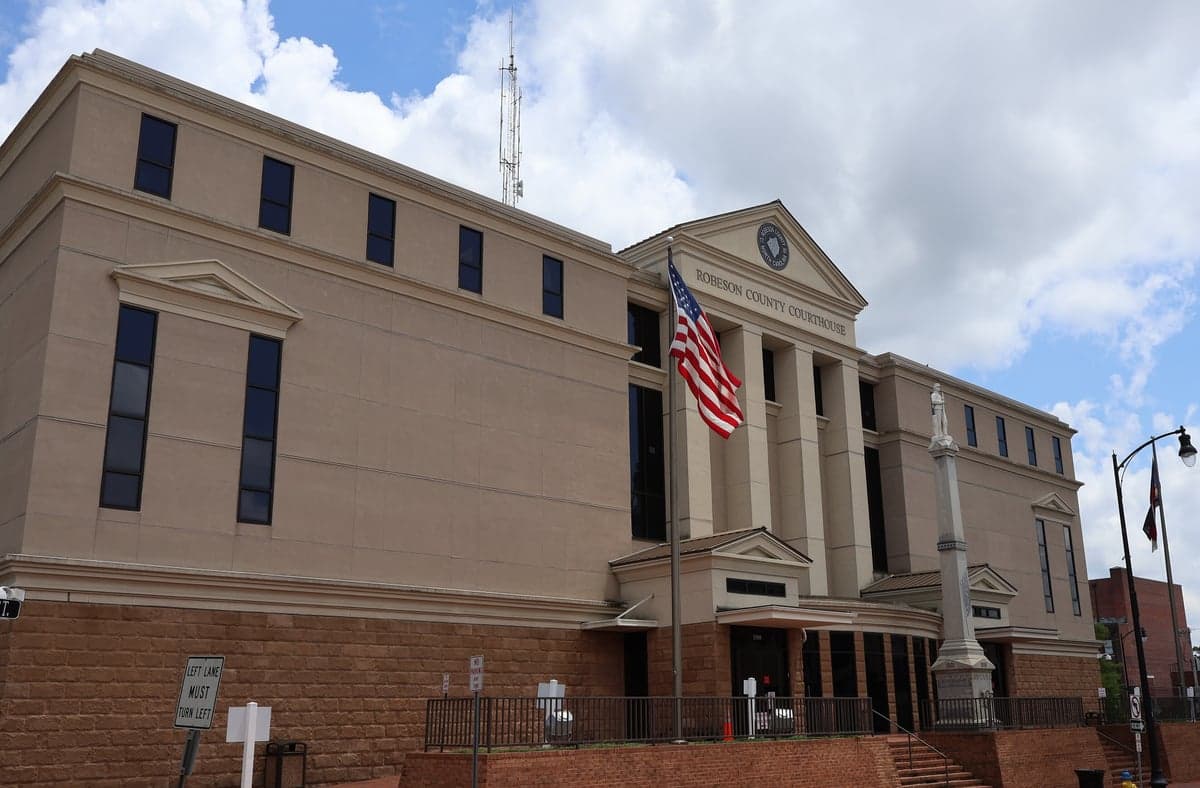
Photo: Wikipedia
Political ClimatePolitical Climate in Robeson County
Showing district-level results — no local-only data available.
Local Political AnalysisPolitical Analysis of Robeson County
Robeson County is a political outlier in North Carolina, a deeply conservative rural county that nonetheless has a strong Democratic tradition at the local level, creating a fascinating split-ticket reality. The county's Cook PVI of R+10 is a full 11 points more Republican than the state's R+1 rating, but that number masks a more complex story: Robeson County voted for Donald Trump in 2024, but it also regularly elects Democrats to county commission, school board, and sheriff positions. The real action is in the precinct-level divide between the county's small cities and towns, where the political map looks less like a solid red block and more like a patchwork of competing loyalties.
How it compares
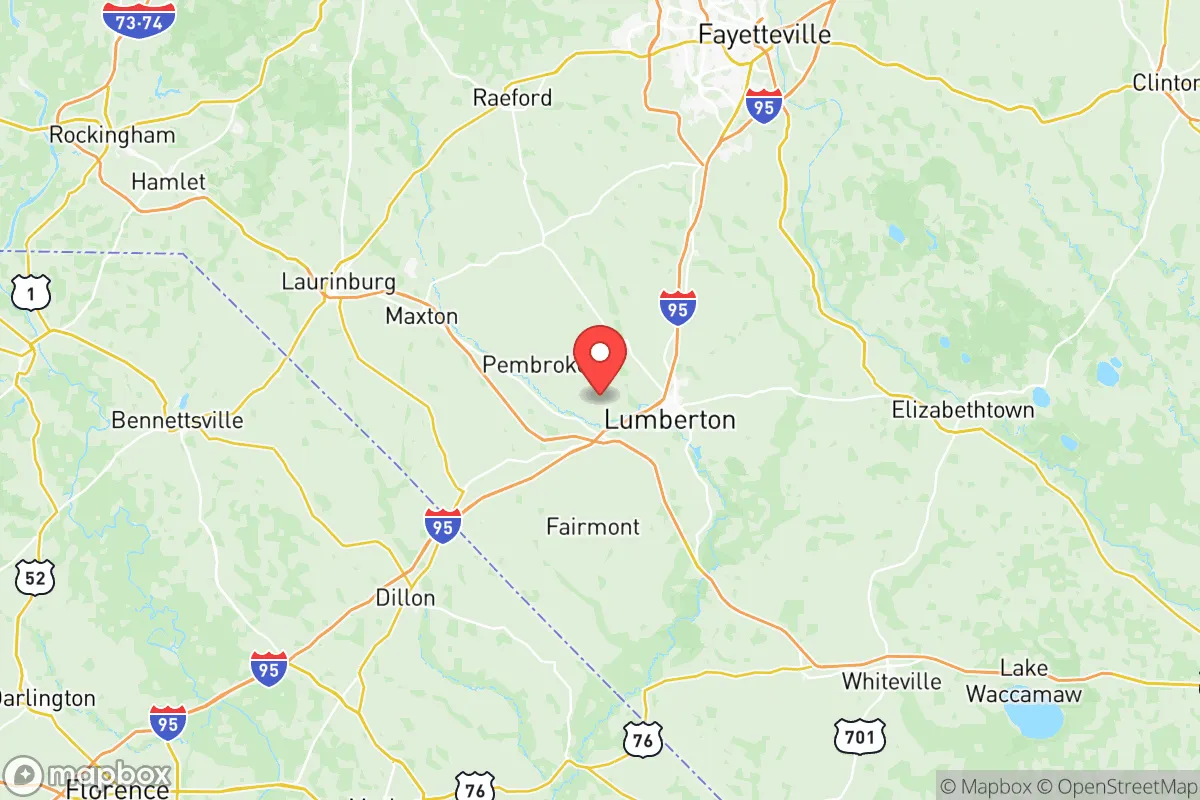
Compared to North Carolina as a whole, Robeson County is both more Republican in presidential races and more Democratic in local ones. The state's R+1 PVI reflects a true swing state where both parties compete, but Robeson County's R+10 rating puts it in the same league as neighboring rural counties like Scotland and Columbus. The difference is that Robeson County's Democratic base is concentrated in the Lumbee tribal communities around Pembroke and the historically Black neighborhoods of Lumberton, where precincts often go 60-70% Democratic. Meanwhile, the white rural precincts around Fairmont, St. Pauls, and Rowland vote reliably Republican, often by 70% or more. The swing precincts are in the more suburban parts of Lumberton and around Maxton, where working-class voters of all races split tickets based on candidate personality and local issues rather than party label.
What this means for residents
For conservative residents, the county's Republican lean means their presidential and statewide votes usually align with the winner, but they often find themselves in the minority on county commission votes, where Democrats hold a 5-2 majority as of 2025. For liberal residents, the reverse is true: they can reliably elect local officials who reflect their values on issues like education funding and infrastructure, but they are consistently outvoted in state and federal races. This creates a practical reality where both sides have genuine representation at different levels of government, but neither feels fully in control. The county's political culture is less about ideological warfare and more about personal relationships and family names, with local elections often turning on which candidate has deeper roots in the community rather than which party label they carry.
One cultural distinction that sets Robeson County apart from the rest of North Carolina is the central role of the Lumbee Tribe in local politics. The tribe's influence is strongest in Pembroke and the surrounding areas, where tribal membership is a major factor in elections and where candidates routinely campaign at tribal events and powwows. This creates a political dynamic that doesn't exist anywhere else in the state, where Native American voters are a decisive bloc rather than a marginal one. The county also has a higher-than-average rate of split-ticket voting, with many residents voting for Trump for president while supporting Democratic candidates for sheriff and county commission. This pattern has held steady for decades, suggesting that Robeson County's political identity is less about party loyalty and more about a pragmatic, candidate-by-candidate approach that frustrates both state and national party strategists.

State Political ClimatePolitical Climate in North Carolina
State Political AnalysisPolitical Environment in the State
North Carolina is a classic purple state that has been trending rightward in recent cycles, with a Cook Partisan Voting Index of R+1, but it remains a genuine battleground where neither party can take victory for granted. The state’s political identity is shaped by a rapidly growing, diversifying population, a powerful rural conservative base, and a handful of booming metro areas that lean Democratic. Over the last 10-20 years, North Carolina has gone from a reliably Republican state in presidential elections (voting for the GOP nominee every time from 1980 to 2008 except for 1976) to a true toss-up, with Barack Obama winning it in 2008, Mitt Romney in 2012, and Donald Trump in 2016 and 2020 by razor-thin margins. The dominant coalitions are a rural and exurban conservative base that turns out heavily in non-presidential years, and a growing, younger, and more diverse urban coalition centered in the Research Triangle, Charlotte, and the Piedmont Triad that can swing statewide elections when turnout is high.
Urban vs. rural divide
The political map of North Carolina is a textbook study in the urban-rural divide. The state’s three major metro areas — Charlotte (Mecklenburg County), the Raleigh-Durham-Chapel Hill Research Triangle (Wake, Durham, and Orange Counties), and the Piedmont Triad (Greensboro, Winston-Salem, and High Point in Guilford and Forsyth Counties) — are solidly Democratic and growing fast. Mecklenburg County alone delivered a 30-point margin for Joe Biden in 2020, while Wake County gave him a 25-point win. These metros are powered by finance, tech, and higher education, attracting a highly educated, diverse, and younger workforce. In contrast, the vast rural and small-town areas of eastern North Carolina (places like Greenville, Jacksonville, and the coastal counties), the Sandhills, and the western mountains (around Asheville and Boone) are deeply Republican. The state’s rural counties, many of which have been losing population for decades, vote by margins of 40-60 points for the GOP. The key swing areas are the fast-growing exurban and suburban counties that ring the metros — places like Union County (southeast of Charlotte), Johnston County (southeast of Raleigh), and Cabarrus County (northeast of Charlotte) — which have been trending toward the GOP but are becoming more competitive as new residents arrive from blue states. The 2024 election saw Trump improve his performance in many of these suburban counties compared to 2020, suggesting the GOP is consolidating its hold on the exurbs even as the urban cores become more Democratic.
Policy environment
North Carolina’s policy environment is a mix of conservative governance and pragmatic moderation, shaped by a Republican-controlled General Assembly that has held supermajorities for much of the last decade, and a Democratic governor (Roy Cooper from 2017 to 2025) who has used veto power to moderate the most aggressive conservative bills. The state has a flat income tax rate of 4.5% (set to decline further under a 2021 law), a relatively low corporate tax rate of 2.5%, and no state-level property tax (localities set their own). Sales tax rates vary by county but average around 6.75%. The regulatory posture is generally business-friendly, with a right-to-work law and a strong tort reform environment. On education, the state has a robust charter school sector and a growing school voucher program (the Opportunity Scholarship Program), which was expanded in 2023 to make vouchers available to all families regardless of income. Higher education is dominated by the 17-campus UNC system, which remains a major economic driver. Healthcare policy has been a flashpoint: the state expanded Medicaid in 2023 under a bipartisan deal, covering roughly 600,000 low-income adults, but the expansion came with a sunset clause and work requirement provisions that are still being litigated. Election laws have been a battleground: the state requires voter ID (implemented in 2023 after years of legal challenges), has strict absentee ballot rules, and has drawn congressional and legislative maps that have been repeatedly challenged in court for partisan gerrymandering. The state does not have a state-level Equal Rights Amendment, and abortion is currently legal up to 12 weeks (as of 2023), with a 20-week ban for rape and incest exceptions, after a Republican override of Governor Cooper’s veto.
Recent policy direction
Over the last five years, North Carolina has moved decisively in a conservative direction on several fronts, while maintaining some moderate guardrails. On gun and self-defense law, the state is a "shall-issue" state for concealed carry permits, does not require a permit to purchase a handgun (permitless purchase was enacted in 2023), and has a "stand your ground" law. Open carry is legal without a permit. On parental and education rights, the 2023 "Parents' Bill of Rights" (HB 755) requires schools to notify parents of any changes in a student's health or well-being, including mental health and gender identity, and prohibits instruction on gender identity and sexual orientation in K-4 classrooms. On speech and privacy, the state has no broad privacy law comparable to California or Virginia, but it does have a data breach notification law and a 2023 law restricting TikTok on government devices. On medical and bodily autonomy, the 12-week abortion ban is among the more moderate in the South, but it represents a significant restriction compared to the pre-2023 status quo. The state has not passed any laws restricting gender-affirming care for minors, though such bills have been introduced. On property rights, North Carolina is a "Dillon's Rule" state, meaning local governments have only the powers explicitly granted by the state, which limits local zoning and land-use control. The state has strong eminent domain protections and a "right to farm" law shielding agricultural operations from nuisance lawsuits. On taxation, the trend is toward lower rates: the flat income tax is scheduled to drop to 3.99% by 2027, and the corporate rate to 0% by 2030. On voting and ballot access, the state has tightened rules: voter ID is now required, same-day registration is not available during early voting (only on Election Day), and absentee ballot drop boxes were eliminated in 2023. The overall direction is toward a more conservative, business-friendly, and culturally traditionalist policy environment, but with enough moderation on healthcare and education to avoid the sharpest edges seen in states like Texas or Florida.
Civil unrest & political movements
North Carolina has a history of significant political activism and occasional civil unrest, though it has been less volatile than some other swing states. The 2020 protests following George Floyd's murder were large and sometimes destructive in Charlotte, Raleigh, and Durham, with property damage and clashes with police, but they did not reach the scale of Portland or Seattle. The state has a strong and organized conservative grassroots movement, particularly around gun rights (Grass Roots North Carolina is a powerful lobbying force) and school choice. Immigration politics are less heated than in border states, but there are flashpoints: Charlotte and Durham have declared themselves "sanctuary cities" (limiting cooperation with ICE), which has drawn legislative pushback from the General Assembly, which passed a law in 2015 (HB 318) requiring sheriffs to honor ICE detainer requests. Election integrity has been a major issue since 2020: the state was the site of a high-profile absentee ballot fraud investigation in the 9th Congressional District in 2018 (which led to a new election), and the 2020 and 2022 cycles saw intense litigation over absentee ballot rules and voter ID. The "Stop the Steal" movement had a significant presence in the state, with rallies at the state capitol in Raleigh. There is no serious secession or nullification movement, but there is a vocal "constitutional sheriff" movement in some rural counties. A new resident would notice that political polarization is visible in everyday life: yard signs, bumper stickers, and political conversations are common, and the state's status as a swing state means that national political ads dominate the airwaves during election years.
Projection
Over the next 5-10 years, North Carolina is likely to remain a competitive swing state, but the trajectory favors the GOP in the near term. The state is growing rapidly — it added over 1 million residents between 2010 and 2020, and the pace has accelerated since — and the new arrivals are a mixed bag: many are retirees and families from the Northeast and Midwest who lean conservative, but the metros are also attracting young, diverse, and liberal-leaning professionals. The rural population is aging and shrinking, which should theoretically help Democrats, but the GOP has been effective at turning out its base in non-presidential years and has benefited from gerrymandered legislative maps that are likely to remain in place for the rest of the decade. The 2024 election results suggest that Trump improved his margins in the exurbs and rural areas, even as the urban cores became more Democratic, which points to a continued polarization. The wild card is the state's growing Hispanic and Asian populations, which are not yet reliably Democratic and could swing either way. For a new resident, the realistic expectation is that North Carolina will remain a state where control of the governorship and the legislature is closely contested, with policy outcomes swinging between conservative and moderate depending on who holds power. The state is unlikely to become a deep red or deep blue state in the next decade; it will remain a purple state where the outcome of every election is uncertain.
For someone moving to North Carolina, the practical takeaway is that you will be living in a state where your political views are likely to be represented somewhere — the urban centers are reliably blue, the rural areas are deeply red, and the suburbs are a mix. The policy environment is generally conservative but with enough moderation on healthcare and education to avoid the most extreme outcomes. You will see political ads constantly during election years, and you will encounter people with strong opinions on both sides. If you are conservative, you will find a state that is trending in your direction on taxes, gun rights, and education policy. If you are liberal, you will find strong communities in the cities and a state that still has a Democratic governor (as of 2025) and a competitive political landscape. The bottom line: North Carolina is a place where your vote matters, and where the political future is still being written.
* Values derived from national, state, county, city and local statistics and may differ in a specific area. Last updated: 2026-07-21T18:06:10.000Z
Narrative content on this page is AI-generated and may contain mistakes. Verify any details that matter before acting on them.
ReloMaps may earn a commission from affiliate links at no extra cost to you.

