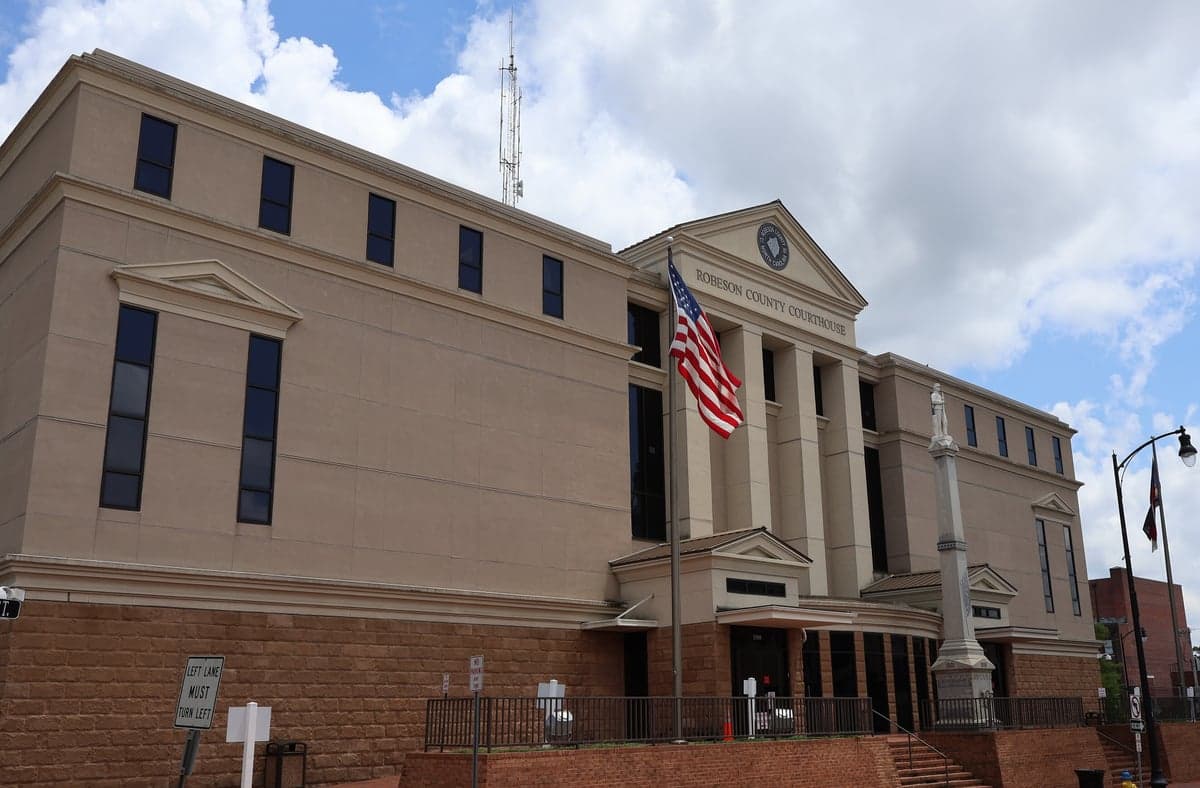
Photo: Wikipedia
Demographics of Robeson County
Affluence Level in Robeson County
A low-income area with significant economic hardship. Household wealth and educational attainment are well below national averages.
People of Robeson County
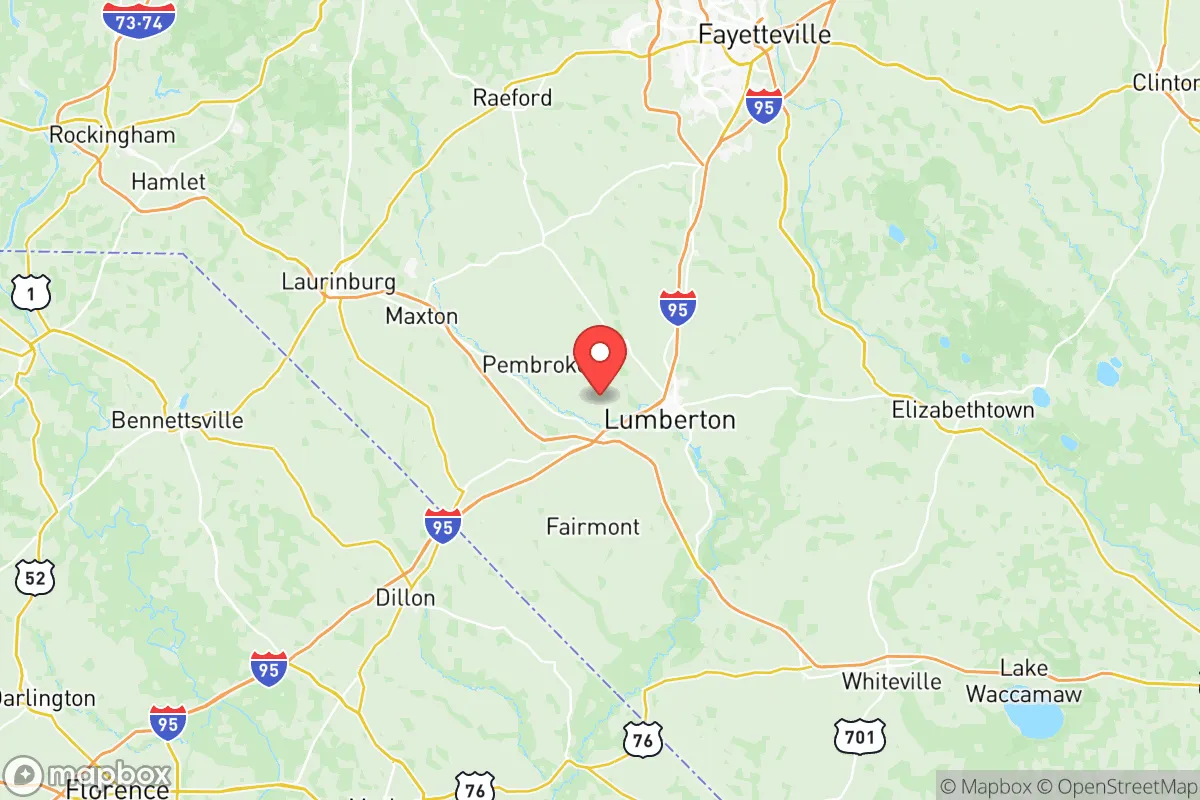
The people of Robeson County, North Carolina, today form one of the most distinctive tri-racial communities in the American South, with a population of 116,858 that is roughly 23.6% White, 23.2% Black, and a plurality identifying as Native American — primarily the Lumbee Tribe, the largest state-recognized tribe east of the Mississippi. The county is also 10.5% Hispanic and 3.9% foreign-born, though only 14.6% of adults hold a college degree, reflecting a rural, working-class character rooted in agriculture, manufacturing, and a deeply intertwined cultural history. The population is concentrated in the county seat of Lumberton, the historic trading town of Pembroke (the cultural heart of the Lumbee community), and smaller communities like Fairmont, Maxton, and St. Pauls, each with its own ethnic and economic identity.
Settlement & growth (pre-1960)
Long before European contact, the region that became Robeson County was home to Siouan-speaking tribes, including the Cheraw and Keyauwee, whose descendants are central to the modern Lumbee identity. The Lumbee themselves trace their continuous presence in the swamps and woodlands along the Lumber River to at least the 18th century, and they are widely believed to descend from a mix of surviving Siouan peoples, early English colonists from the Roanoke and Jamestown settlements, and possibly free people of color who sought refuge in the remote region. By the time of the American Revolution, the area was a frontier where English, Scots-Irish, and Highland Scots settlers pushed south and west from the coastal plain, drawn by cheap land and the promise of self-sufficient farming. The town of Lumberton, founded in 1787 on the Lumber River, became the county seat and a center for the naval stores industry — turpentine, tar, and timber — which dominated the local economy through the 19th century.
The antebellum period saw the arrival of enslaved African Americans, who worked the cotton and tobacco fields of the county's larger plantations, particularly in the fertile river bottoms around Lumberton and Fairmont. After the Civil War and Emancipation, freedmen established their own communities, such as the historically Black settlement of Saddletree and the neighborhoods around Maxton and Rowland, where they built churches, schools, and small farms. Meanwhile, the Lumbee people, who had been classified as "free persons of color" or "mulatto" in census records, consolidated their identity in the Pembroke area, where they established their own schools and churches in the face of Jim Crow segregation. The 1885 Croatan Act, which recognized the Lumbee as a distinct Indian tribe by the state of North Carolina, was a landmark legal victory that allowed them to form separate schools and later found what is now the University of North Carolina at Pembroke in 1887 — originally the Croatan Normal School, one of the first public institutions for Native Americans in the United States.
The early 20th century brought the expansion of the railroad and the rise of the textile and garment industries, which drew rural workers — both Black and White — into Lumberton, Maxton, and St. Pauls, where mills like the Maxton Mills and Lumberton's garment factories provided steady wages. The Great Migration saw a significant outflow of Black residents to Northern industrial cities, but Robeson County also received a small influx of White families from the Appalachian foothills and the Piedmont during the 1920s and 1930s, seeking work in the timber and turpentine camps. By mid-century, the county's population was roughly one-third White, one-third Black, and one-third Lumbee, a tri-racial balance that has persisted in broad terms to the present day, though the Lumbee share has grown as other groups have moved away.
Modern era (post-1965)
The 1965 Hart-Cellar Act had a relatively modest direct impact on Robeson County compared to urban areas, but the broader shifts in the American economy and migration patterns reshaped the county's demographics nonetheless. The decline of the textile and garment industries in the 1980s and 1990s hit Lumberton and Maxton hard, leading to job losses and out-migration of younger White and Black residents to Charlotte, Raleigh, and other Sun Belt cities. At the same time, the county's agricultural sector — tobacco, soybeans, corn, and hog farming — began to attract a new wave of Hispanic immigrants, primarily from Mexico and Central America, who arrived as farm laborers and later settled permanently in Lumberton, Fairmont, and St. Pauls. The Hispanic share of the population rose from under 1% in 1990 to 10.5% by the 2020s, making it the fastest-growing demographic group in the county.
The Lumbee community, meanwhile, experienced a cultural and political renaissance. The tribe's long campaign for full federal recognition — which has been repeatedly blocked in Congress — has strengthened internal identity and political organization, with Pembroke serving as the undisputed capital of Lumbee life. The county's Black population, concentrated in Lumberton and the rural communities of Rowland and Saddletree, has seen a slight relative decline as younger generations move to urban centers, but remains a vital part of the county's social and political fabric. The White population, once the largest group, has fallen to 23.6% as many families have left for suburban and urban opportunities elsewhere, leaving behind an older, more rural demographic. The foreign-born share remains low at 3.9%, and East/Southeast Asian and Indian-subcontinent communities are tiny (0.5% and 0.3%, respectively), concentrated almost entirely in Lumberton, where a small number of professionals work in healthcare and education.
Suburbanization has been limited in Robeson County, which remains predominantly rural. The most notable growth has occurred along the I-95 corridor near Lumberton, where new retail developments and distribution centers — including a large Amazon fulfillment center — have drawn some in-migration from other parts of the state. However, the county's poverty rate remains high, and the population has been essentially flat since 2010, with natural increase offset by net out-migration of young adults.
The future
Robeson County is likely to become more diverse in the coming decades, driven primarily by the continued growth of the Hispanic population, which is younger and has higher birth rates than the White, Black, and Lumbee populations. The Lumbee share is also expected to grow as the tribe's political influence and cultural institutions — including UNC Pembroke — attract Lumbee families from other parts of the country to return or remain. The White and Black populations will likely continue a slow decline, as out-migration of younger adults to urban job markets persists. The county's overall population may remain stable or grow slightly, but it will not see the explosive growth of the Charlotte or Raleigh suburbs; instead, it will become a more Hispanic and Native American county, with Lumberton and Pembroke as the primary centers of growth and change. The cultural identity of the county is evolving from a tri-racial Southern model toward a more multi-ethnic one, though the Lumbee presence will remain the defining feature that sets Robeson County apart from any other place in the United States.
For someone moving in now, Robeson County offers a deeply rooted, community-oriented way of life at a relatively low cost of living, but with limited economic opportunity and a population that is older and less educated than the state average. The county's future is one of gradual demographic change, where the Lumbee and Hispanic communities will play increasingly central roles in shaping the economy, politics, and culture of the Lumber River region.

* Values derived from national, state, county, city and local statistics and may differ in a specific area. Last updated: 2026-07-21T18:06:10.000Z
Narrative content on this page is AI-generated and may contain mistakes. Verify any details that matter before acting on them.
ReloMaps may earn a commission from affiliate links at no extra cost to you.

