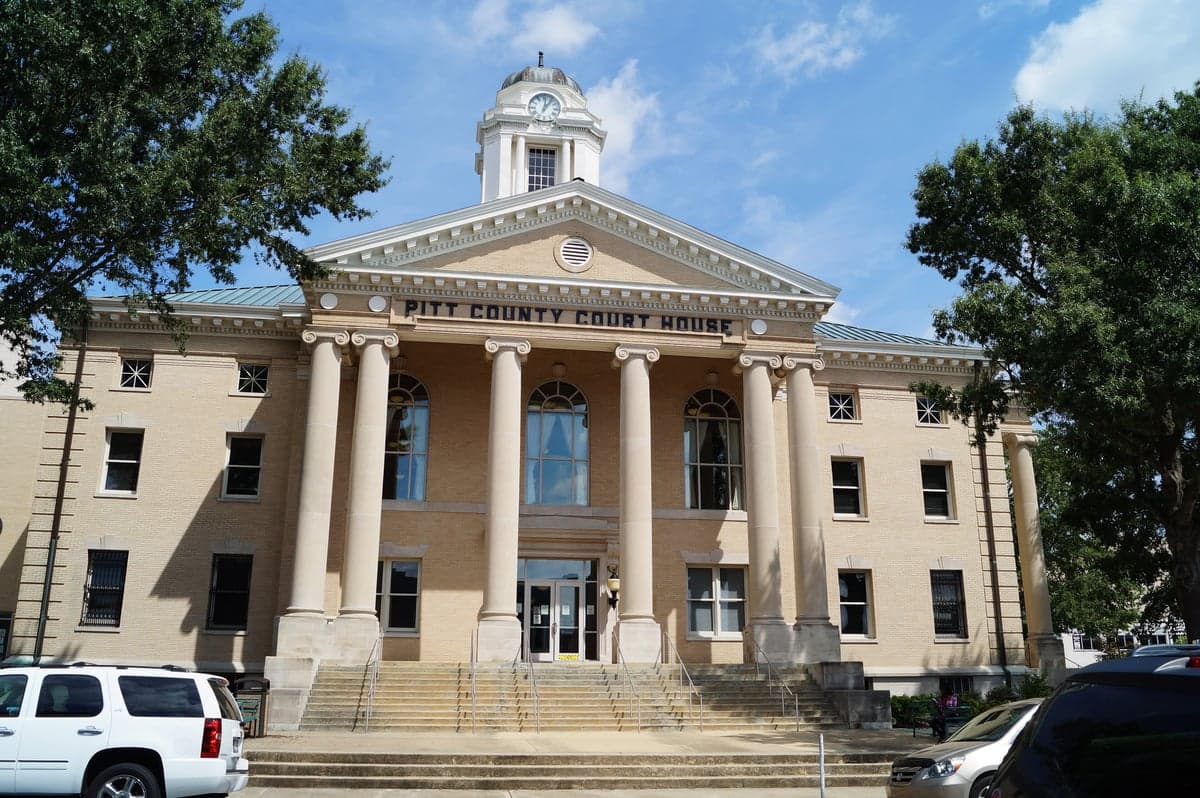
Photo: Wikipedia
Political ClimatePolitical Climate in Pitt County
Showing district-level results — no local-only data available.
Local Political AnalysisPolitical Analysis of Pitt County
Pitt County, anchored by Greenville, has long been a political outlier in eastern North Carolina, leaning right of the state as a whole but with a distinct urban-rural split that keeps things interesting. The county’s Cook Partisan Voting Index (PVI) of R+10 is a full nine points more Republican than North Carolina’s overall R+1, a gap that reflects the deep-red character of its small towns and farmland. But that countywide number masks a more nuanced reality: Greenville itself, home to East Carolina University and a growing healthcare sector, has been trending blue over the past decade, while the surrounding communities—places like Winterville, Ayden, and Grifton—remain reliably conservative. The result is a county that votes Republican by comfortable margins in most elections but where local races can be genuinely competitive, especially when Democratic candidates run up the score in Greenville’s precincts near the university and the medical district.
How it compares
Compared to North Carolina as a whole, Pitt County is significantly more Republican, but the comparison is not as simple as “red county vs. purple state.” The state’s R+1 PVI reflects a closely divided electorate where both parties have strongholds—Mecklenburg and Wake counties are deep blue, while rural counties like Pitt are deep red. Within Pitt, the political geography is stark: Greenville’s 1st and 2nd wards, which include the ECU campus and the Vidant Medical Center area, have voted Democratic by 10-15 points in recent presidential elections, while precincts in Winterville and Ayden have gone Republican by 20-30 points. The swing precincts are in the county’s suburban fringe—places like the area around Pactolus Highway and the new developments near the Greenville-Pitt County Airport—where voters are more moderate and often split tickets, voting Republican for president but Democratic for local school board or county commission. This internal variation means that while Pitt County is reliably red in statewide races, it is not a monolith; a Democratic candidate who can turn out Greenville’s base and win over a few of those swing precincts can make races competitive, as seen in the 2020 county commission race where a Democrat came within 2 points of winning a district that had been solidly Republican for a decade.
What this means for residents
For conservative residents, Pitt County’s lean means they are generally in the majority, especially in county-level decisions like zoning, school funding, and law enforcement priorities. The county commission and school board have been Republican-controlled for years, which has translated into lower property tax rates compared to more Democratic counties like Wake or Durham, and a focus on rural infrastructure like road improvements and broadband expansion. For liberal residents, the reality is more about finding community in Greenville’s urban core, where progressive candidates can win city council seats and where issues like affordable housing and public transit get more attention. The cultural divide is real but not hostile; in places like the Uptown Greenville district, you’ll find a mix of ECU students, medical professionals, and longtime locals who have learned to navigate the political differences over coffee at places like The Scullery or over a beer at Pitt Street Brewing Company. The biggest practical impact for both sides is in state-level representation: Pitt County’s state house and senate districts are held by Republicans, which means that regardless of local preferences, the area’s voice in Raleigh is consistently conservative on issues like abortion, gun rights, and education policy.
One cultural distinction that sets Pitt County apart from more polarized parts of the state is the role of East Carolina University and the medical community. The university brings in a steady stream of faculty and students from outside the region, many of whom lean left, while the Vidant Health system employs a large, politically diverse workforce. This creates a kind of buffer against the extreme partisanship seen in some other rural counties. You don’t see the same level of political yard-sign warfare here that you might in, say, rural Johnston County or the mountains. Instead, the political climate feels more like a pragmatic negotiation: conservatives focus on economic development and keeping taxes low, liberals push for investment in education and healthcare access, and most residents just want the potholes fixed and the schools to stay open. Looking ahead, the county’s trajectory will likely depend on how fast Greenville grows. If the city continues to attract young professionals and retirees from more liberal areas, the countywide PVI could edge toward R+8 or R+7 over the next decade, but the rural towns will keep it solidly red for the foreseeable future.

State Political ClimatePolitical Climate in North Carolina
State Political AnalysisPolitical Environment in the State
North Carolina holds a well-earned reputation as the premier swing state of the Southeast, currently sitting at a Cook PVI of R+1 after a decade of hair’s-edge elections. The dominant coalition is a classic Sun Belt mix: fast-growing suburbanites who lean center-right on economics but are socially moderate, combined with a reliable rural conservative base that turns out heavily in non-presidential years. Over the past twenty years, the state has shifted from a reliably Republican stronghold to a true battleground—Democrats won the governorship three cycles in a row (2008, 2012, 2016) and flipped a Senate seat in 2022, while Republicans held the legislature and the 2024 presidential vote went to the GOP by a narrow margin. The net effect is a state where neither party gets everything it wants, and the policy fights are constant and high-stakes.
Urban vs. rural divide
The state's political map is a textbook example of the urban-rural chasm. The research triangle anchored by Raleigh, Durham, and Chapel Hill is the heart of Democratic strength—professionals, academics, and a younger electorate drive margins of 60-70% for Democratic candidates. Charlotte’s Mecklenburg County is similarly deep blue, powered by a growing banking and tech workforce and a substantial African American voting bloc. Meanwhile, the eastern rural counties—places like Duplin and Robeson—and the western mountain counties such as Mitchell and Yancey routinely deliver 70-80% of the vote for Republicans. The tipping-point areas are the suburban rings around the big metros: Wake County’s fast-growing suburbs like Cary and Apex are becoming more Democratic as professionals move in, while exurban counties like Union (just south of Charlotte) and Cabarrus lean Republican by double digits. The state’s House and Senate districts are drawn to reflect this geography, meaning the legislature stays Republican even when statewide races are close. The urban islands of Asheville and Wilmington are also reliably blue, but they sit in otherwise red rural regions, creating a constant tension over state versus local control.
Policy environment
North Carolina’s policy posture reflects its divided government. The tax structure is relatively favorable for individuals and families: a flat income tax rate that has been gradually lowered to 4.5% as of 2025, with ongoing legislative pressure to reduce it further. The state maintains a right-to-work law and has a regulatory climate that business groups rate as above average, particularly on environmental permitting and occupational licensing. On education, the state offers a robust school choice ecosystem—the Opportunity Scholarship Program now provides vouchers for private school tuition with no income cap, and charter school growth has been steady. Healthcare policy is a hybrid: after years of Republican opposition, the legislature passed a limited Medicaid expansion in 2023, covering adults up to 138% of the federal poverty level. Election laws are a flashpoint: voter ID is in effect after years of court challenges, same-day registration is available during early voting, and in 2024 the legislature passed restrictions on absentee ballot drop boxes. The overall environment is one where conservatives have achieved durable wins on tax and education policy, while liberals have held the line on some social services and local autonomy.
Recent policy direction
The last three legislative sessions have moved the state in a distinctly conservative direction on several fronts a relocator might weigh. On gun and self-defense law, the 2023 session enacted permitless carry for concealed handguns (HB 189), removing the requirement for a purchase permit and training class for legal gun owners—joining the majority of states now without a permit system. Parental and education rights saw a major overhaul with the Parents’ Bill of Rights (HB 755), which requires schools to notify parents about curriculum on gender identity and sexuality, and bars instruction on those topics in K-4 classrooms. The law also mandates parental consent before any medical or counseling service related to gender transition. On medical and bodily autonomy, the legislature passed a 12-week abortion ban (SB 20/HB 22) in 2023, with exceptions for rape, incest, and life of the mother, effectively restricting access after the first trimester. Property rights have been strengthened by a series of eminent domain reform measures, and the state has no statewide zoning preemption, leaving land use largely to local control. Voting and ballot access tightened with SB 747 (2023), which eliminated the three-day grace period for mail ballots and set stricter rules for absentee ballot collection. The picture is one of deliberate, incremental conservative reform—rather than a radical red-state shift, it’s a legislature pushing on multiple fronts with the governor’s veto power as the only real check.
Civil unrest & political movements
North Carolina has a history of organized political activism that can surprise newcomers. The 2020 protests over policing in Charlotte and Raleigh were large and sustained, drawing thousands into the streets for weeks, with some property damage and arrests. Since then, left-leaning groups like the Down Home North Carolina (rural organizing) and Carolina Abortion Fund have maintained a visible presence. On the right, the John Locke Foundation and Carolina Journal are influential policy voices, and groups like the N.C. Family Policy Council have driven the parental rights and abortion restriction agenda. Immigration politics are less charged than in border states: the state has no sanctuary city policies, and local law enforcement generally cooperates with federal immigration authorities, though some cities like Durham and Orange County have adopted soft limits on cooperation. Election integrity has been a major flashpoint since 2020, with the legislature creating the Joint Legislative Committee on Election Integrity and passing the aforementioned SB 747. A new resident should expect to see visible political signage, frequent local protests on hot-button issues, and a media environment that is polarized but still has strong local outlets (News & Observer, Charlotte Observer). The tone is more intense than a deeply red state but less volatile than a state like Florida or Texas.
Projection
Looking five to ten years ahead, the demographic trends point toward continued tightening. In-migration from blue states—mostly into the Charlotte and Triangle suburbs—is adding hundreds of thousands of moderate and left-leaning voters each decade. The exurban and rural counties are aging in place, and their political weight is slowly shrinking as a share of the statewide vote. This doesn’t mean the state is destined to flip blue; rather, it means the R+1 lean becomes R+0 or D+1 by the early 2030s, with all the oscillation that implies. A new resident moving in now should expect a state that remains sharply divided, with legislative majorities that may shift but are currently structurally tilted toward Republicans by district lines. The most practical implication is that your local policies will vary dramatically depending on which county you choose—an Apex parent will have vastly different school board dynamics than a Winston-Salem parent, even though both live under the same state laws. Taxes will remain low-ish, business climate will stay favorable, and the culture wars will continue to play out in every session of the General Assembly.
For someone choosing North Carolina, the bottom line is simple: you get a state where your wallet benefits from low taxes and mild regulation, but you sign up for perennial political gridlock on social issues. Conservatives will find school choice, gun rights, and a favorable business environment largely secure for the foreseeable future. Liberals will find a state where their metro is safe and their vote matters in statewide races, but where they lose most of the big policy fights. The path of least resistance is to pick a town that matches your political expectations—Cary for a moderate suburban life, Charlotte for urban energy with a business tilt, Wilmington for coastal living with a conservative local flavor, or Asheville if you want a blue enclave in the mountains. Anywhere you land, you’ll be part of a battleground state where every election is a high-stakes affair and the political climate changes with each census.
* Values derived from national, state, county, city and local statistics and may differ in a specific area. Last updated: 2026-06-24T22:15:22.000Z
Narrative content on this page is AI-generated and may contain mistakes. Verify any details that matter before acting on them.
ReloMaps may earn a commission from affiliate links at no extra cost to you.

