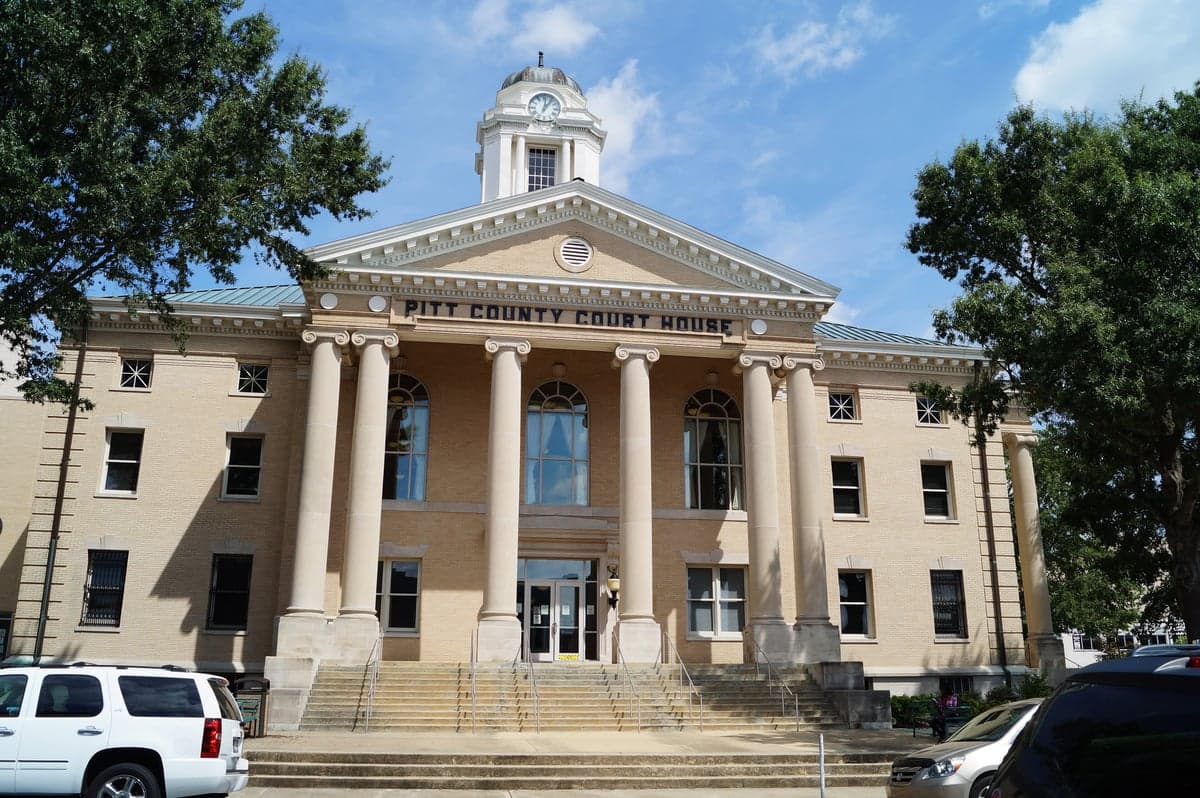
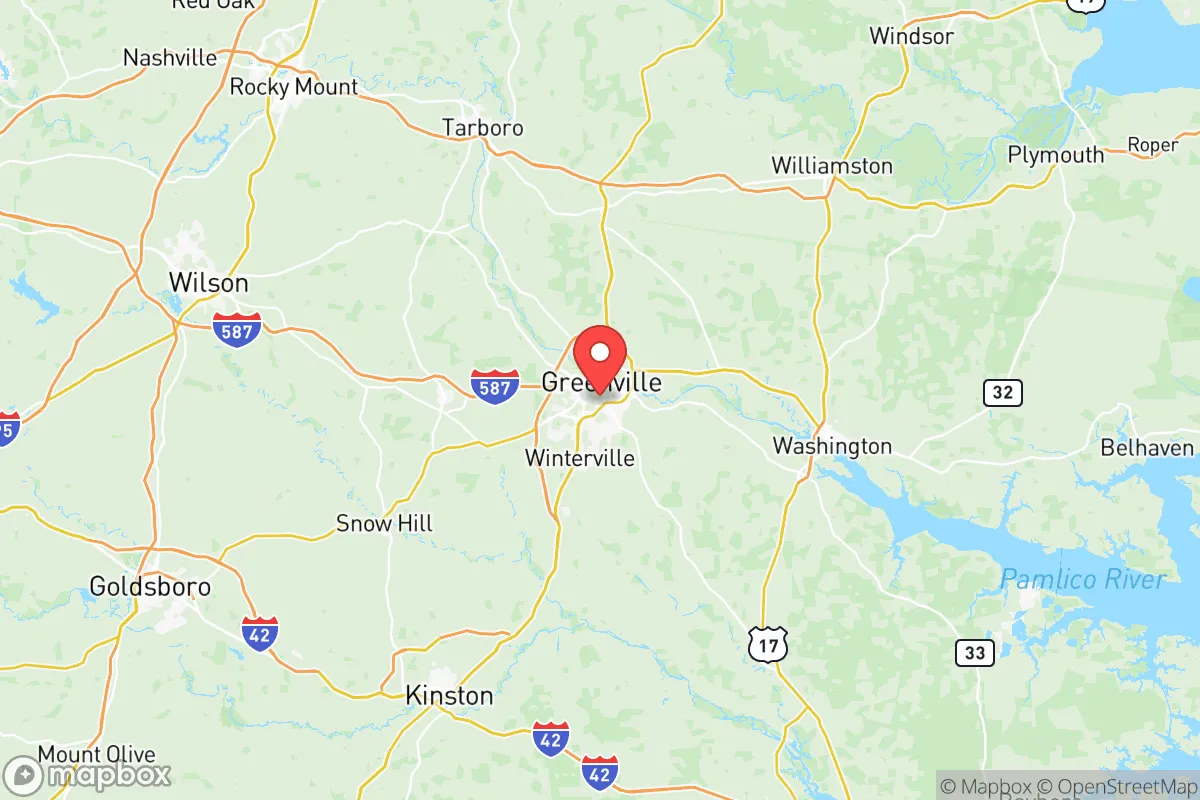
Photo: Wikipedia
Demographics of Pitt County
Affluence Level in Pitt County
A middle-class area roughly in line with national averages across income, home values, education, and employment.
People of Pitt County
Today, Pitt County is home to 172,279 residents, making it a mid-sized eastern North Carolina hub anchored by the city of Greenville. The population is predominantly Black (34.9%) and White (51.9%), with a growing Hispanic community (7.7%) and smaller East/Southeast Asian (1.3%) and Indian-subcontinent (0.5%) groups. The county’s character is defined by the presence of East Carolina University and Vidant Medical Center, which draw a college-educated workforce (33.9% with a bachelor’s or higher), while the surrounding rural towns retain deep agricultural roots. Only 3.3% of residents are foreign-born, a figure that reflects the region’s limited recent international immigration compared to urban centers.
Settlement & growth (pre-1960)
Before European settlement, the area now called Pitt County was home to the Tuscarora people, who lived in palisaded villages along the Tar River. After the Tuscarora War (1711–1715), the defeated tribe largely relocated north, opening the land to English and Scots-Irish settlers. The county was formed in 1760 from Beaufort County and named after William Pitt the Elder. The first permanent European settlers were primarily small farmers of English descent, who established homesteads along the river bottoms in what are now Greenville (originally called Martinsborough), Winterville, and Farmville. They brought a tobacco-based plantation economy that relied on enslaved African labor, a system that persisted through the Civil War and Reconstruction.
After emancipation, many freed Black families remained in the county as sharecroppers and tenant farmers, concentrating in rural communities that later became towns like Ayden and Bethel. By the early 1900s, tobacco curing and bright-leaf tobacco cultivation drove economic growth, and small manufacturing—textile mills and timber—began to supplement farming. The arrival of the railroad spurred the growth of Greenville as a trading center, and by 1920 it had become the county’s undisputed commercial hub. During the Great Migration (1910–1970), many Black residents left Pitt County for northern industrial cities, but a substantial Black population remained, anchored by the landowning farming families that had managed to acquire property. White population growth in this era came from natural increase and limited migration from other parts of the rural South. By 1960, Pitt County was still overwhelmingly rural, with Greenville’s population barely surpassing 20,000. The major industries were tobacco farming, warehousing, and a fledgling East Carolina College (founded 1907), which gradually began to reshape the local economy and demography.
Modern era (post-1965)
The 1965 Hart-Cellar Act had a muted impact on Pitt County compared to metropolitan areas. The foreign-born share remains low at 3.3%, and most of that growth has occurred since the 1990s. The largest new immigrant group has been Hispanic, primarily from Mexico and Central America, drawn by agricultural labor—tobacco and sweet potato farming—and construction. This population has concentrated in Greenville and the farming towns of Ayden and Farmville, where a small but growing Hispanic business corridor has emerged. East/Southeast Asian communities (1.3%) arrived largely as professionals and students affiliated with East Carolina University and the medical school; many are of Vietnamese and Filipino ancestry, and they tend to live in Greenville’s university-adjacent neighborhoods. The Indian-subcontinent population (0.5%) is similarly tied to the university and health sciences sector, with families settling in Winterville and south Greenville.
The most significant domestic shift has been the expansion of Greenville as a regional medical and educational center. Vidant Medical Center (now ECU Health) grew into a major employer, attracting physicians, nurses, and administrators from across the United States. This drew a new wave of domestic migrants—primarily White professionals from rural North Carolina and other states—who settled in Winterville and suburban developments along the Greenville Boulevard corridor. Black professionals also moved into these areas, and the county’s Black population shifted from primarily rural to mixed urban-suburban. Suburbanization has pushed growth outward: Winterville’s population tripled between 1990 and 2020, and towns like Grifton and Simpson have absorbed commuters. Meanwhile, the historic Black towns of Bethel and Fountain have seen slower growth as younger residents leave for opportunities in Greenville.
Racially, Pitt County in 2026 is a Black-White majority region with a small but visible Hispanic minority. The 34.9% Black share is well above the national average, reflecting the county’s deep African American roots in tobacco agriculture and the resilience of landowning families. The White share (51.9%) is bolstered by ongoing domestic in-migration of professionals, while the Hispanic share (7.7%) is growing steadily, particularly in the southern half of the county around Ayden and along Highway 11 toward Kinston.
The future
Pitt County’s population is projected to continue growing, likely exceeding 190,000 by 2040, driven by expansion of the university and medical sectors. The foreign-born share will rise gradually as the university recruits international faculty and students, but it will likely remain below 8%—far lower than the state average. The Hispanic population will be the fastest-growing group, dispersing from Ayden and Greenville into more suburban areas as families become established. East/Southeast Asian and Indian-subcontinent communities will grow in absolute numbers but remain small percentage shares, concentrated in professional neighborhoods near the medical campus.
Racial tensions, which have occasionally flared in Greenville over issues of policing and economic inequality, may ease as Black homeownership rates improve—though the county’s persistent Black-White gap in median income and wealth remains a challenge. The county’s rural towns are likely to continue losing population to the Greenville-Winterville urban core, consolidating the region’s character as a hub for healthcare and education surrounded by a shrinking agricultural periphery. Pitt County is becoming more suburban, more diverse, and more educated, but it retains a distinctive Eastern North Carolina identity rooted in tobacco history, family land ownership, and the African American community that has been central here for generations.
For someone moving in now, Pitt County offers a stable, mid-sized community with a solid job base in health and education, affordable housing outside of Greenville, and a social environment that is still relatively traditional and family-oriented. The political lean is conservative but not rigid—the county voted Republican in the last presidential election but has a Democratic stronghold in Greenville’s Black and academic precincts. The best advice: settle in Greenville for access to amenities, or in Winterville for newer suburbs and good schools, and plan to engage with the region’s history rather than ignore it.

* Values derived from national, state, county, city and local statistics and may differ in a specific area. Last updated: 2026-06-24T22:15:22.000Z
Narrative content on this page is AI-generated and may contain mistakes. Verify any details that matter before acting on them.
ReloMaps may earn a commission from affiliate links at no extra cost to you.

