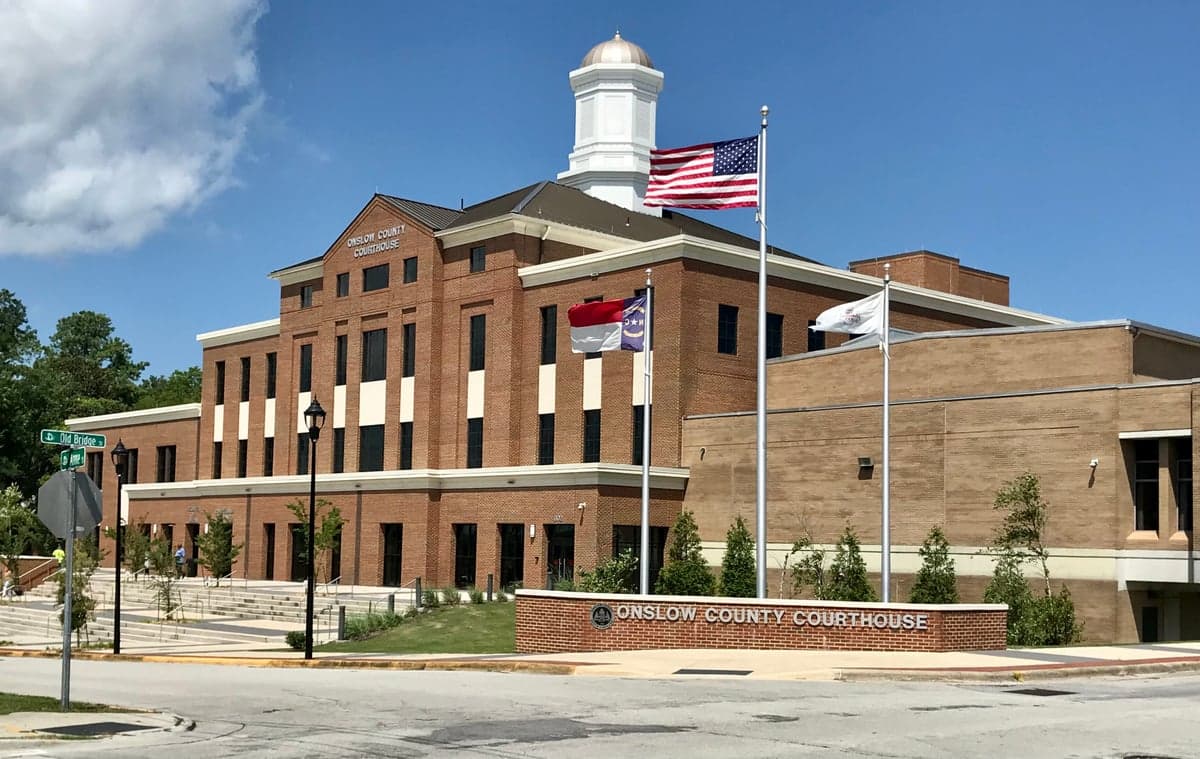
Photo: Wikipedia
Political ClimatePolitical Climate in Onslow County
Showing district-level results — no local-only data available.
Local Political AnalysisPolitical Analysis of Onslow County
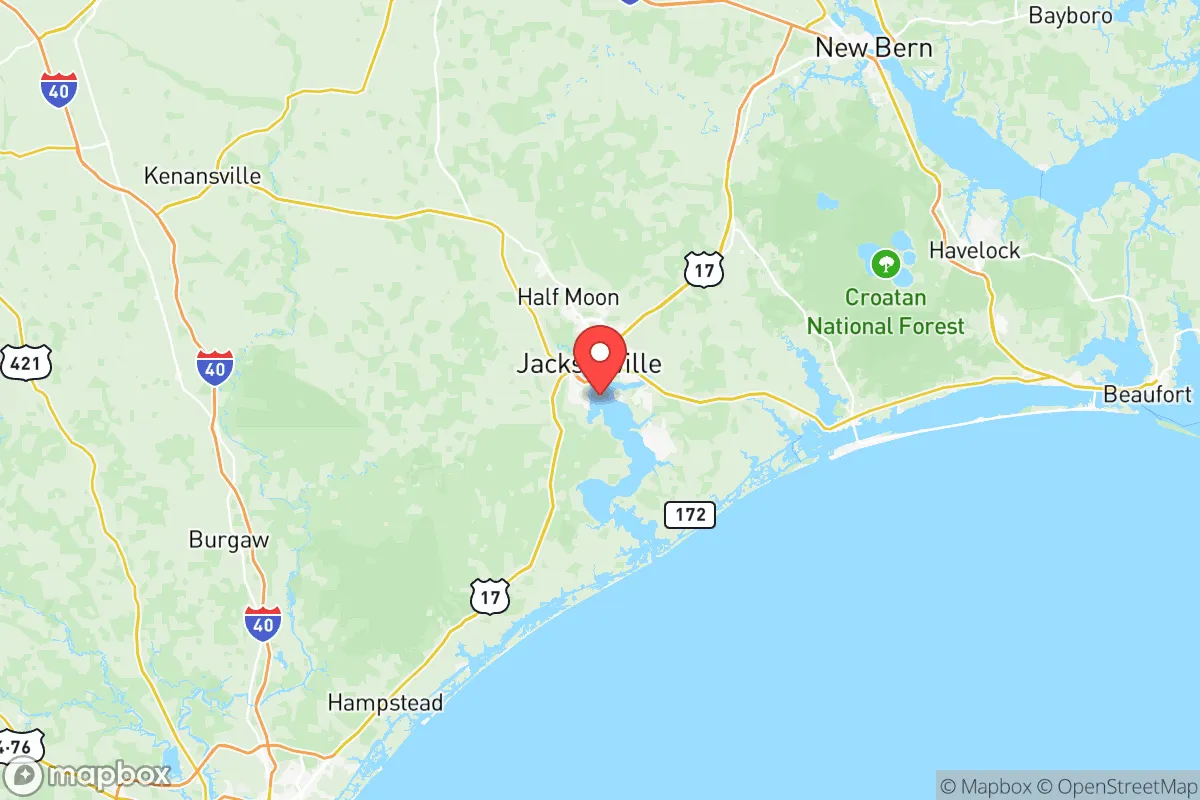
Onslow County, anchored by the city of Jacksonville and the massive Marine Corps Base Camp Lejeune, is a solidly Republican stronghold with a Cook PVI of R+10, making it significantly more conservative than North Carolina as a whole, which sits at R+1. This isn't a recent shift; the county has voted for the GOP presidential candidate in every election since 1980, and the margin has only widened in the last decade. The military and veteran population, which makes up a huge chunk of the electorate, drives a reliably red vote, though you'll find pockets of blue in the more transient, younger neighborhoods near the base and in the college areas around Coastal Carolina Community College.
How it compares
Compared to the state's razor-thin partisan balance, Onslow County is a deep red outlier. While North Carolina as a whole is a perennial swing state, Onslow County behaves more like a rural, exurban county in the Deep South. The political geography within the county is surprisingly varied, though. The city of Jacksonville itself is the most competitive area, with precincts near the downtown and the waterfront often leaning slightly more Democratic, reflecting a mix of younger service members, civilian workers, and a growing minority population. In contrast, the smaller towns like Richlands, Swansboro, and Sneads Ferry are deeply conservative, routinely delivering 70-80% of the vote for Republican candidates. The swing precincts are almost exclusively in the newer housing developments around Camp Lejeune's gates, where military families from all over the country bring a more diverse set of political views. The county's R+10 rating means that while a Democrat can win statewide in North Carolina, they rarely break 40% in Onslow County.
What this means for residents
For conservative residents, Onslow County feels like a natural fit. Local government, from the county commission to the school board, is reliably Republican, and policy debates tend to focus on tax rates, infrastructure, and support for the military community. For liberal residents, the reality is more about finding your niche. While you won't see many "progressive" candidates on the ballot, the sheer size of the transient military population means the area is more tolerant of diverse viewpoints than many other R+10 counties. You'll find like-minded folks in Jacksonville's arts scene, at the local breweries, and in the university-adjacent neighborhoods. The practical effect of the lean is that property taxes remain low, and there's strong community support for veterans' services and base-related spending, but social issues like public health mandates or land-use regulations often face an uphill battle.
Culturally, the county's political identity is inseparable from its military character. The base is the largest employer, and the constant rotation of personnel creates a unique blend of Southern conservatism and a more national, transient culture. You'll see "Support Our Troops" signs as often as political yard signs, and the local economy is heavily tied to federal defense spending. This creates a policy distinction from the rest of North Carolina: Onslow County is far more focused on military housing, base access, and veteran employment than on the tech or agriculture issues that dominate state politics. The long-term trajectory suggests the county will stay red, but the growing civilian population in Jacksonville and the influx of younger, more diverse military families could slowly nudge the margins closer to the state average over the next decade.

State Political ClimatePolitical Climate in North Carolina
State Political AnalysisPolitical Environment in the State
North Carolina is a classic swing state with a slight Republican lean (Cook PVI R+1), but calling it simply "red" misses the real story. Over the last 20 years, the state has shifted from a reliably conservative stronghold to a true battleground, driven by explosive growth in the Research Triangle (Raleigh-Durham-Chapel Hill) and Charlotte, while rural and small-town areas have hardened their Republican loyalties. The result is a state where statewide races are decided by razor-thin margins—often less than 1.5 points—while the legislature remains firmly under GOP control thanks to aggressive redistricting. For a relocator, this means you'll find a mix of deep-red counties like Yadkin and Cleveland, purple suburbs like Wake Forest and Huntersville, and deep-blue urban cores like Durham and Asheville, all under a state government that has consistently pushed conservative policy since 2011.
Urban vs. rural divide
The political map of North Carolina is a textbook case of the urban-rural split. The state's three major metros—Charlotte (Mecklenburg County), the Research Triangle (Wake, Durham, Orange counties), and the Piedmont Triad (Greensboro, Winston-Salem, High Point)—are Democratic strongholds. Mecklenburg County alone delivered over 280,000 votes for Biden in 2020, while Wake County added another 310,000. These two counties together account for roughly a quarter of the state's total vote. Meanwhile, the rural east (counties like Robeson, Columbus, and Duplin) and the western mountain counties (like Watauga, Avery, and Mitchell) are heavily Republican, often voting 65-75% for GOP candidates. The real battlegrounds are the fast-growing suburban counties that ring the metros: Union County (southeast of Charlotte) has flipped from reliably red to competitive, while Cabarrus County (north of Charlotte) and Johnston County (southeast of Raleigh) are still red but trending purple as new residents arrive. Buncombe County (Asheville) is a blue island in the western mountains, while Forsyth County (Winston-Salem) has become reliably Democratic. The rural-urban divide isn't just about party ID—it's about lifestyle: urban voters prioritize transit, public schools, and environmental regulation, while rural voters focus on property rights, gun access, and local control.
Policy environment
North Carolina's policy environment is a study in contrasts. The state has a flat income tax rate of 4.5% (down from 7% in 2013), with a scheduled phase-down to 3.99% by 2027. The corporate income tax is 2.5%, one of the lowest in the Southeast. There is no state property tax, but local property taxes vary widely—expect 0.6-0.8% of assessed value in most counties. Sales tax is 4.75% state plus local options, typically totaling 6.75-7.25%. On education, the state funds a voucher program (the Opportunity Scholarship Program) that now serves over 30,000 students, and charter schools are plentiful. The state has not expanded Medicaid under the Affordable Care Act, though a bipartisan expansion deal passed in 2023 and took effect in December 2023, adding roughly 600,000 low-income adults to coverage. Election laws are moderately restrictive: voter ID is required (photo ID, with limited exceptions), early voting runs 17 days, and same-day registration is available during early voting but not on Election Day. The state has no "stand your ground" law but does have a Castle Doctrine and a permitless carry law for concealed handguns (effective 2023). Abortion is legal up to 12 weeks, with a 72-hour waiting period and mandatory counseling; after 12 weeks, exceptions exist for rape, incest, and fetal anomalies up to 20 weeks, and for life of the mother at any point.
Recent policy direction
Since the GOP took full control of the legislature in 2011, the policy direction has been consistently conservative, though moderated by Democratic governors from 2017-2023 (Roy Cooper) and now a Republican governor (Josh Stein, elected 2024). Key recent laws include: HB 808 (2023), which eliminated the requirement for a permit to carry a concealed handgun; SB 20 (2023), which banned nearly all abortions after 12 weeks; HB 574 (2023), which expanded the Opportunity Scholarship voucher program to all families regardless of income; and HB 88 (2021), which requires sheriffs to cooperate with federal immigration enforcement (the "Cooperate with ICE" law). On education, the state passed HB 755 (2023), which prohibits instruction on gender identity and sexual orientation in K-4 classrooms and requires parental notification of any LGBTQ+ curriculum. On voting, SB 747 (2023) shortened the absentee ballot return window and eliminated the "cure" process for mismatched signatures. On property rights, the state has a strong right-to-farm law and limits local governments' ability to regulate short-term rentals. On privacy, the state has no comprehensive data privacy law, but HB 347 (2023) banned TikTok on state-issued devices. For a relocator weighing liberties: gun rights are strong, parental rights in education are expanding, taxes are low and falling, but medical autonomy (abortion) is restricted, and voting access is moderate compared to other swing states.
Civil unrest & political movements
North Carolina has seen its share of political flashpoints. The 2016 HB2 "bathroom bill" controversy—which required transgender people to use restrooms matching their birth certificate—sparked massive boycotts from the NCAA, NBA, and major corporations, costing the state an estimated $3.76 billion in lost business. The law was partially repealed in 2017, but the political scars remain. In 2020, the Wright Amendment protests in Charlotte and Raleigh saw thousands demonstrating after the killing of George Floyd, with some property damage and a heavy police presence. More recently, the 2023 abortion ban sparked sustained protests at the General Assembly in Raleigh, with activists on both sides holding weekly rallies. Immigration politics are heated: the Cooperate with ICE law (HB 88) was passed over Governor Cooper's veto, and several sheriffs (including in Wake and Mecklenburg counties) have refused to fully comply, leading to ongoing legal battles. Election integrity remains a live issue: the 2020 election saw Trump's campaign challenge results in the state (though the state certified Biden's narrow win), and the 2024 election saw similar disputes over mail-in ballot procedures. There is no serious secession or nullification movement, but rural counties have occasionally floated "secession" from their urban neighbors (e.g., a 2021 proposal to split Moore County from the rest of the Sandhills region). A new resident would notice that political yard signs are common, bumper stickers are everywhere, and local news is heavily politicized—especially in the Piedmont Triad and Charlotte metros.
Projection
Over the next 5-10 years, North Carolina is likely to become more competitive, not less. In-migration is driving growth in the suburbs of Charlotte, Raleigh, and the Triad, and these new residents tend to be younger, more diverse, and more moderate than the existing rural population. Wake County is projected to add 200,000 residents by 2030, and Mecklenburg County another 150,000. This will likely push the state toward a purple equilibrium—think Ohio in the 2000s or Virginia in the 2010s. However, the legislature's gerrymandered maps (which gave Republicans a 10-4 U.S. House delegation in 2024 despite a 50-49 statewide vote split) mean that state policy will remain conservative even as the electorate shifts left. Expect continued fights over abortion access (a ballot initiative to restore pre-12-week access is possible), education funding (voucher expansion vs. public school funding), and voting laws (early voting expansion vs. voter ID enforcement). The wild card is the 2026 gubernatorial election, which will test whether the GOP can hold the governor's mansion after Stein's term. For a relocator, the bottom line is: if you're conservative, you'll find a friendly policy environment and a growing community of like-minded people in the suburbs and exurbs; if you're liberal, you'll find vibrant urban centers and a state that's trending your way, but you'll need to accept that state-level policy will lag behind your preferences for at least another decade.
For someone moving to North Carolina, the practical takeaway is that your experience will depend heavily on where you land. In Charlotte or Raleigh, you'll live in a blue bubble with progressive neighbors, good public transit, and a diverse economy—but you'll pay higher property taxes and deal with traffic. In Wilmington or Greenville, you'll find a more conservative, slower-paced lifestyle with lower taxes and strong gun rights. In Asheville, you'll get a liberal mountain town with a strong arts scene but limited job options. The state's political divide is real, but it's also manageable: most people don't talk politics at the grocery store, and the state's famous "Southern hospitality" means you'll be welcomed regardless of your views. Just know that your vote will matter more here than in almost any other state—and that the laws you live under will depend on which party controls the legislature after the next census.
* Values derived from national, state, county, city and local statistics and may differ in a specific area. Last updated: 2026-07-02T10:10:28.000Z
Narrative content on this page is AI-generated and may contain mistakes. Verify any details that matter before acting on them.
ReloMaps may earn a commission from affiliate links at no extra cost to you.

