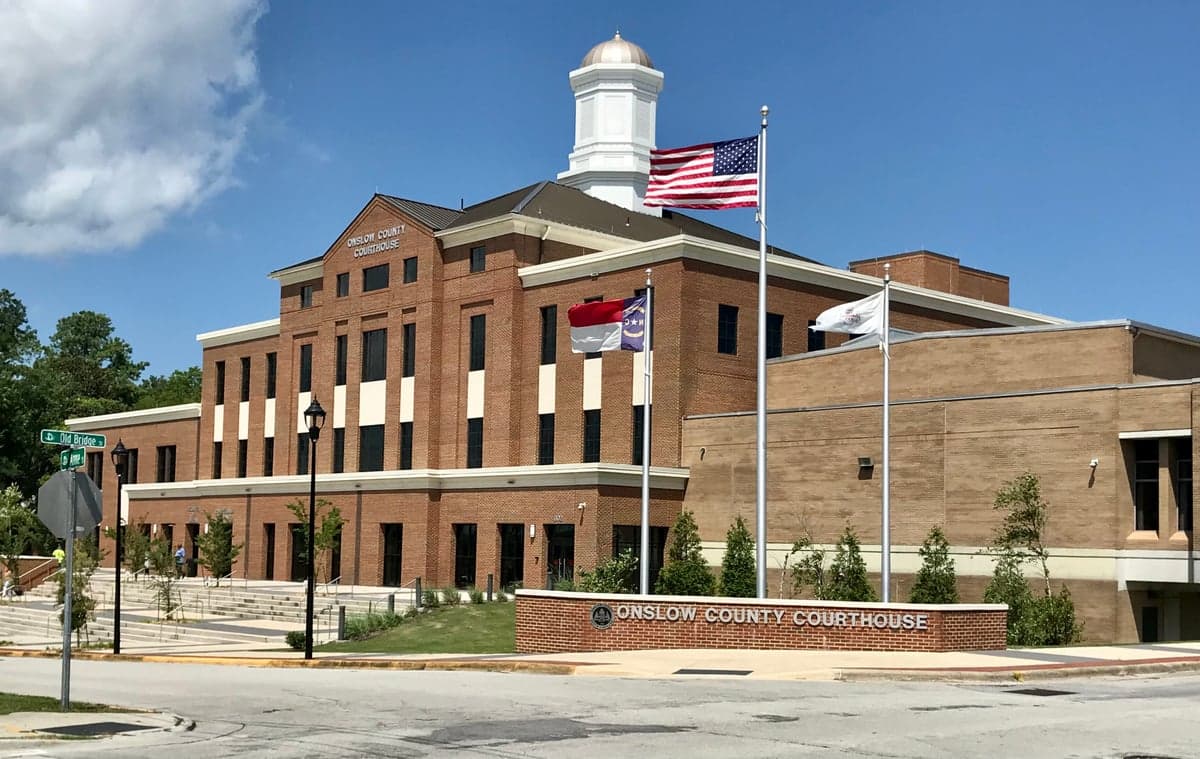
Photo: Wikipedia
Personal Sovereignty in Onslow County
Viable for self-reliance. Generally workable, though some barriers may limit total independence.
What does Personal Sovereignty tell us?
Personal Sovereignty measures your capacity for self-reliance and independence with minimal government friction. Higher scores mean fewer barriers between you and the way you want to live... but it assumes you have the space you need and good neighbors.
What does this tell us?
Personal Sovereignty measures your capacity for self-reliance and independence with minimal government friction. Higher scores mean fewer barriers between you and the way you want to live... but it assumes you have the space you need and good neighbors.
State Policy
Energy independence: Importer (15% of energy produced in-state)
Personal Liberty
Homesteading

Personal Liberty Analysis
Onslow County, anchored by Jacksonville and the Marine Corps base Camp Lejeune, offers a personal sovereignty environment that is distinctly North Carolinian — a blend of strong Second Amendment protections, a relatively light regulatory touch, and a culture of self-reliance shaped by a large military and veteran population. The county’s autonomy profile is not uniform; the coastal and suburban areas near the base lean toward convenience and community services, while the rural western and northern reaches, including towns like Richlands, Hubert, and Sneads Ferry, provide more room for independent living. For a relocation audience prioritizing personal freedom, Onslow County presents a pragmatic balance: state-level preemption laws limit local overreach, but the county’s own zoning and tax policies still require careful navigation.
Tax burden and regulatory posture in Onslow County
North Carolina’s flat income tax rate of 4.5% (as of 2025) and a state sales tax of 4.75% (with local add-ons bringing Onslow County’s total to 7%) keep the overall tax burden moderate. Onslow County’s property tax rate is approximately $0.585 per $100 of assessed value, which is competitive with neighboring counties like Carteret ($0.53) but higher than more rural Jones County ($0.47). The county does not impose any local income tax, and there is no municipal property tax in unincorporated areas — a significant advantage for those buying land in places like Richlands or Hubert, where county taxes are the only property levy. Regulatory posture is generally light: building permits are required for new construction and major renovations, but the county does not enforce overly restrictive zoning in rural zones. Agricultural and forestry uses are largely exempt from subdivision regulations, and there are no countywide noise or nuisance ordinances that would hinder a small farm or workshop. However, within Jacksonville city limits, zoning is more conventional, with setbacks and use restrictions that can complicate home-based businesses or accessory dwelling units. The county’s approach is best described as “hands-off until a complaint arises,” which suits most self-reliant individuals but requires due diligence on specific parcel zoning before purchase.
Self-defense and gun law specifics in Onslow County
North Carolina is a shall-issue state for concealed carry permits, and Onslow County’s sheriff’s office processes applications efficiently, typically within 45 days. The state does not require a permit to open carry a handgun or long gun, and there is no state-level ban on any class of firearm (including AR-15s or standard-capacity magazines). Onslow County is home to a high concentration of active-duty military and veterans, which reinforces a gun-friendly culture — ranges like the Onslow County Gun Range near Jacksonville are well-used, and local gun shops report steady business. Stand-your-ground laws apply statewide, with no duty to retreat in any place where the individual is lawfully present. Castle doctrine protections extend to vehicles and occupied structures. The county does not impose any local firearm ordinances beyond state law, meaning no additional waiting periods, background checks, or storage requirements. For those moving from states with magazine capacity limits or permit-to-purchase laws, Onslow County offers a straightforward legal environment. The only notable restriction is that concealed carry is prohibited on federal property, including Camp Lejeune, but this is a federal, not local, limitation. In towns like Sneads Ferry and Swansboro, gun ownership is common and socially accepted, with no stigma attached to visible carry.
Self-reliance and homesteading viability in Onslow County
Onslow County’s rural areas offer genuine homesteading potential, though the coastal geography and soil quality require adaptation. Minimum lot sizes in unincorporated zones are typically 1 acre for a single-family home with a septic system, but parcels of 5 to 20 acres are common in the western part of the county around Richlands and Pink Hill. Zoning in these areas is permissive: keeping chickens, goats, or a small herd of cattle is allowed without a special permit, and beekeeping is unrestricted. Off-grid living is feasible but not frictionless. The county requires a septic permit for any dwelling, and well permits are issued by the Onslow County Health Department with a straightforward process for private wells. Solar panels and rainwater collection are not regulated at the county level, though homeowners associations (HOAs) in subdivisions like those near Hubert may impose restrictions — so buying outside an HOA is critical for full autonomy. The county does not have a building moratorium or growth boundary, and agricultural tax deferments are available for parcels of 10 acres or more in active use. The main limitation is soil quality: much of Onslow County has sandy, acidic soil that requires amendment for vegetable gardening, and the high water table in coastal areas can complicate septic system placement. For those willing to invest in raised beds or greenhouse growing, the long growing season (March to November) is a major asset. The county’s proximity to the coast also means hurricane preparedness is a practical necessity, not a theoretical concern — self-reliance here includes having a generator, stored water, and an evacuation plan.
Personal liberties in Onslow County: parental rights, medical autonomy, and property
North Carolina’s legal framework generally supports parental rights in education and healthcare decisions. The state’s Parents’ Bill of Rights (enacted in 2023) requires school districts to notify parents of any changes in a student’s health or well-being and to obtain parental consent for non-emergency medical services. Onslow County Schools, the county’s sole public school district, has implemented these policies without notable controversy. Homeschooling is straightforward: parents file a notice of intent with the state, maintain attendance and immunization records, and administer a standardized test annually — no curriculum approval or home inspection is required. Medical autonomy is more limited: North Carolina has not expanded Medicaid (as of 2025), and the state requires a physician’s prescription for most medications, including those used in telehealth consultations. Vaccine mandates are not enforced at the county level for adults, and there are no local health orders restricting private medical choices. Property rights are well-protected: Onslow County does not have a countywide zoning ordinance for agricultural or forestry uses, and there is no rent control or short-term rental ban in unincorporated areas. In Swansboro and Jacksonville, short-term rentals are regulated but not prohibited, requiring a permit and occupancy limits. The county’s approach to property is generally libertarian-leaning, with the caveat that coastal development is subject to state-level Coastal Area Management Act (CAMA) rules, which can affect building setbacks and dune protection in waterfront areas.
Overall, Onslow County ranks as one of North Carolina’s more sovereignty-friendly areas for individuals and families who value self-reliance. The combination of low taxes, permissive gun laws, minimal zoning in rural zones, and strong parental rights creates an environment where personal autonomy is the default, not the exception. Compared to more restrictive counties in the Triangle or Charlotte metro, Onslow offers a lighter regulatory touch and a culture that respects individual choice. The trade-offs are real: the county’s reliance on the military economy means that base decisions (deployments, BRAC) can ripple through the local job market, and the coastal location introduces hurricane risk that demands personal preparedness. For a relocation reader who wants to live with minimal government interference while still having access to a regional hospital, schools, and a military base’s amenities, Onslow County delivers a practical, grounded version of personal sovereignty — one that doesn’t require living in a remote mountain cabin to achieve.

* Values derived from national, state, county, city and local statistics and may differ in a specific area. Last updated: 2026-07-02T10:10:28.000Z
Narrative content on this page is AI-generated and may contain mistakes. Verify any details that matter before acting on them.
ReloMaps may earn a commission from affiliate links at no extra cost to you.

