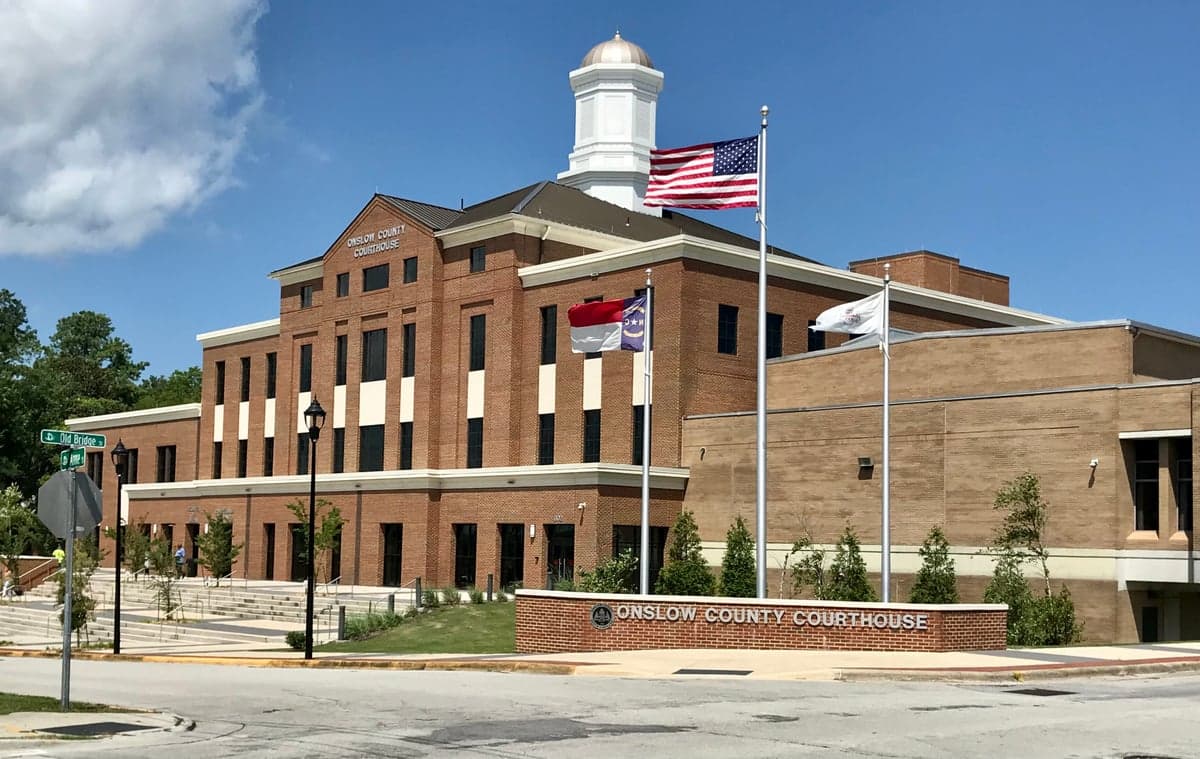
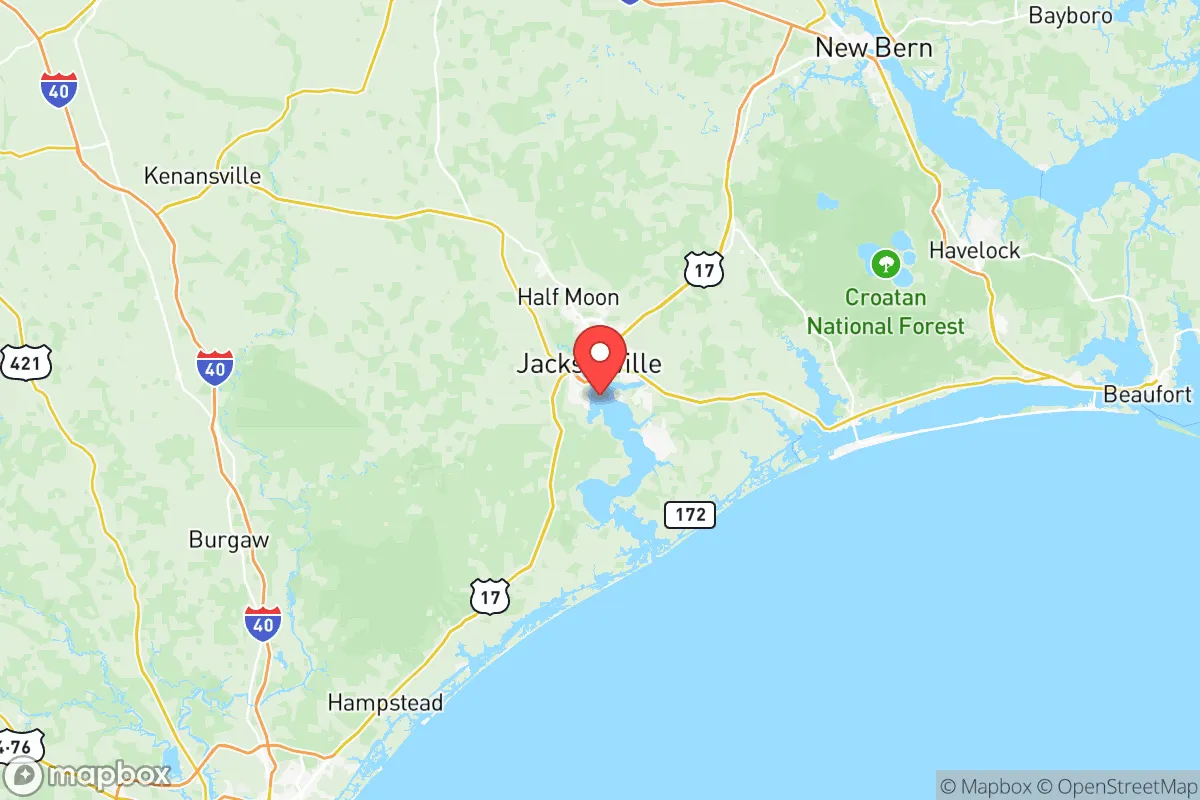
Photo: Wikipedia
Demographics of Onslow County
Affluence Level in Onslow County
A middle-class area roughly in line with national averages across income, home values, education, and employment.
People of Onslow County
Onslow County’s 208,537 residents form a community shaped overwhelmingly by the U.S. military, with Camp Lejeune and Marine Corps Air Station New River anchoring a population that is younger, more transient, and more racially diverse than much of rural North Carolina. The county’s identity is defined by a blend of long-standing coastal Carolina families, active-duty and retired service members from across the country, and a growing Hispanic workforce that has expanded rapidly since 2000. With just 1.5% foreign-born and a college attainment rate of 26.1%, Onslow remains a predominantly native-born, working-class county where military culture and Southern coastal traditions intersect.
Settlement & growth (pre-1960)
Before European contact, the region now known as Onslow County was inhabited by the Coree and Tuscarora peoples, who lived along the New River and the coast. Spanish explorers briefly visited the area in the 16th century, but no permanent settlement took hold. English colonists from the Albemarle region began moving south into the area in the early 1700s, and Onslow County was formally established in 1734, named after a British political figure. The first permanent European settlers were primarily English and Scots-Irish farmers who took up land grants along the New River and the White Oak River, establishing small agricultural communities that remain today as Jacksonville, Richlands, and Swansboro.
Through the 18th and 19th centuries, the county’s economy revolved around naval stores (turpentine and pitch), lumber, and subsistence farming. Enslaved Africans were brought in to work on larger plantations, particularly along the New River floodplains, and by 1860, Black residents made up roughly 35% of the county’s population. After the Civil War, many freedmen remained in the area, forming small farming communities such as Folkstone and Pumpkin Center, where their descendants still live today. The county remained rural and poor through the early 1900s, with little industrial development and a population that hovered around 15,000.
The single most transformative event in Onslow’s history was the establishment of Camp Lejeune in 1941. The U.S. Marine Corps purchased over 100,000 acres along the New River, displacing several existing communities, including the town of Moscow and parts of Verona. The base brought an immediate influx of Marines and civilian workers from across the United States, many of whom stayed after their service ended. Jacksonville, the county seat, grew from a small farming town of about 800 people in 1940 to a bustling military hub of over 13,000 by 1960. This period also saw the arrival of a small number of Filipino and Puerto Rican service members, the first non-European ethnic groups to settle in the county in significant numbers.
Modern era (post-1965)
The post-1965 era in Onslow County has been defined less by international immigration and more by domestic military migration and the growth of the Hispanic population. The 1965 Hart-Cellar Act had a muted direct effect here—the county’s foreign-born share remains just 1.5%, far below the national average. Instead, the demographic story since the 1970s is one of military rotations and Sun Belt domestic migration. Camp Lejeune’s expansion during the Vietnam War, the Gulf War, and the post-9/11 conflicts brought waves of Marines and their families from all 50 states, many of whom retired in the area. This has created a population that is more geographically diverse than the surrounding counties, with a significant number of residents originally from the Northeast, the Midwest, and California.
The most notable ethnic shift since 1965 has been the growth of the Hispanic population, which now stands at 13.8% of the county’s residents. This growth began in the 1990s, driven by construction and service jobs tied to the military base and the broader coastal economy. Hispanic residents, primarily of Mexican and Central American origin, have concentrated in Jacksonville and the unincorporated areas around Camp Lejeune, where they work in construction, landscaping, restaurants, and retail. The Black population, at 11.9%, has remained relatively stable since the 1970s, with communities in Jacksonville, Richlands, and the rural areas of eastern Onslow. East and Southeast Asian residents, at 1.5%, are largely military-affiliated families from the Philippines, Korea, and Vietnam, living near the base. The Indian-subcontinent population is negligible at 0.2%.
Suburbanization has reshaped the county since the 1980s, with new housing developments spreading outward from Jacksonville along Highway 17 and Highway 24. Communities like Piney Green and Midway Park have grown as bedroom suburbs for military personnel and civilian base employees. The county’s white population, at 64.8%, includes both old-stock Southern families and a large contingent of military retirees from outside the region, giving Onslow a cultural blend that is more national in character than the rest of inland eastern North Carolina.
The future
Onslow County’s population is projected to continue growing, driven by the ongoing presence of Camp Lejeune and the broader coastal development of southeastern North Carolina. The county is likely to become slightly more diverse, with the Hispanic share expected to rise toward 18-20% by 2040, as younger Hispanic families have higher birth rates and continued migration for construction and service work. The Black and East/Southeast Asian shares are expected to remain stable, as military recruitment patterns do not show major shifts. The white share will continue to decline gradually, but Onslow will remain a majority-white county for the foreseeable future.
New residential growth is concentrating in the Northwoods area near Jacksonville and along the Swansboro corridor, where retirees and commuters to Camp Lejeune are building homes. The county’s cultural identity is evolving from a purely military town into a more diversified coastal community, with a growing Hispanic presence adding new festivals, restaurants, and churches, particularly in Jacksonville. The transient nature of the military population means that political and social attitudes remain moderate by North Carolina standards, with a pragmatic conservatism that prioritizes base funding and veteran services over social issues.
For someone moving to Onslow County now, the area offers a stable, military-anchored economy with a lower cost of living than the North Carolina coast to the south, but with less cultural diversity and fewer amenities than larger metro areas. The population is young, family-oriented, and accustomed to turnover, making it relatively easy for newcomers to integrate. The county’s future is tied to the Marine Corps, and as long as Camp Lejeune remains active, Onslow will continue to grow as a working-class, predominantly native-born community with a growing Hispanic minority and a distinctly American military character.

* Values derived from national, state, county, city and local statistics and may differ in a specific area. Last updated: 2026-07-02T10:10:28.000Z
Narrative content on this page is AI-generated and may contain mistakes. Verify any details that matter before acting on them.
ReloMaps may earn a commission from affiliate links at no extra cost to you.

