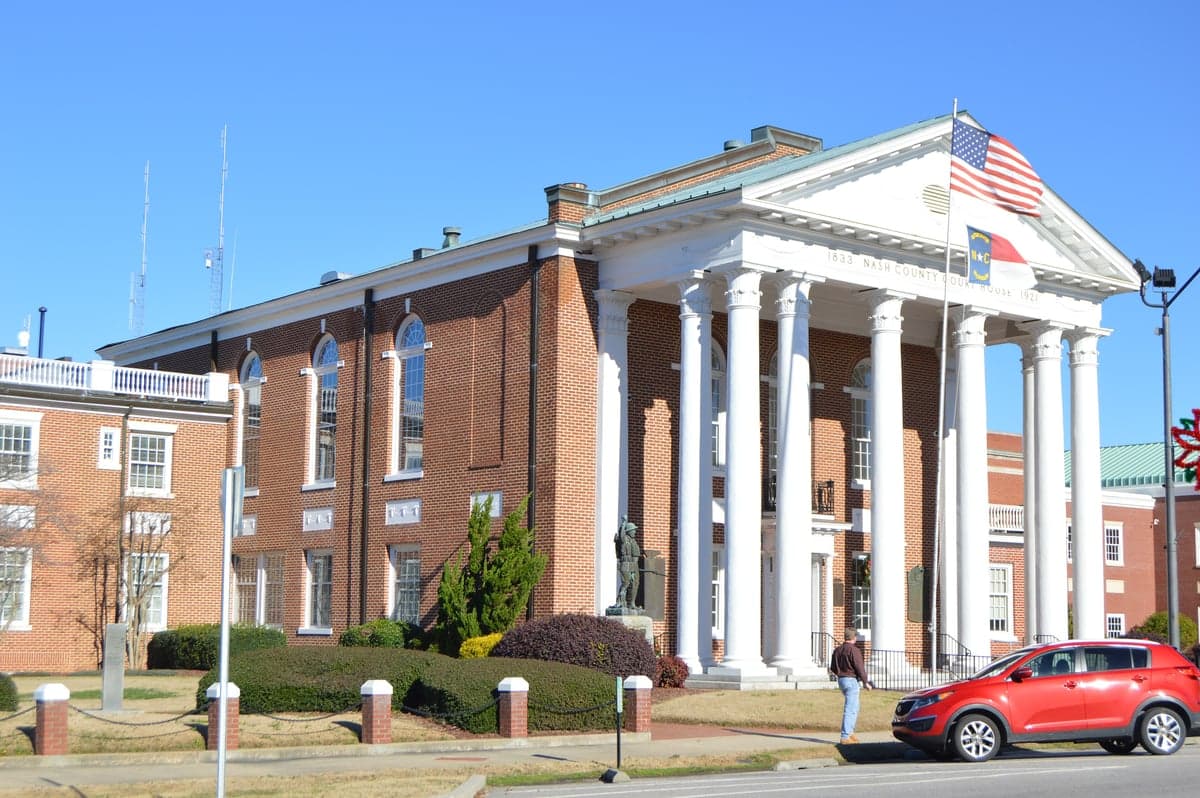
Photo: Wikipedia
Political ClimatePolitical Climate in Nash County
Showing district-level results — no local-only data available.
Local Political AnalysisPolitical Analysis of Nash County
Nash County, North Carolina, sits in a fascinating political middle ground. With a Cook Partisan Voting Index (PVI) of R+1, it’s a perfect mirror of the state’s overall R+1 rating, making it one of the most representative counties in a battleground state. But don’t let that single number fool you—the county is a patchwork of deep red rural precincts, blue-leaning college towns, and swing suburbs that have shifted noticeably over the last decade. The county voted for Donald Trump in 2020 by a narrow 49.6% to 49.0% margin, a far cry from the 18-point Republican advantage it gave George W. Bush in 2004. That trajectory—from solid red to true purple—is the key story here.
How it compares
Nash County’s R+1 PVI is identical to North Carolina’s statewide R+1, but the internal dynamics are quite different. The state’s overall lean is driven by massive Republican margins in rural western counties and deep blue strongholds like Mecklenburg (Charlotte) and Wake (Raleigh). Nash County, by contrast, is a microcosm of the state’s suburban and exurban shift. The county seat, Nashville, and the larger town of Rocky Mount (which straddles Nash and Edgecombe counties) are the Democratic anchors. Rocky Mount’s precincts, particularly around the historic downtown and the Nash Community College area, routinely deliver 60-70% Democratic margins, driven by a strong African American voting bloc and younger professionals. Meanwhile, the western and southern parts of the county—towns like Spring Hope, Middlesex, and Bailey—are reliably Republican, often voting 65-75% for GOP candidates. The real action is in the unincorporated suburbs between Rocky Mount and Nashville, along US 64 and NC 97. These swing precincts, like the ones around Red Oak and Castalia, have been trending Democratic since 2016, driven by an influx of commuters from Raleigh-Durham (about 45 minutes west) and younger families priced out of Wake County. In 2020, these areas flipped from a 10-point Republican margin to a 2-point Democratic one.
What this means for residents
For conservative residents, Nash County still feels like a comfortable place politically. Local offices—county commission, school board, sheriff—are held by Republicans, and the county’s gun culture and agricultural roots are respected. You’ll see Trump signs in Spring Hope and Bailey year-round. But the days of uncontested GOP dominance are over. For liberal residents, especially in Rocky Mount and the newer subdivisions, there’s a growing sense of political viability. Democratic candidates now campaign actively in the county, and local Democratic Party groups have seen membership double since 2018. The practical effect is that both sides feel they have a voice, but also that elections are genuinely competitive. Policy-wise, this means the county government tends toward moderate, pragmatic governance—avoiding the culture-war extremes seen in deeper red or blue counties. For example, Nash County has maintained a relatively business-friendly tax environment (the property tax rate is around $0.73 per $100 of assessed value) while also investing in public school funding and a new regional sports complex in Rocky Mount.
Culturally, the county’s political split mirrors a deeper divide between the rural, agricultural east and the more suburban, commuter-oriented west. Rocky Mount has a vibrant, historically Black downtown with a growing arts scene and the Imperial Centre for the Arts, while Spring Hope still hosts the National Pumpkin Festival. The biggest policy distinction you’ll notice is in development: the western part of the county is seeing rapid residential growth (new subdivisions and apartment complexes), while the eastern and southern parts fight to preserve farmland and small-town character. For newcomers, the key takeaway is that Nash County is a place where your vote genuinely matters—and where the political conversation is still civil enough that neighbors with different yard signs can share a beer at the local barbecue joint. It’s not a flashy political battleground, but it’s a real one, and that’s exactly what makes it interesting to live in.

State Political ClimatePolitical Climate in North Carolina
State Political AnalysisPolitical Environment in the State
North Carolina is a classic purple state that has been trending slightly redder in recent cycles, with a Cook PVI of R+1, but it’s far from a lock for either party. The state’s political identity is shaped by a powerful urban-rural split: fast-growing metros like Charlotte, Raleigh-Durham, and Asheville lean Democratic, while vast rural and exurban areas—think the Sandhills, the Piedmont Triad exurbs, and the coastal plain—vote solidly Republican. Over the past 20 years, the state has flipped from reliably red (voting for Bush in 2004) to a battleground that narrowly went for Obama in 2008, Trump in 2016 and 2020, and then saw close races in 2024. The dominant coalition is a mix of suburban moderates, rural conservatives, and a growing urban progressive base, with the GOP holding a trifecta in state government since 2023.
Urban vs. rural divide
The political map of North Carolina is a tale of two landscapes. The urban crescent—Mecklenburg County (Charlotte), Wake County (Raleigh), Durham County, and Buncombe County (Asheville)—drives Democratic turnout, with Charlotte and Raleigh each adding tens of thousands of new residents annually, many from out of state. These metros are economic engines (banking, tech, pharma) and culturally liberal, with Durham and Asheville being particularly progressive. In contrast, rural counties like Columbus, Robeson, and Rutherford vote heavily Republican, often by 30-40 point margins. The exurban counties around the Triad—like Davidson, Randolph, and Stanly—have shifted right as well, driven by white working-class voters and retirees. A key battleground is the suburban ring of Wake County (e.g., Cary, Apex) and Mecklenburg (e.g., Matthews, Huntersville), where college-educated voters have trended Democratic but still swing in close races. The 2024 presidential race saw Trump win the state by about 1.5 points, with the rural vote overwhelming the urban margins.
Policy environment
North Carolina’s policy environment is a mix of conservative governance and pragmatic moderation. The state has a flat income tax rate of 4.5% (down from 5.25% in 2022, with a path to 3.99% by 2027), no state property tax, and a sales tax capped at 7.5% locally. This makes it relatively tax-friendly for both individuals and businesses. The regulatory posture is business-friendly, with right-to-work laws and limited union influence. On education, the state has a school choice program (the Opportunity Scholarship Program) that now offers vouchers for private school tuition, expanded in 2023 to all income levels. Healthcare is a mixed bag: the state expanded Medicaid in 2023 under a bipartisan deal, covering about 600,000 low-income adults, but abortion is banned after 12 weeks (with exceptions for rape, incest, and life of the mother) under a 2023 law. Election laws have tightened: voter ID is required (photo ID, with exceptions), early voting is still generous (17 days), and same-day registration is available during early voting. The state also has a Republican-drawn congressional map that gives the GOP a 10-4 edge in U.S. House seats, despite the statewide vote being close.
Recent policy direction
Over the past two years, the Republican supermajority in the legislature has pushed a distinctly conservative agenda. On gun rights, the state passed permitless carry (constitutional carry) in 2023, allowing anyone 18+ who can legally own a firearm to carry it concealed without a permit. Parental rights were strengthened with the Parents’ Bill of Rights (2023), requiring schools to notify parents about curriculum changes and medical services, and banning instruction on gender identity and sexual orientation in K-4 classrooms. On speech and privacy, the state has no broad surveillance law, but local police can use license plate readers and body cameras—body cam footage is generally public record. Medical and bodily autonomy is restricted: the 12-week abortion ban is among the strictest in the Southeast, and transgender care for minors is banned under the 2023 “Youth Health Protection Act.” Property rights are strong, with no state-level rent control and a homestead exemption for seniors. Voting access has tightened with the voter ID law, but mail-in voting is still available with a witness requirement. The overall direction is toward more conservative governance, but the state’s growing urban population may moderate this over time.
Civil unrest & political movements
North Carolina has a history of civil unrest, particularly around racial justice and election integrity. The 2020 protests in Charlotte and Raleigh over George Floyd’s death were large but mostly peaceful, though there were isolated incidents of property damage. The state has seen organized movements on both sides: the Moral Mondays protests (2013-present) led by the NAACP have rallied against conservative policies, while the “We the People” movement and local Tea Party groups have been active in rural areas. Immigration politics are relatively quiet—the state is not a sanctuary state, and local sheriffs in counties like Alamance and Cabarrus cooperate with ICE. There’s no serious secession or nullification rhetoric, but election integrity controversies have flared: the 2020 election saw Trump’s campaign challenge results in the state (unsuccessfully), and the 2024 cycle saw GOP-led audits of voter rolls. A visible flashpoint is the “Silent Sam” Confederate monument controversy at UNC-Chapel Hill, which was toppled by protesters in 2018 and remains a symbol of cultural division. New residents will notice the political polarization in yard signs, bumper stickers, and local news, but daily life is generally civil.
Projection
Over the next 5-10 years, North Carolina is likely to remain a competitive purple state, but the trend lines favor a slight Democratic shift in presidential races due to in-migration from blue states (New York, California, New Jersey) into the urban crescent. The state’s population is growing by about 100,000 people per year, with most settling in Wake, Mecklenburg, and Buncombe counties. This will slowly erode the GOP’s rural advantage, but the legislature’s gerrymandered maps and the state’s conservative-leaning exurbs (like Union County, which voted 65% for Trump) will keep the state government red for the foreseeable future. The 2024 election showed that the GOP can still win statewide (Trump, Lt. Gov. Mark Robinson, and the Council of State races), but the margins are razor-thin. A new resident moving in now should expect a state that is politically divided but functionally conservative in policy, with a growing urban population that will push for more progressive changes on education, healthcare, and voting rights. The state’s economy is strong, and the political climate is stable, but don’t expect dramatic shifts—North Carolina is a slow-moving battleground.
For a new resident, the bottom line is this: North Carolina offers a low-tax, business-friendly environment with a conservative tilt on social issues, but the urban areas provide a counterbalance for those seeking more progressive policies. If you’re conservative, you’ll find a state government that aligns with your values on taxes, guns, and education. If you’re liberal, you’ll find vibrant communities in Charlotte, Raleigh, and Asheville where your views are shared, but you’ll need to accept that state-level policy will often be at odds with your preferences. The state is a true purple battleground, and your vote will matter—especially in local and state races. Just be prepared for the political ads to be relentless every two years.
* Values derived from national, state, county, city and local statistics and may differ in a specific area. Last updated: 2026-07-17T00:19:35.000Z
Narrative content on this page is AI-generated and may contain mistakes. Verify any details that matter before acting on them.
ReloMaps may earn a commission from affiliate links at no extra cost to you.

