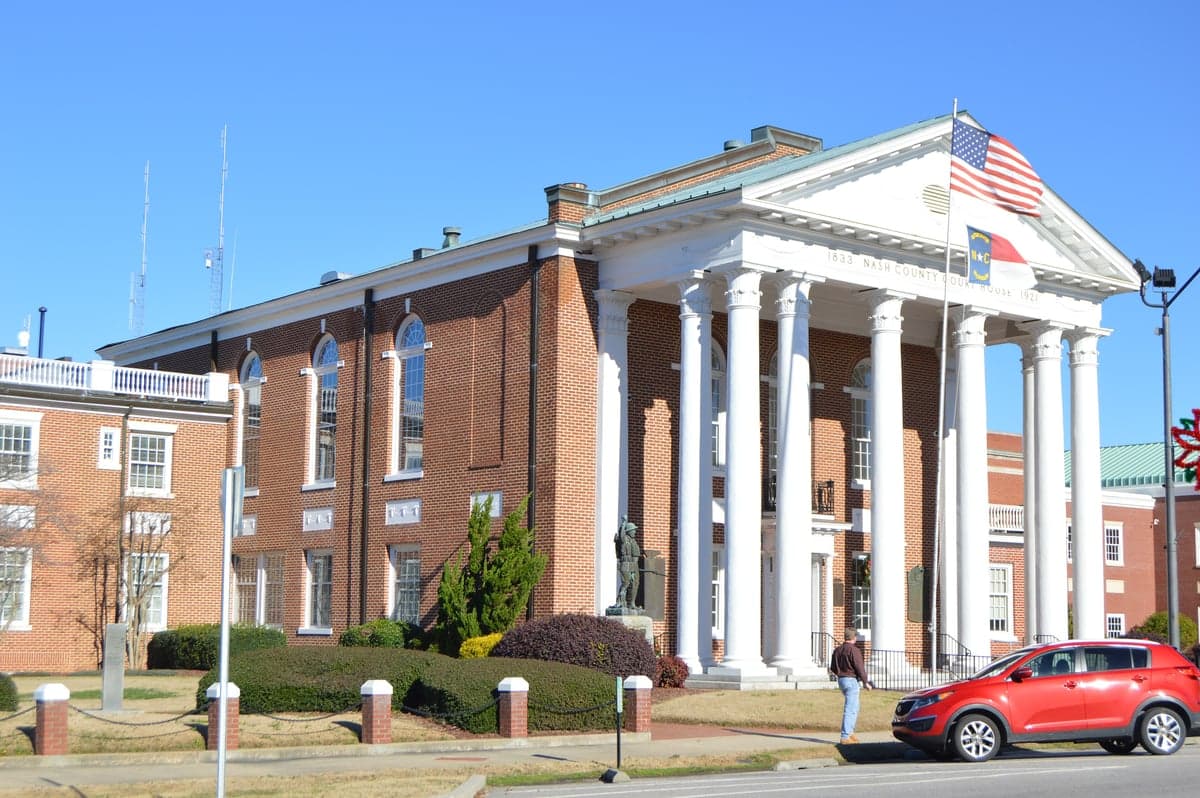
Photo: Wikipedia
Personal Sovereignty in Nash County
Viable for self-reliance. Generally workable, though some barriers may limit total independence.
What does Personal Sovereignty tell us?
Personal Sovereignty measures your capacity for self-reliance and independence with minimal government friction. Higher scores mean fewer barriers between you and the way you want to live... but it assumes you have the space you need and good neighbors.
What does this tell us?
Personal Sovereignty measures your capacity for self-reliance and independence with minimal government friction. Higher scores mean fewer barriers between you and the way you want to live... but it assumes you have the space you need and good neighbors.
State Policy
Energy independence: Importer (15% of energy produced in-state)
Personal Liberty
Homesteading

Personal Liberty Analysis
Nash County, North Carolina, offers a notably high degree of personal sovereignty compared to many urban and suburban areas on the East Coast, driven by a combination of low taxes, permissive gun laws, and a regulatory environment that generally favors individual autonomy over government oversight. The county’s political character, anchored by the city of Rocky Mount and the county seat of Nashville, leans conservative, with local officials consistently prioritizing limited government and personal responsibility. For a relocation-minded individual or family seeking to maximize control over their finances, self-defense, and daily life, Nash County presents a compelling balance of rural independence and access to regional amenities, though the level of autonomy varies between its more developed towns and its unincorporated rural stretches.
Tax burden and regulatory posture in Nash County
Nash County’s tax burden is among the lighter in North Carolina, a state already known for its business-friendly climate. The county’s property tax rate sits at approximately $0.74 per $100 of assessed value (as of 2025), which is well below the state average and significantly lower than rates in neighboring Wake County (Raleigh area) or Durham County. This low rate directly translates to lower annual costs for homeowners, a key factor for those prioritizing financial sovereignty. There is no county-level income tax, as North Carolina levies a flat state income tax of 4.5% (2025), which is among the lowest in the nation. The regulatory posture in Nash County is similarly light-touch. Zoning is minimal in unincorporated areas, allowing for a wide range of property uses without extensive permitting. In towns like Rocky Mount and Nashville, zoning exists but is generally applied with a practical, pro-business bent. For example, home-based businesses are permitted in most residential zones with few restrictions, and the county’s planning department is known for straightforward, non-adversarial processes. The overall environment is one where the default answer from local government is “yes” unless there is a clear public safety reason for “no,” a posture that appeals strongly to those seeking to minimize bureaucratic interference.
Self-defense and gun law specifics in Nash County
North Carolina is a “shall-issue” state for concealed carry permits, and Nash County’s sheriff’s office processes permits efficiently, typically within the statutory 45-day window. The county is home to a strong gun culture, with multiple shooting ranges and gun shops in Rocky Mount and Spring Hope. Open carry of handguns is legal without a permit for anyone over 18 who can legally possess a firearm, and concealed carry requires a permit (which is issued after a background check and a safety course). Stand Your Ground laws apply statewide, meaning there is no duty to retreat before using deadly force in self-defense in any place where the individual is lawfully present. Castle Doctrine protections are also in full effect, covering homes, vehicles, and workplaces. Local law enforcement in Nash County is generally supportive of lawful gun ownership; there are no local ordinances that restrict magazine capacity or ban specific firearm types, as state law preempts such local regulations. For a reader prioritizing self-defense autonomy, Nash County offers a legal framework that is permissive and predictable, with no additional local hurdles beyond state requirements.
Self-reliance and homesteading viability in Nash County
Nash County is a strong candidate for homesteading and off-grid living, particularly in its rural townships. In unincorporated areas, there are no county-wide restrictions on keeping livestock, including chickens, goats, or even larger animals like cattle or horses, on residential lots. Minimum lot sizes in these areas are typically 1 to 2 acres for a single-family home, though many parcels available for purchase are 5 acres or larger, providing ample space for gardens, small orchards, or a few head of livestock. In towns like Middlesex and Castalia, zoning is minimal, and residents commonly practice rainwater collection, composting, and small-scale farming without needing permits. Off-grid feasibility is high: while the county requires connection to a septic system (per state health regulations), there is no mandate to connect to municipal water or sewer in rural areas. Solar panels are permitted without special permitting beyond standard electrical inspections, and wood stoves are common for supplemental heating. The county’s agricultural extension office actively supports small-scale farming and offers workshops on soil health, beekeeping, and food preservation. For those seeking to reduce reliance on external systems, Nash County’s rural areas provide a legal and practical environment that encourages self-sufficiency, with the caveat that Rocky Mount and Nashville have more conventional suburban codes that restrict some of these activities within town limits.
Personal liberties in Nash County: parental rights, medical autonomy, speech, and property
Personal liberties in Nash County are broadly protected, with local governance reflecting a strong presumption of individual freedom. Parental rights are respected in the county’s public school systems, including those in Rocky Mount and Nashville, where school boards have generally avoided controversial curriculum mandates and have maintained policies that allow parents to opt children out of specific instruction. Homeschooling is common and well-supported, with several local co-ops and support groups operating in the area. Medical autonomy is largely a matter of state law, but Nash County’s health department has taken a hands-off approach to individual medical choices, with no local vaccine mandates or health orders beyond state requirements. Freedom of speech and assembly are robustly protected; the county has no history of restricting public expression, and local government meetings are open and accessible. Property rights are strongly defended, with the county’s zoning and planning departments generally deferring to landowners’ intended uses. Eminent domain actions are rare and typically limited to major infrastructure projects. The overall legal culture in Nash County is one where the individual is presumed capable of making their own decisions, and the government’s role is limited to maintaining public safety and basic infrastructure.
Compared to many other areas in the Southeast, Nash County offers a notably high degree of personal sovereignty, particularly for those who value low taxes, permissive gun laws, and the ability to live self-sufficiently on rural land. It is not a libertarian utopia—state-level regulations on building codes, septic systems, and vehicle inspections still apply—but the local government’s light touch and pro-freedom orientation make it a standout choice for relocation. For a family or individual seeking to maximize autonomy while remaining within a reasonable commute to the Research Triangle region’s jobs and healthcare, Nash County represents a practical and principled option that balances independence with access to modern amenities.

* Values derived from national, state, county, city and local statistics and may differ in a specific area. Last updated: 2026-07-17T00:19:35.000Z
Narrative content on this page is AI-generated and may contain mistakes. Verify any details that matter before acting on them.
ReloMaps may earn a commission from affiliate links at no extra cost to you.

